
Reviewed · BUCKINGHAM PALACE & CHANGING OF THE GUARD
Buckingham Palace, St James Palace & Tea at Kensington Palace
Royal London works best on foot. This experience links three palaces, grand monuments, and quiet St James’s lanes before ending with tea at Kensington Palace. I like the small groups of up to 10, usually only four to six people, and I like the way guides such as Simon, David, and Tom turn royal facts into lively stories. The main catch is that this is a walking tour with limited palace entry unless you add State Rooms admission at checkout.
I also like the practical route for a short London visit. You see Buckingham Palace, St James’s Palace, Kensington Palace, Wellington Arch, Apsley House, the Royal Albert Hall, and the Albert Memorial in one outing. The afternoon tea gives the tour a proper finish, with sandwiches, scones, clotted cream, jam, and seasonal cakes served at a private table in the Orangery.
In This Review
- Key points to know before booking
- Green Park starts the royal walk
- St James’s lanes and aristocratic London
- Spencer House and the royal neighborhood
- The Mall, Clarence House and St James’s Palace
- Buckingham Palace without the crowds inside
- Wellington Arch, the Bomber Command Memorial and Apsley House
- The bus transfer matters
- Royal Albert Hall and the Albert Memorial
- Kensington Palace and the final royal stories
- Tea at the Orangery
- Guides make the biggest difference
- Is the $173.45 price good value?
- Who should book this experience?
- Final verdict
- FAQ
- Where does the tour begin?
- Where does the tour end?
- How long does the experience last?
- Are palace entrances included?
- How large is the group?
- Is afternoon tea included?
- Can dietary requirements be accommodated?
Key points to know before booking
- The walk begins in Green Park and ends at Kensington Palace, making it a one-way experience rather than a return trip to the starting point.
- The group is capped at 10 people, with four to six people typical, so you can ask questions without shouting across a crowd.
- The palaces are mainly viewed from outside unless you pay for State Rooms admission as an added option.
- Afternoon tea is part of the experience, with gluten-free, vegetarian, vegan, and halal choices available when requested ahead of time.
- The route covers a lot of ground, and one booking includes a short bus ride costing £1.75 per person.
- The guides receive the strongest praise, especially Simon, David, and Tom, for friendly storytelling and explanations that work well for mixed-age groups.
Green Park starts the royal walk
Meet at Green Park Underground, on Piccadilly, at W1J 9DZ. The park was once known as Upper St James’s Park, and it gives the tour a calmer start than the packed pavement around Buckingham Palace.
The opening section lasts about 10 minutes. Your guide points out quieter corners and discreet passageways that many people miss when they hurry toward the palace gates. This is a useful introduction because the tour is not simply a march from one famous facade to another. It tries to show how royal London fits into the streets around it.
Keep your ears open from the start. The value here comes from the guide’s explanation of what you are seeing, not from a long stop at a single monument. Simon is especially praised for making information work for both adults and children, while David is noted for adding small details to familiar landmarks.
More Buckingham Palace and Changing of the Guard:
- Changing of the Guard Guided Walking Tour in London
★ 5.0 · 1,793 reviews - Buckingham Palace Entrance Ticket & Changing of the Guard Tour
★ 4.0 · 1,720 reviews - Changing of the Guard Guided Tour at Buckingham Palace
★ 4.5 · 941 reviews
St James’s lanes and aristocratic London
From Green Park, you move into St James’s, one of London’s most aristocratic districts. The route follows small back streets linked to the landed gentry, political figures, chocolate houses, taverns, and private clubs that shaped the area in the seventeenth century.
The stop is brief, around 10 minutes at first, with another short St James’s Palace section later. That may sound rushed, but the compact timing helps the tour cover a wide area. You are not asked to spend an hour on one street corner while the rest of London waits.
The best reason to have a guide here is context. On your own, you might notice fine doorways and polished facades but miss why the district became a meeting place for powerful people. The guide connects those streets with the social world that grew around the royal court.
Spencer House and the royal neighborhood
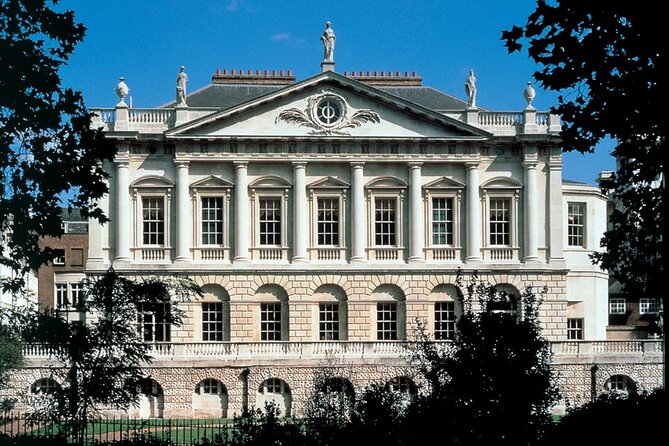
Spencer House takes only about five minutes, but it adds an important layer to the walk. Built between 1756 and 1766 for John, the first Earl Spencer, it is one of London’s finest surviving eighteenth-century town houses.
The connection with Diana, Princess of Wales, makes the house especially interesting for visitors curious about modern royal family links. The building is not presented as a standard palace stop, and you should not expect an interior visit as part of the basic walk. Instead, you see it as part of the architectural setting around St James’s.
This is typical of the experience. The tour gives you a broad view of royal and aristocratic London, with short stops that work together. If you want extended time inside grand houses, you may find the pace too quick.
The Mall, Clarence House and St James’s Palace
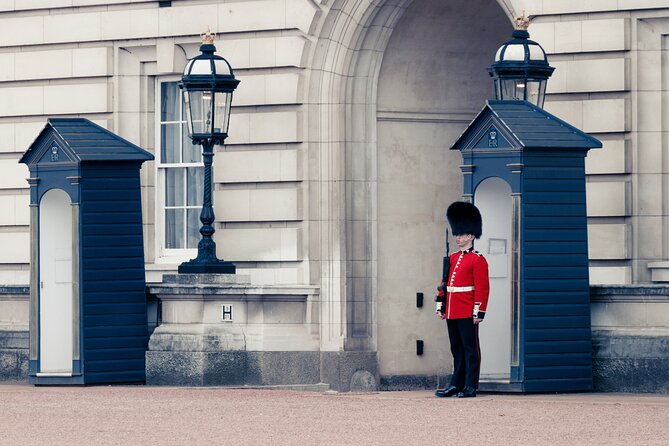
The route then reaches The Mall and the cluster of royal buildings nearby. Clarence House was built between 1825 and 1827 to designs by John Nash for the Duke of Clarence, who became King William IV. He preferred it to neighboring St James’s Palace, which he considered too cramped.
That small detail helps explain why royal residences changed over time. A palace may have official importance but still be uncomfortable for everyday living. You see how royal choices were shaped by space, convenience, and personal taste, not only ceremony.
St James’s Palace remains the official London royal palace, although it is not regularly open to the public. The public can attend Sunday services at the Chapel Royal and the Queen’s Chapel, but the walking portion does not include a standard palace entry.
The stop at St James’s Palace is short, about five minutes. That is enough to orient you and hear the key facts, but not enough for a full architectural study. Think of it as a guided exterior visit with useful background.
Something different for another day:
- Stonehenge, Windsor Castle, and Bath from London
★ 4.5 · 18,662 reviews - London Big Bus Hop-On Hop-Off Tour with Optional River Cruise
★ 3.5 · 10,803 reviews - London Small Group Tour of Historical Pubs
★ 5.0 · 10,422 reviews - Stonehenge, Windsor Castle and Bath with Pub Lunch in Lacock
★ 4.5 · 7,402 reviews
Buckingham Palace without the crowds inside
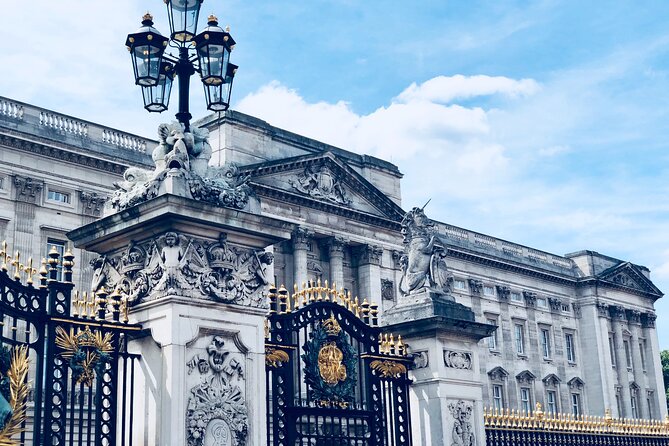
Buckingham Palace is the most famous stop, yet the itinerary allows only about five minutes here. You learn about the site’s much older origins, including its connection to the Manor of Ebury and the River Tyburn, which still flows beneath the palace courtyard and south wing.
That underground river is the sort of detail you are unlikely to notice while taking the standard palace photograph. The site changed hands over the centuries and eventually passed through the ownership of Westminster Abbey’s monks. The grand palace you see today grew from a place with medieval and even earlier roots.
Set your expectations carefully. The basic walking experience does not include entrance to Buckingham Palace or its State Rooms. The tour is designed to give you the setting, stories, and royal connections from outside. If entering the State Rooms is important to you, check the booking choice carefully and select that option if available.
You also should not book this experience expecting a guaranteed Changing of the Guard viewing. One person specifically wished for part of the ceremony. The route may give you a palace-area visit, but it does not promise a dedicated guard-changing section.
Wellington Arch, the Bomber Command Memorial and Apsley House
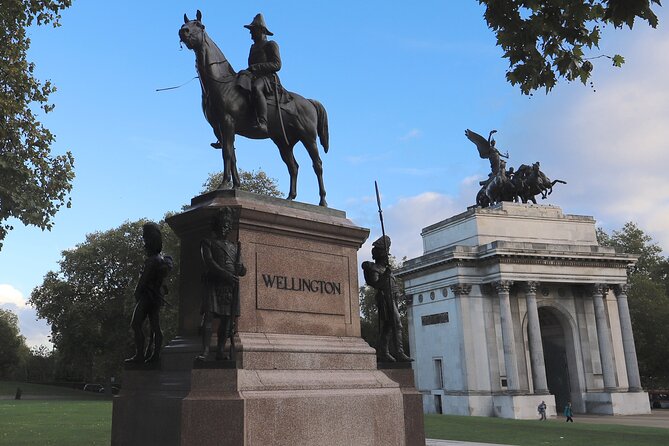
After Buckingham Palace, the walk crosses toward Wellington Arch, designed by Decimus Burton in 1828. The arch includes a four-horse chariot with a figure of Peace added in 1912. Its central passage was reserved for royalty.
This is a quick five-minute stop, but it helps you read the ceremonial route around Hyde Park Corner. The monument is not just a traffic island ornament. It marks the edge of an area shaped by military memory, royal movement, and grand public planning.
Nearby, the Bomber Command Memorial offers a more solemn pause. It commemorates the crews of RAF Bomber Command who served during the Second World War. The memorial records the loss of 55,573 aircrew from Britain, Canada, Australia, New Zealand, Czechoslovakia, Poland, and other Allied countries, along with civilians killed during raids.
The memorial changes the tone of the walk. Until this point, the focus is mostly palaces, aristocrats, and ceremony. Here you are asked to remember the human cost of war. The five-minute visit is brief, but the stop adds weight to the route.
Apsley House follows. Robert Adam built the original red-brick house between 1771 and 1778 for Lord Apsley, the Lord Chancellor. Later, the Duke of Wellington added the giant Corinthian portico. Some Adam interiors survive, including the Piccadilly Drawing Room and Portico Room.
Again, the tour offers the outside and the story rather than a full house visit. If you have already seen Apsley House on another day, this may feel like a quick reminder. If not, it gives you a reason to return for a longer interior visit.
The bus transfer matters
The route is too spread out to treat as one compact central London stroll. A bus fare of £1.75 per person is not included, so bring a contactless card or Oyster card.
This detail matters more than it first appears. You should budget for the fare and avoid assuming that the tour price covers every transfer. Contactless payment keeps things simple, but make sure each person has a usable payment method.
The bus section also gives your feet a break. One person described the walking as substantial but not overly athletic, which is a fair way to think about it. Wear comfortable shoes, leave room in your schedule, and do not plan a demanding activity immediately afterward.
Royal Albert Hall and the Albert Memorial
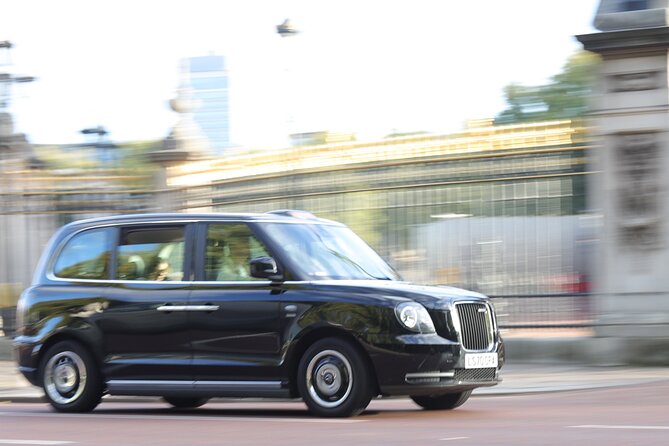
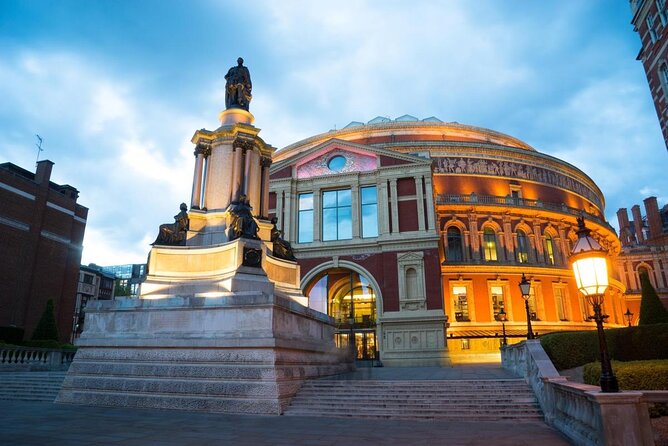
The Kensington portion begins with the Royal Albert Hall, opened by Queen Victoria in 1871. The concert hall seats 5,272 people and has hosted leading performers from many types of music and entertainment.
You spend about five minutes here, so this is not a concert-hall tour. Still, the building gives you a strong sense of the Victorian public world that shaped South Kensington. It also sets up the nearby Albert Memorial.
The memorial in Kensington Gardens commemorates Prince Albert, who died of typhoid in 1861. It is one of London’s most ornate monuments, and the short stop lets you take in its scale and decoration before the final palace visit.
The route can feel like a series of snapshots at this point. That is useful if you have limited time and want a wide sweep of London. It is less suitable if you prefer long, quiet visits at each site.
Kensington Palace and the final royal stories
Kensington Palace is the last major stop before tea. The tour explains the palace through royal stories, including the death of George II there in 1760. He rose at six in the morning, drank hot chocolate, and went to his close stool alone. After a loud crash, his valet found him on the floor. A post-mortem later identified a thoracic aortic dissection.
It is a striking story because it brings the palace down to human scale. The royal setting was grand, but the details of illness, routine, and sudden death are plain and personal. George II was nearly 77 and remains the most recent monarch buried in Westminster Abbey.
The palace stop itself is about five minutes in the walking schedule. As with the other palaces, entrance is not part of the standard walking option unless you select palace admission at checkout. The route ends at the Orangery, where the tea service takes place.
Tea at the Orangery
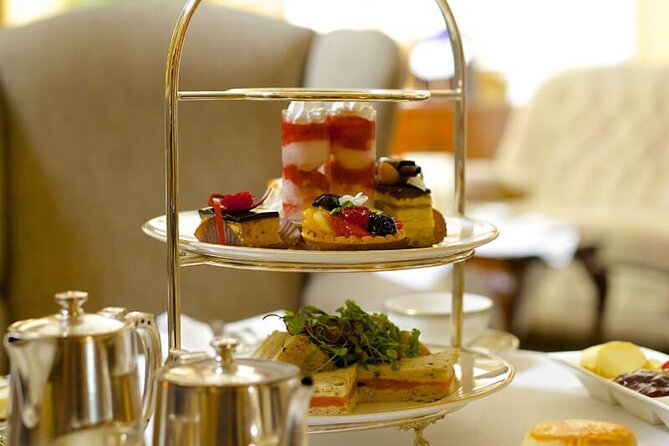
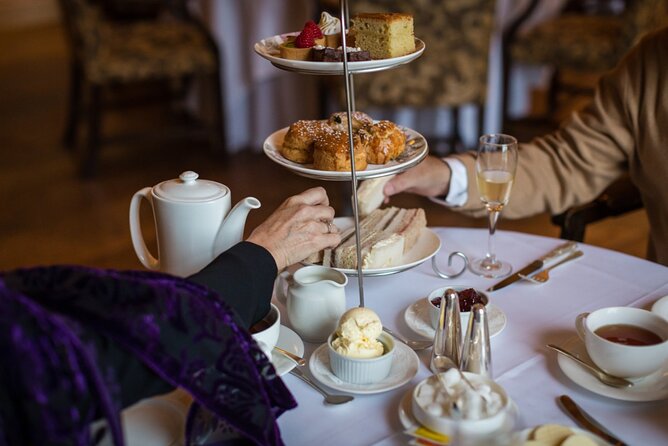
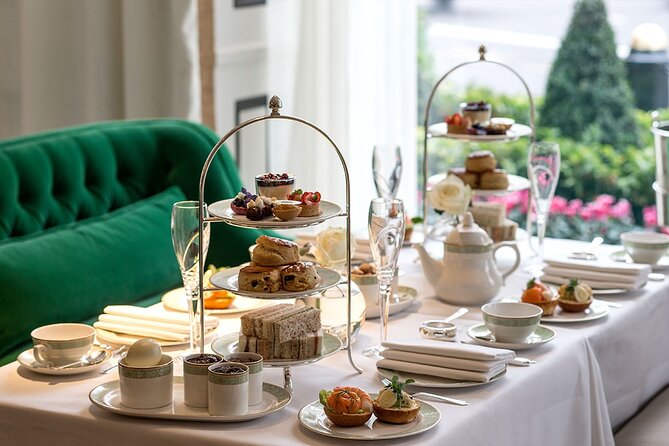
Afternoon tea is the experience’s reward, and it is more than a quick snack after a walk. You receive a private table at the venue, with delicate finger sandwiches, Welsh scones, clotted cream, strawberry jam, and a selection of cakes that changes with the season.
The sandwich selection varies, and gluten-free, vegan, vegetarian, and halal arrangements can be made with advance notice. Ask for dietary options when you book rather than waiting until the day. Child tea is typically intended for children aged 11 and younger.
The scones come with and without raisins. That small choice matters if your family has strong opinions about fruit in baked goods, as many British households seem to. Alcoholic drinks can be purchased during the tea service, but they are not included.
Several people particularly enjoyed the presentation, including tea served on Princess Diana’s royal china. The beautiful tea setting adds ceremony without requiring formal palace entry. The cakes and sandwiches are meant to be part of the event, not an afterthought.
Do remember that the tour is listed at roughly two hours, while the full walk, transfer, palace-area visits, and tea can make the day feel more involved. Confirm the exact schedule at booking and leave flexibility around the experience.
Guides make the biggest difference
The strongest praise goes to the guides. Simon is repeatedly described as friendly, witty, and able to explain royal history to different ages. David receives similar praise for careful details, personal attention, and an engaging walk through Hyde Park and the royal homes.
Tom is also singled out for his pleasant manner and strong storytelling. The guide quality matters here because so many stops are viewed from the outside. Without good narration, Buckingham Palace and St James’s Palace could become quick photo pauses. With a strong guide, the streets connect into a story about monarchy, politics, war, architecture, and public ceremony.
The maximum group size is 10, and four to six people is typical. That gives you a better chance to ask about a confusing family connection or stop briefly for a photograph. Smaller groups also make it easier to hear in busy parts of London.
Is the $173.45 price good value?
At $173.45 per person, this is not a cheap sightseeing walk. The value depends on how much you want from the day.
You are paying for a guided royal history walk, a small group, the bus transfer guidance, and a full afternoon tea in a palace setting. If you tried to arrange several separate visits and then book a quality tea service, the total could add up quickly. The tour also saves planning time by linking places that are otherwise spread across central London.
The price is harder to justify if you mainly want to enter the palaces. The basic experience does not include palace admission, and State Rooms entry is an extra selection at checkout. Check exactly what your booking includes before paying, especially if interior access is your main reason for coming.
I see the best value for a first London visit, a family wanting a clear royal theme, or anyone with only a short stay. You get a broad introduction without spending the day figuring out connections between sites.
Who should book this experience?
I would choose this tour if you enjoy stories, architecture, royal ceremony, and a traditional tea service. It is especially useful for families because the guide can adjust explanations for different ages, and the route includes plenty of changing scenery.
It also suits people who prefer a small group to a large coach tour. Simon, David, and Tom are all praised for warmth and clear storytelling, which is important when the itinerary moves quickly.
I would hesitate if you dislike walking, want long interior visits, or require a completely self-paced day. The route covers a lot of ground, and several stops last only five minutes. You should also skip it if you need a guaranteed Changing of the Guard viewing.
Free cancellation is available when you cancel at least 24 hours before the start time. The experience requires a minimum number of participants, so a cancellation by the operator may lead to another date, another experience, or a full refund.
Final verdict
Book it if you want a polished introduction to royal London with a memorable tea at the end. The small group and excellent guide reports give it an edge over a basic sightseeing bus ride, while the private table and seasonal food make the Orangery finish feel special.
Do not book it expecting to tour all three palaces inside. The real product is the guided outdoor route, the stories that connect the buildings, and the afternoon tea. Add State Rooms admission if that matters to you, bring contactless payment for the £1.75 bus fare, and wear good shoes. For a compact royal day with plenty of personality, this is a strong choice.
FAQ
Where does the tour begin?
It begins at Green Park Underground Ltd, Piccadilly, London W1J 9DZ, UK.
Where does the tour end?
It ends at the Orangery at Kensington Palace in Kensington Gardens, London W8 4PX, where the afternoon tea is served.
How long does the experience last?
The experience is listed as approximately two hours.
Are palace entrances included?
Palace entrance is not included in the standard walking tour. Entrance to the State Rooms is available if you select that option at checkout.
How large is the group?
The maximum group size is 10 people, and the group is typically four to six people.
Is afternoon tea included?
Yes. The tea includes sandwiches, scones with clotted cream and strawberry jam, and a seasonal selection of cakes. Alcoholic drinks can be purchased separately.
Can dietary requirements be accommodated?
Gluten-free, vegetarian, vegan, and halal options are available with prior request. Child tea is typically for children aged 11 and younger.
Just added around London
- The Private British Museum Tour★ 5.0 · 6 reviews
- London to Southampton Cruise Port | Private Transfer★ 5.0 · 6 reviews
- London’s Chinatown Food Experience★ 4.0 · 6 reviews
- London Gatwick (LGW) Airport Departure Private Transfer – Hotel to Airport★ 4.0 · 6 reviews
- Christmas in Canterbury, Dover and Greenwich with Christmas Lunch★ 4.5 · 6 reviews
- Transfer from Heathrow Airport to London hotel on private car★ 4.5 · 6 reviews
- Jazz Notes – Jazz Jam Ticket★ 5.0 · 6 reviews
- Transfer from London Stansted Airport to Central London★ 5.0 · 6 reviews
Buckingham Palace & Changing of the Guard, compared.

Changing of the Guard Guided Walking Tour in London
Read our review →
Buckingham Palace Entrance Ticket & Changing of the Guard Tour
Read our review →
Changing of the Guard Guided Tour at Buckingham Palace
Read our review →
Changing of the Guard Walking Tour in London at Buckingham Palace
Read our review →
Buckingham Palace & Big Ben (& Westminster Abbey entry)
Read our review →
The Changing of the Guard Tour and Buckingham Palace
Read our review →
Buckingham Palace Entrance Ticket & British Royalty Guided Tour
Read our review →Browse the lists this tour appears in