
Reviewed · WALKING TOURS
Crime and Policing London Walking Tour
London’s crime story hides in plain sight. This 2-hour-15-minute walk connects Bow Street, Trafalgar Square, Whitehall, and Scotland Yard with stories about murder, espionage, police work, and wartime London. Former police officer Francis Mullan leads the experience, with David also guiding some departures.
I like the mix of major London sights and lesser-known police history. I also like the gentle pace, the small maximum of 20 people, and the chance to examine real police regalia. The main consideration is that this is an outdoor walking tour, so poor weather can affect the schedule, and anyone hoping for a museum-style crime exhibit may find the experience more about storytelling than indoor displays.
In This Review
- Key points to know before you book
- Why this London crime walk is different
- Starting at Bow Street and the birth of organized policing
- Aldwych, espionage, and an unsolved murder
- Charing Cross and the blue lamp of London
- Northumberland Avenue and the Sherlock Holmes connection
- Great Scotland Yard and the creation of the Metropolitan Police
- Trafalgar Square and London’s smallest police station
- Whitehall, Downing Street, women in policing, and wartime London
- The final stops at New Scotland Yard
- How the guides shape the experience
- Price, group size, and the real value
- Practical advice for choosing the right day
- Who should take this tour?
- Should you book the Crime and Policing London Walking Tour?
- FAQ
- Where does the Crime and Policing London Walking Tour start?
- Where does the tour finish?
- How long does the walking tour last?
- What does the tour cost?
- What language is the tour offered in?
- How large is the group?
- Is this a difficult walk?
- Are refreshments and toilet stops available?
- Who leads the tour?
- Can I cancel for a full refund?
Key points to know before you book
- Former police officer at the front: Francis Mullan brings professional experience and personal stories to the subject of British policing.
- Central London route: The walk links Covent Garden, Bow Street, Charing Cross, Trafalgar Square, Whitehall, and New Scotland Yard.
- Crime stories beyond the usual sights: Expect tales of unsolved murder, espionage, wartime policing, riots, and the early Metropolitan Police.
- A manageable 2-hour-15-minute walk: The pace is gentle, with refreshment and toilet stops available if required.
- Small group size: The tour accepts a maximum of 20 people, which gives you a better chance to ask questions.
- Good value for history fans: At $48.61 per person, the price pays for a specialist guide and a focused look at London that a standard sightseeing walk usually skips.
Why this London crime walk is different
Most first-time walks through central London focus on kings, churches, grand buildings, and royal ceremonies. This one looks at the city through the people who tried to control its streets. You still see famous places, but the stories shift your attention toward police stations, courtrooms, public disorder, murder cases, and the practical work of keeping order.
That change in viewpoint is the main reason I find the tour appealing. You are not simply passing the landmarks. You are asking what happened there after dark, who investigated it, and how London’s police force developed.
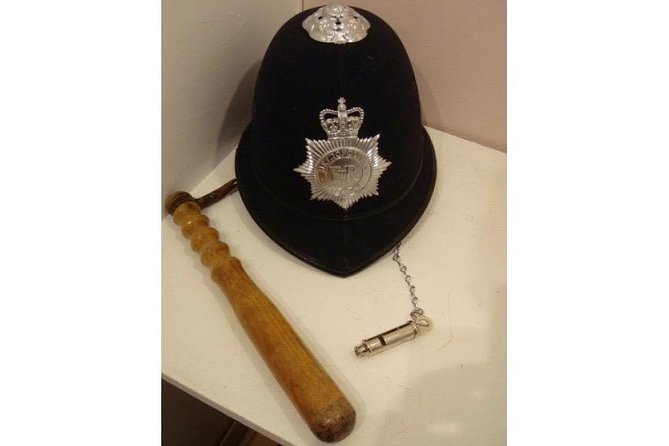
Francis Mullan is a former police officer, and that matters here. He can explain policing from professional experience rather than relying only on guidebook facts. The tour also includes the opportunity to examine genuine historic police regalia, giving the subject something physical as well as verbal.
The experience is in English and uses a mobile ticket. It is designed for most people who can take a gentle city walk. Comfortable shoes are a sensible choice, but this is not presented as a strenuous route.
More Walking Tours in London
- Tour for Muggles The Ultimate Harry Potter Walking Tour in London
★ 5.0 · 4,684 reviews - London Jack The Ripper Guided Walking Tour
★ 5.0 · 3,131 reviews - Changing of the Guard Guided Walking Tour in London
★ 5.0 · 1,793 reviews
Starting at Bow Street and the birth of organized policing
The tour begins at Covent Garden Underground, on Long Acre, then moves toward Bow Street. This is a useful place to start because the story begins with the early development of organized law enforcement.
At Bow Street, you see the famous police station and Magistrates Court associated with the Bow Street Runners. The stop lasts about 10 minutes, and there is no admission charge. The setting helps explain how policing and the courts once worked together in central London.
The Bow Street Runners were not the same as the modern Metropolitan Police. They belonged to an earlier system of law enforcement, tied closely to the Bow Street court. That makes this opening stop valuable: you begin with the roots of policing before moving on to the larger institution created later.
You should expect a talk beside historic buildings rather than an indoor court visit. If you want a detailed architectural tour of the court, this may feel brief. If you want a clear introduction to how London moved toward a formal police service, 10 minutes is enough to set the scene.
Aldwych, espionage, and an unsolved murder
The next stop is in the Aldwych area, where you hear about one of London’s saddest unsolved murders. The story also touches on international espionage and murder.
This is where the tour moves away from institutional history and into individual cases. That contrast keeps the walk from becoming a dry account of police departments and dates. You get a sense of the human cost behind the official story.
The details provided for the stop are intentionally broad, so you should not book this expecting a full case-file presentation or a guaranteed solution to the mystery. The value lies in hearing how crime, public fear, and international affairs could meet in the center of London.
Aldwych is also a good reminder that London’s crime stories are not confined to dark alleys. Important cases unfolded in busy, respectable parts of the city. You may look at the street very differently after hearing what took place there.
Charing Cross and the blue lamp of London
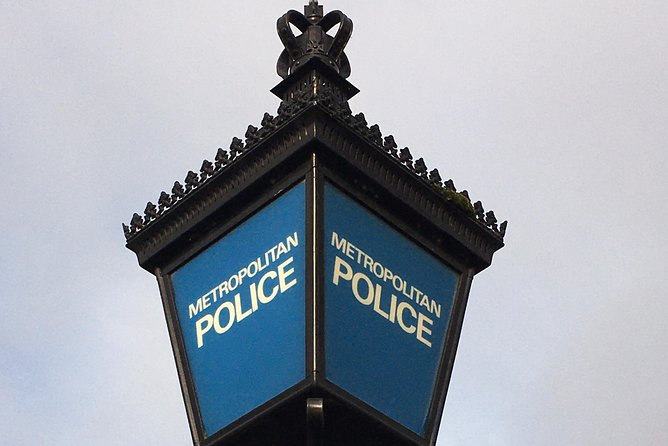
At Charing Cross, the walk takes up tales of murder and mayhem before pointing out one of Europe’s busiest police stations. You also learn about the famous blue lamp associated with London police stations.
This stop works well for anyone curious about the visual language of policing. A police station is easy to overlook when you are hurrying between Trafalgar Square and the West End. The blue lamp offers a small but memorable detail, one that connects London’s police presence with the street itself.
The stop lasts about 10 minutes. You will be standing in a central area with plenty of city activity around you, so you should expect an urban sightseeing stop rather than a quiet atmosphere. The guide’s explanation is what gives the location its meaning.
For me, this is one of the better examples of the tour’s approach. A familiar London crossing becomes part of a story about public safety, police visibility, and serious crime. You gain a detail you can spot again during the rest of your stay.
Something different for another day:
- Stonehenge, Windsor Castle, and Bath from London
★ 4.5 · 18,662 reviews - London Big Bus Hop-On Hop-Off Tour with Optional River Cruise
★ 3.5 · 10,803 reviews - London Small Group Tour of Historical Pubs
★ 5.0 · 10,422 reviews - Stonehenge, Windsor Castle and Bath with Pub Lunch in Lacock
★ 4.5 · 7,402 reviews
Northumberland Avenue and the Sherlock Holmes connection
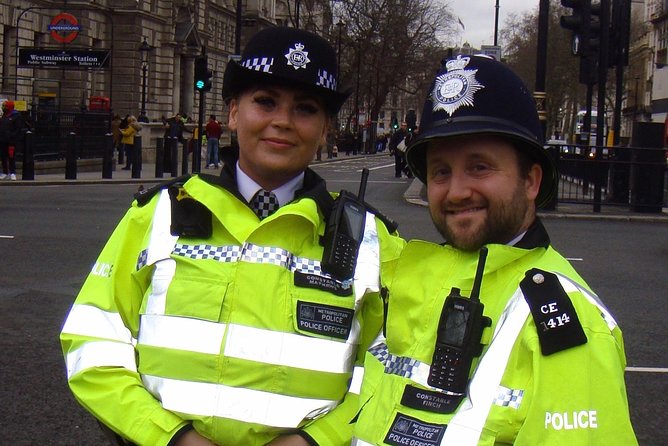
Northumberland Avenue brings in a lighter, more theatrical part of London’s crime culture. The tour stops at the Sherlock Holmes Pub, linked to Arthur Conan Doyle’s famous fictional detective, before crossing toward Great Scotland Yard.
The itinerary allows 20 minutes here, making it the longest scheduled stop. A drink stop is mentioned, but drinks are not listed among the included features, so you should be prepared to pay for anything you order yourself.
Sherlock Holmes is fictional, yet his image has shaped the way many people imagine crime investigation. Putting the pub into a police history walk gives you a chance to consider the difference between detective fiction and actual police work. Holmes uses deduction, observation, and dramatic clues. Real policing is usually less tidy, more procedural, and far more connected to courts and evidence.
This section may appeal especially to anyone visiting London because of Holmes. It also gives the group a natural pause before the tour turns toward the Metropolitan Police and government district.
Great Scotland Yard and the creation of the Metropolitan Police
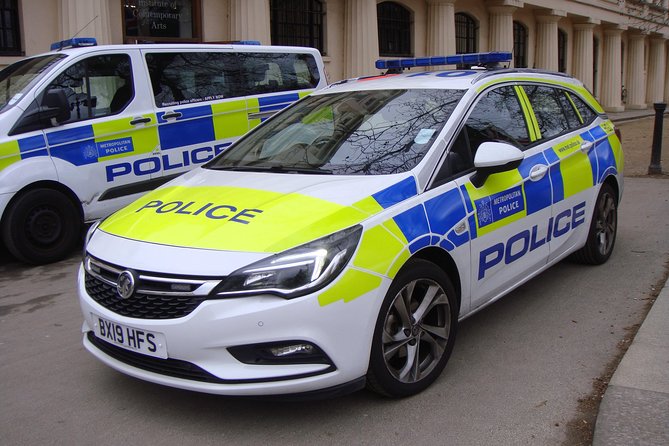
The route then reaches Great Scotland Yard, described as the location of the first police headquarters and the place where London policing was created. This is the central stop for understanding the Metropolitan Police.
Great Scotland Yard is not simply a famous name from detective novels and television. It represents the development of a police organization with a citywide role. Hearing that story on location gives the name more weight than it has when you encounter it only in fiction.
The stop lasts about 10 minutes. You will not be entering a working police headquarters as part of the stated tour, so expect to view the exterior area and hear the explanation from your guide.
This is one of the places where Francis’s background adds real value. A former officer can connect the formal creation of the force with the practical realities of police work. You can also examine historic police equipment during the tour, which helps bring the early service to life.
Trafalgar Square and London’s smallest police station
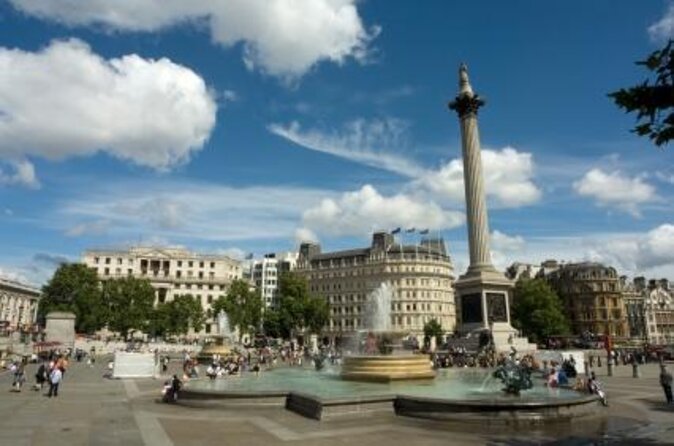
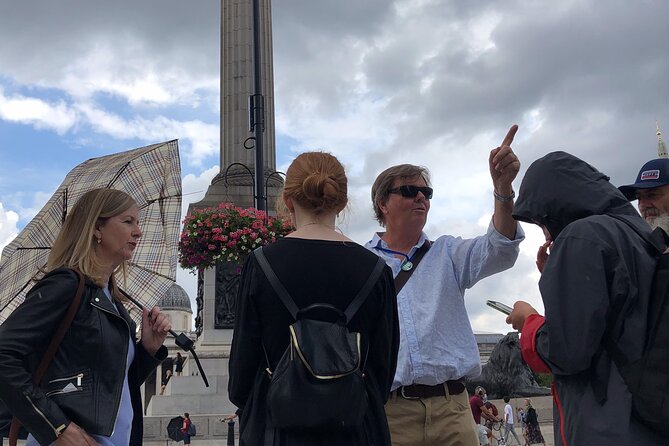
At Trafalgar Square, the focus shifts to national celebrations, demonstrations, and riots. The square has long been a stage for public gatherings, and the tour points out the world’s smallest police station nearby.
This stop gives you a useful lesson in crowd control. Trafalgar Square is not only a postcard view with fountains and monuments. It is also a place where public celebration, political protest, and disorder can share the same open space.
The tiny police station is a memorable curiosity. Its small size makes it easy to dismiss as a novelty, but it also prompts a practical question: how much police presence can fit into a small structure, and what was it meant to do during large public events?
The scheduled time is about 10 minutes. If you have already visited Trafalgar Square, this section gives you a fresh reason to pause. If you have not, you get both a major London landmark and a police-related detail without leaving the main sightseeing route.
Whitehall, Downing Street, women in policing, and wartime London
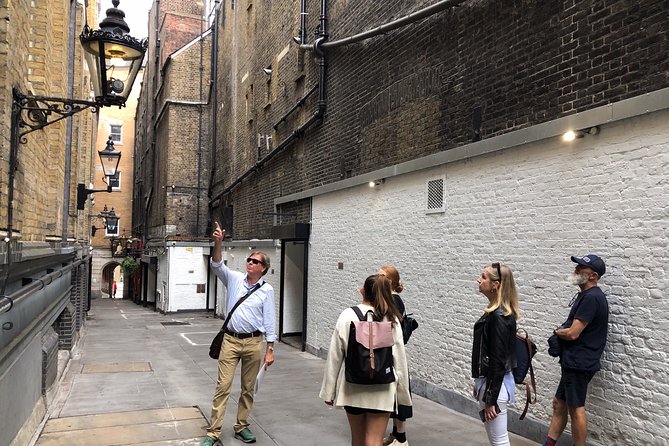
Whitehall brings the tour into the heart of government. You see the area around Downing Street and learn about the role of women in policing and the police response during wartime London.
This is a strong part of the experience because it widens the subject beyond famous male detectives and early police chiefs. The inclusion of women in policing lets you consider how the force changed over time and how different responsibilities developed.
The wartime section adds another layer. Police work during war is not limited to ordinary crime. It involves public order, emergency response, protection of important sites, and the pressures placed on civilians and officials. Whitehall is a fitting place to discuss those duties because government decision-making is all around you.
Again, the stop is about 10 minutes, so you should expect an overview rather than a long lecture. Still, the range of subjects gives the walk more substance than a simple collection of gruesome stories.
The final stops at New Scotland Yard
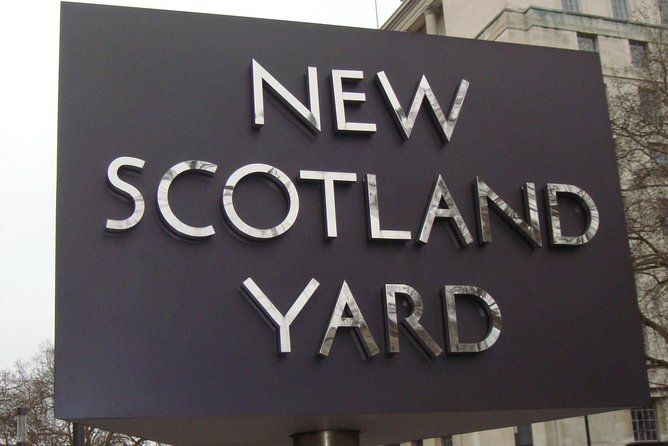
The walk finishes around New Scotland Yard at 35 Victoria Embankment. Here, you see the Metropolitan Police and its iconic revolving sign, known around the world.
The ending works well from a practical point of view. You finish near Westminster Underground Station, which connects with the Tube, buses, and riverboats. Pubs, bars, and restaurants are also nearby, so you can continue your afternoon without crossing the city.
The finish is useful for sightseeing too. One description of the route notes that you can walk on afterward toward Big Ben, Westminster Abbey, Buckingham Palace, or Trafalgar Square. Those attractions are not included in the tour, but the location makes it easy to build a larger day around the walk.
New Scotland Yard is also a fitting final image. The tour begins with Bow Street and the early roots of law enforcement, then ends with the modern Metropolitan Police. You see the broad arc without needing to visit a separate police museum.
How the guides shape the experience
Francis Mullan receives especially strong praise for his punctual, welcoming manner, clear explanations, and personal connection to police work. He is described as willing to answer questions, including questions that reach beyond the main subject of the walk.
That flexibility matters. Crime and policing can attract people with very different interests. You might care about Victorian London, Sherlock Holmes, British police procedure, wartime history, or unsolved cases. A guide who takes questions can make the same route work for all of you.
David also guides some departures and is described as able to explain the material clearly while giving detailed answers. If your booking is led by David rather than Francis, you should still expect an experienced guide familiar with the subject.
The strongest praise centers on the combination of factual history and personal experience. One retired American peace officer found the comparison between British and American policing especially interesting. You do not need a law enforcement background, though. The walk also works for families and for people who simply want a different way to see central London.
The tone appears informative but not stiff. The guide has also adjusted the pace and sought shade during hot weather, which is a useful sign for anyone worried about spending more than two hours outside.
Price, group size, and the real value
The price is $48.61 per person. That is more than a free city walk, but the comparison is not quite fair. You are paying for a specialist subject, a former officer’s perspective, historic police items, and a planned route through several central districts.
At a maximum of 20 people, the group is small enough to make questions practical. It is not a private tour, and you should not expect unlimited personal attention, but it is more manageable than a large crowd gathered around a guide.
I think the price makes the most sense if you already enjoy crime history, British policing, detective fiction, or unusual London stories. It is also good value if you want a central orientation walk that finishes near Westminster and leaves you close to several major sights.
The value is weaker if you only want landmark photography or if you dislike stories about murder and unsolved cases. This is a specialist walk. The famous sights are supporting players, not the whole show.
Practical advice for choosing the right day
Wear comfortable footwear. The walk is described as gentle, but it lasts more than two hours and takes place on city streets. Refreshment and toilet stops are available if required, which helps, though you should still plan sensibly before setting out.
The tour is offered in English and uses a mobile ticket. Service animals are allowed, and it is near public transportation. Most people can participate, but the experience depends on being comfortable walking and standing outdoors.
Book ahead if your London dates are fixed. The experience is booked an average of 46 days in advance, suggesting that last-minute availability may not always be dependable.
You can cancel for a full refund up to 24 hours before the start time. If bad weather cancels the experience, you are offered another date or a full refund. The same applies if the minimum number of participants is not reached.
Who should take this tour?
I would choose this walk if you want London with a police file in hand rather than a royal family guidebook. It suits adults, families with an interest in crime stories, fans of Sherlock Holmes, and anyone curious about how British policing differs from policing elsewhere.
It also suits you if you want a useful first look at central London. The route passes through places you may already plan to see, but the police angle gives you a reason to stop and listen.
I would be more cautious if you need guaranteed indoor shelter, dislike grisly subjects, or want entry into police buildings. The tour is primarily an outdoor storytelling walk, and the listed admission at each stop is free because the sites are viewed from the route.
Should you book the Crime and Policing London Walking Tour?
Book it if you want a focused, human look at London crime and policing led by someone with real police experience. Francis Mullan’s stories, the historic regalia, and the route from Bow Street to New Scotland Yard give the walk a clear shape and a strong sense of place.
Skip it if your priority is only the classic monuments or if you prefer a museum visit with extensive indoor exhibits. For everyone else, the $48.61 price is reasonable for a small-group walk that combines major sights with cases, police traditions, wartime stories, and details you are unlikely to notice on your own.
FAQ
Where does the Crime and Policing London Walking Tour start?
It starts at Covent Garden Underground Ltd on Long Acre, London WC2E 9JT, UK.
Where does the tour finish?
The tour finishes at 35 Victoria Embankment, London SW1A 2JH, near New Scotland Yard and Westminster Underground Station.
How long does the walking tour last?
The tour lasts approximately 2 hours and 15 minutes.
What does the tour cost?
The price is $48.61 per person.
What language is the tour offered in?
The tour is offered in English.
How large is the group?
The maximum group size is 20 participants.
Is this a difficult walk?
The walk takes place at a gentle pace, and most people can participate. Comfortable footwear is recommended.
Are refreshments and toilet stops available?
Refreshment and toilet stops are available if required. A drink stop is included at the Sherlock Holmes Pub area, but drinks are not listed as included.
Who leads the tour?
The experience provider is Francis Mullan. Francis is a former police officer, and David also leads some tours.
Can I cancel for a full refund?
Yes. You can cancel at least 24 hours before the start time for a full refund. Poor weather or failure to meet the minimum number of participants may also result in a different date or a full refund.
Just added around London
- The Private British Museum Tour★ 5.0 · 6 reviews
- London to Southampton Cruise Port | Private Transfer★ 5.0 · 6 reviews
- London’s Chinatown Food Experience★ 4.0 · 6 reviews
- London Gatwick (LGW) Airport Departure Private Transfer – Hotel to Airport★ 4.0 · 6 reviews
- Christmas in Canterbury, Dover and Greenwich with Christmas Lunch★ 4.5 · 6 reviews
- Transfer from Heathrow Airport to London hotel on private car★ 4.5 · 6 reviews
- Jazz Notes – Jazz Jam Ticket★ 5.0 · 6 reviews
- Transfer from London Stansted Airport to Central London★ 5.0 · 6 reviews
Walking Tours, compared.

Oxford University Walking Tour With University Alumni Guide
Read our review →
Tour for Muggles The Ultimate Harry Potter Walking Tour in London
Read our review →

Cambridge University Walking Tour by Alumni™ Kings College Option
Read our review →
Blackbeard to Banksy – The Ultimate Walking Tour of Bristol
Read our review →
Air Raid Shelter + St. Nicholas Market Walking Tour
Read our review →
Walking Tour of Bath with Blue Badge Tourist Guide
Read our review →
Changing of the Guard Guided Walking Tour in London
Read our review →Browse the lists this tour appears in