
Reviewed · JACK THE RIPPER TOURS
Jack the Ripper Walking Tour with Expert Ripperologist
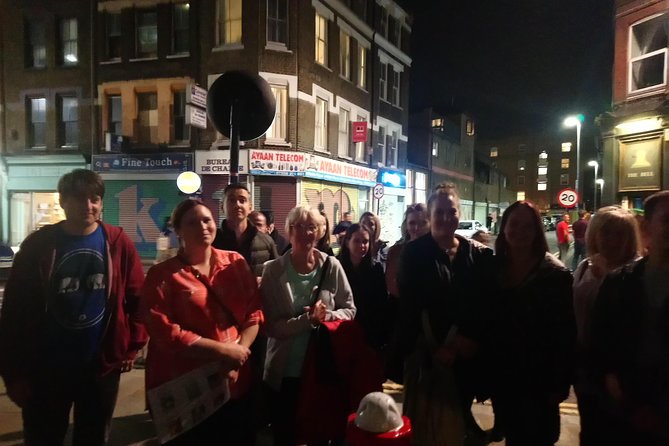
Murder, maps, and Victorian London meet here. This 2.5-hour walking tour follows Jack the Ripper’s trail through Whitechapel, using a costumed guide and clear images on a backlit tablet to connect today’s streets with 1888. I like the strong focus on the women who were killed, and I like that you move through the area without stopping to wrestle with a map.
The main caution is the group size, which can reach 30 people and may feel crowded at narrow stops. You will also spend more than two hours standing and walking, with very limited toilet access. Still, the tour earns a strong 4.8 out of 5 rating from 204 reviews, and 97 percent of customers recommend it.
In This Review
- Key things to know before you book
- Starting at Aldgate, where the story takes shape
- Mitre Square and the double event
- Petticoat Lane and the police boundary
- Goulston Street and the clue left behind
- Gunthorpe Street and Martha Tabram
- Thrawl Street and the final hours of Mary Ann Nichols
- Hanbury Street and Annie Chapman’s murder
- Wilkes Street, Puma Court, and the letters
- The Ten Bells and Itchy Park
- Old Spitalfields Market and the final case material
- What the guides do best
- Price, group size, and practical comfort
- Who should book this Whitechapel walk?
- Should you book it?
- FAQ
- How long does the Jack the Ripper walking tour last?
- Where does the tour start?
- Where does the tour finish?
- What language is the tour offered in?
- Is the tour suitable for children?
- How large can the group be?
- Is cancellation free?
Key things to know before you book

- The route links real crime sites: Mitre Square, Hanbury Street, Goulston Street, and the area around the Ten Bells all help turn a famous unsolved case into a walk through actual streets.
- The visual tablet is a major aid: Murder victims, old photographs, crime scenes, and neighborhood views are shown on a 14-inch backlit tablet.
- The tour puts victims and poverty first: You get substantial background on Whitechapel life, not just a parade of suspects and theories.
- The City boundary matters: The walk explains how two police forces operated in the area, a key detail in understanding the investigation.
- Expect a serious walking commitment: The route lasts about two hours and 30 minutes, with little chance to sit or use a toilet.
- It suits older teens and adults: No one under 15 is allowed, and those aged 16 or 17 must come with an adult.
Starting at Aldgate, where the story takes shape
Meet outside Aldgate Station on Aldgate High Street. The opening stop is St Botolph’s Church, sometimes called the Prostitutes Church because women once solicited on the island where the church stood.
This short introduction helps place the story in the working district beyond the old City of London. It is not a grand opening with a long lecture. Instead, the guide gets you oriented, explains the setting, and starts building the social background that makes the case more than a collection of grisly tales.
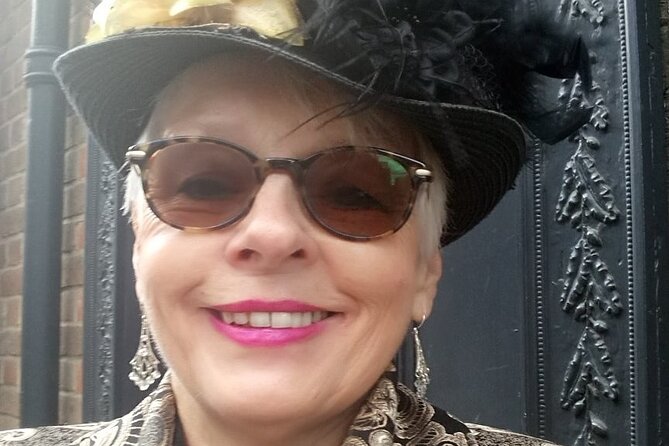
A costumed guide adds a touch of theater. That will appeal to you if you enjoy a little atmosphere with your history, though it may feel too dramatic if you prefer a strictly academic presentation. The strongest guides, including Lindsey, Jenny, and Paul in different sessions, combine the theatrical element with careful explanation.
At Aldgate Square, the focus shifts to Whitechapel in 1888. You hear about overcrowding, poverty, crime, and the daily struggle of people living on the breadline. This section matters because it explains the conditions in which the murders took place. The walk does not treat Whitechapel as a spooky stage set. It gives you a clearer sense of why the neighborhood was so difficult for police to control and so hard for vulnerable women to survive in.
More Walking Tours in London
- Tour for Muggles The Ultimate Harry Potter Walking Tour in London
★ 5.0 · 4,684 reviews - London Jack The Ripper Guided Walking Tour
★ 5.0 · 3,131 reviews - Changing of the Guard Guided Walking Tour in London
★ 5.0 · 1,793 reviews
Mitre Square and the double event
The route then reaches Mitre Street and Mitre Square, just inside the City boundary. This is one of the most important sections of the walk because it concerns Elizabeth Stride, known as Long Liz, and Catherine Eddowes.
Elizabeth Stride was killed on the night often called the double event. About 45 minutes later, Catherine Eddowes was murdered nearby. The guide explains the locations and the sequence of events, helping you understand the short distances involved rather than treating each crime as an isolated story.
I find the boundary here especially useful. The City of London and the Metropolitan Police area were separate jurisdictions, and that division affected communication, patrols, and the hunt for the killer. A walk makes this easier to grasp than a paragraph in a book because you can see how quickly the route crosses from one authority to another.
Mitre Square can be busy and the group may have to gather tightly. Keep near the guide, especially if you want to see the tablet images. This is one of the places where a group of 20 to 30 can feel larger than ideal.
Petticoat Lane and the police boundary
The next stop is Middlesex Street, better known as Petticoat Lane. The name and market area are familiar to many London visitors, but here the street serves a different purpose. It marks the boundary between the City of London and the Metropolitan area.
That administrative line is one of the tour’s useful details. The investigation involved different police forces, and the border helps explain why jurisdiction became such a recurring issue. You are not simply walking from one famous murder site to another. You are being shown how the city itself shaped the investigation.
There is no admission fee for the walk, but Petticoat Lane is not a formal attraction you enter. You stop on the street, listen, and move on. Wear shoes that can handle uneven pavement and bring a rain layer. London weather can make a stationary explanation feel longer than it does on a dry evening.
Goulston Street and the clue left behind
At Goulston Street, the guide takes you to the doorway where the only clue found on the route was discovered. Police followed this same general path while searching for the killer.
This stop works well because it connects the crime scenes with the police response. You hear about the urgency of the investigation and the difficulty of tracing a killer through crowded streets at night. The guide also uses the tablet to show images of the area and relevant material from the case.
The visual presentation is one of the tour’s most praised features. Lindsey has been singled out for using images to show how the area looked in 1888, while other guides have also used the tablet to keep the story grounded. The screen is large enough for a group to see better than a phone, though you should still position yourself close to the guide.
More Jack the Ripper walks:
- London Jack the Ripper Guided Tour with Ripper-Vision
★ 4.5 · 4,840 reviews - Ultimate Jack the Ripper : Guided Tour of London
★ 5.0 · 1,495 reviews - The Original Jack the Ripper : Guided Tour
★ 5.0 · 1,264 reviews - London Jack The Ripper Small-Group Walking Tour
★ 5.0 · 1,013 reviews
Gunthorpe Street and Martha Tabram
From Wentworth Street, you look toward Gunthorpe Street and the former location of George Yard Buildings. This is where Martha Tabram was found murdered on August 7, 1888.
The guide presents Tabram as a likely first victim of Jack the Ripper. That phrasing is important. The case is full of theories, and the tour generally distinguishes established details from later interpretation. You get the known facts, the reasons some researchers connect Tabram to the other killings, and the limits of the evidence.
This is also an early reminder that the story is not only about the five women most often linked to the Whitechapel murders. The tour gives attention to the wider pattern and to the victims as people, not just names in a criminal case. That sensitivity is one of its strongest qualities.
Thrawl Street and the final hours of Mary Ann Nichols
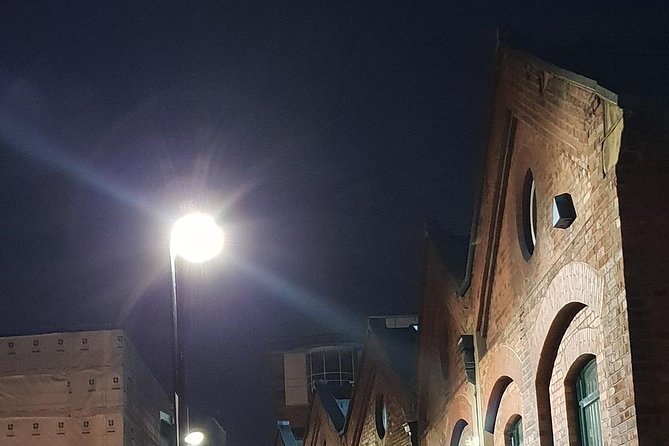
The route continues toward Brick Lane and stops opposite the Frying Pan Pub, near Thrawl Street. Mary Ann Nichols had her last drink here before making her way down Whitechapel Road.
The guide then explains how she was murdered in Bucks Row, behind Whitechapel Station. The stop focuses on her final movements and the surrounding streets. Walking this section helps you understand how close ordinary pubs, lodging houses, markets, and dark passageways were to the crime sites.
You will hear more about the area than you would on a standard sightseeing walk. That is part of the value. The murder story remains central, but it is set within the hard daily life of Whitechapel. If you want only suspect profiles and police theories, you may find this approach less satisfying. If you want the social setting and the victims’ experiences, it is a strong fit.
Hanbury Street and Annie Chapman’s murder
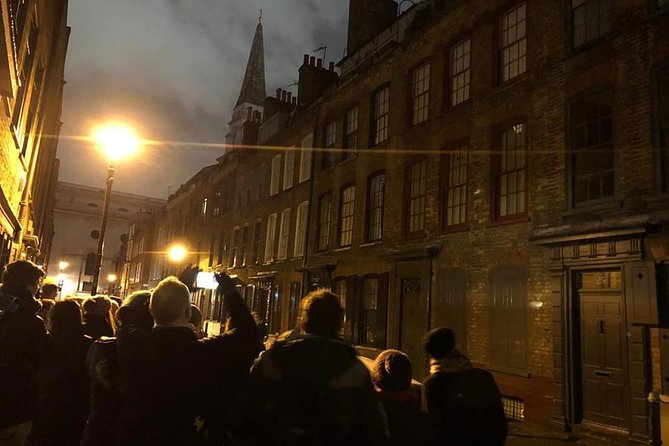
At Hanbury Street, you turn into the street where Annie Chapman was murdered in the yard of number 29.
The guide explains the location and the surrounding evidence, supported by images on the tablet. This is another stop where the physical setting matters. You are not entering a preserved crime scene, and modern London has changed parts of the area, but the street layout still gives you a better sense of distance and access.
The presentation can be graphic. The tour concerns murder and mutilation, and the photographs are intended to make the account more concrete. You should think carefully before bringing a young person or anyone who is uncomfortable with violent crime. The minimum age is 15, and that restriction feels sensible.
Wilkes Street, Puma Court, and the letters
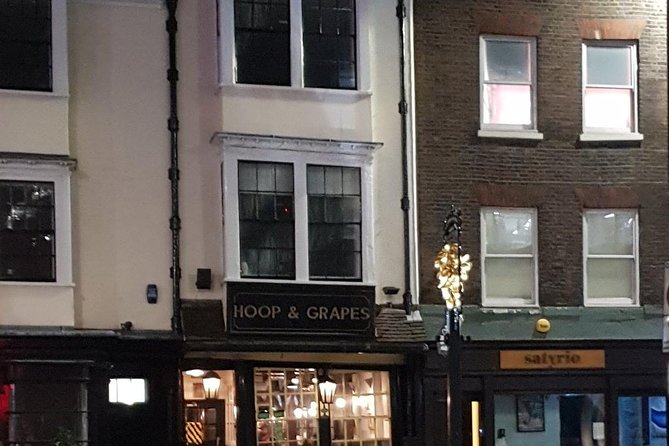
Wilkes Street offers one of the more atmospheric sections of the route. The street has changed less than many surrounding areas, giving you a stronger visual link with the 19th century.
From there, the guide takes you toward Puma Court and discusses the Dear Boss letter, one of the pieces of correspondence associated with the Ripper case. The walk does not need a museum display to create interest here. The narrow streets and old buildings do much of the work, while the guide supplies the context.
This part also shows why a guided walk is more useful than following a pin on your phone. The route is not always obvious, and the meaning of a doorway, corner, or passage depends on the explanation. You can simply follow along and pay attention to the story.
The Ten Bells and Itchy Park
Near the Ten Bells pub, you stop opposite the building associated with Mary Kelly and the women of the area. The pub is often included in Ripper-related sightseeing, but the guide places it within a broader picture of local life.
Across the way, Christchurch Graveyard was known as Itchy Park. The guide explains how homeless people would sleep there during the day. This is a short stop, but it reinforces the gap between popular crime lore and the everyday hardship of Whitechapel.
The best parts of the tour keep returning to that contrast. The killer is the famous name, but the neighborhood and its residents are the real setting. The guide’s tone can be spooky and witty at times, yet the strongest presentations remain respectful toward the women who died.
Old Spitalfields Market and the final case material
The walk then reaches Old Spitalfields Market and the entrance of the London Fruit and Wool Exchange. Here, the story turns to the letter sent to George Lusk, head of the Whitechapel Vigilance Group.
This gives you another side of the case: the public fear, local organizing, and amateur attempts to help police. It also shows how the murders spread beyond individual crime scenes and affected the whole district.
The final section takes place in the square behind the exchange. The guide discusses Mary Kelly, killed on November 9, 1888, and widely regarded as the last victim associated with Jack the Ripper. The tour ends here, with Liverpool Street Station about a five-minute walk away. Your guide directs you toward the station, where you have a choice of Tube lines.
The ending is practical as well as thematic. You are not left in an unfamiliar part of London wondering how to get home. Still, the tour does not include a meal, pub stop, or formal indoor finish, so plan your next activity around reaching Liverpool Street.
What the guides do best
The guide can make or break a walking tour, and this experience has received especially strong praise for its presentations. Lindsey has been noted for her years of research, upbeat delivery, witty touches, and careful treatment of the victims. Jenny has been praised for punctuality, clear explanations, period costume, and for correcting the Hollywood version of the story. Paul has also been described as an exceptional guide.
That does not mean every session will feel identical. Guide style varies, and the tour includes a mix of historical explanation, visuals, and performance. I would book this if you want a guide who can connect murder sites to social conditions and police procedure.
One useful point comes from the discussion of suspects. The tour spends more time on victims, witnesses, and the neighborhood than on long suspect profiles. Suspects and possible explanations receive more attention toward the end, including theories about how the killer could evade police and vigilante groups. If naming suspects is your main reason for booking, check your expectations. This is not a suspect-only lecture.
Price, group size, and practical comfort
At $23.61 per person, the tour is reasonably priced for a guided London experience lasting about two hours and 30 minutes. You are paying for a specialist guide, a carefully arranged route, historical interpretation, and visual material. There are no attraction admissions to cover, so the value rests almost entirely on the quality of the storytelling.
The maximum group size is 30. A smaller group would make it easier to hear and view the tablet, especially at tight street corners. The guide uses a microphone, which helps, but you should stay close and avoid drifting behind at crossings.
This is not a good choice if you cannot walk and stand for two or more hours. Toilet access is very limited, and the route is outdoors in all conditions unless the guide briefly uses an entrance area. Bring water, dress for rain or cold, and use comfortable shoes.
The tour is offered in English and includes a mobile ticket. It is near public transport at both ends, starting at Aldgate Station and finishing near Liverpool Street Station. Confirmation is received at booking, and free cancellation is available up to 24 hours before the start time. If the minimum number is not met, the provider offers another date or a full refund.
Who should book this Whitechapel walk?
I would choose this tour if you enjoy unsolved crime, Victorian London, local history, and guided walks with a little drama. It is particularly good for people who know only the popular movie version and want a more grounded account of the case.
The tour also suits anyone who wants to see a less polished side of London. Whitechapel is not presented as a postcard district. The route asks you to think about poverty, policing, housing, homelessness, and the vulnerability of women in 1888.
I would skip it if graphic crime material bothers you, if you need frequent seating or toilets, or if you want a small private group. A private option is available for those who want more individual attention or a different balance between victims, suspects, and police theory.
Should you book it?
Book it if you want the actual streets, clear historical context, and a guide who treats the victims as people rather than props in a spooky story. The cost is fair, the route is well connected to public transport, and the tablet images add real value.
Go in expecting a walking history lesson with theatrical touches, not a museum or a polished attraction. Stay near the guide, wear good shoes, and allow extra time afterward near Liverpool Street. For dark-history fans aged 15 and up, this is a thoughtful and atmospheric way to meet one of London’s most troubling mysteries.
FAQ
How long does the Jack the Ripper walking tour last?
The tour lasts approximately two hours and 30 minutes.
Where does the tour start?
It starts outside Aldgate Station on Aldgate High Street in London.
Where does the tour finish?
The tour ends in the square behind the London Fruit and Wool Exchange, at 66 to 68 Bell Lane. Liverpool Street Station is about a five-minute walk away, and the guide directs you there.
What language is the tour offered in?
The tour is offered in English.
Is the tour suitable for children?
No children under 15 are allowed. Those aged 16 or 17 must be accompanied by an adult.
How large can the group be?
The tour can have a maximum of 30 people. A microphone is used to help the group hear the guide.
Is cancellation free?
You can cancel for a full refund up to 24 hours before the experience start time. Cancellations or changes made less than 24 hours before the start are not refunded or accepted.
Just added around London
- The Private British Museum Tour★ 5.0 · 6 reviews
- London to Southampton Cruise Port | Private Transfer★ 5.0 · 6 reviews
- London’s Chinatown Food Experience★ 4.0 · 6 reviews
- London Gatwick (LGW) Airport Departure Private Transfer – Hotel to Airport★ 4.0 · 6 reviews
- Christmas in Canterbury, Dover and Greenwich with Christmas Lunch★ 4.5 · 6 reviews
- Transfer from Heathrow Airport to London hotel on private car★ 4.5 · 6 reviews
- Jazz Notes – Jazz Jam Ticket★ 5.0 · 6 reviews
- Transfer from London Stansted Airport to Central London★ 5.0 · 6 reviews
Jack the Ripper Tours, compared.
London Jack the Ripper Guided Tour with Ripper-Vision
Read our review →
Ultimate Jack the Ripper : Guided Tour of London
Read our review →
London Jack The Ripper Small-Group Walking Tour
Read our review →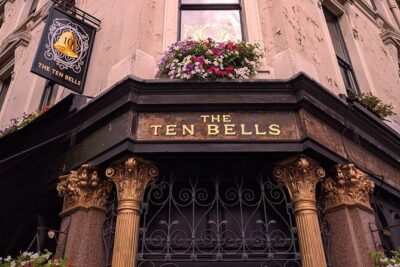
The Original Jack the Ripper Coach Tour of Haunted London
Read our review →
Browse the lists this tour appears in