
Reviewed · WALKING TOURS
London Soho District Guided Walking Tour Semi-Private 12ppl Max
London’s stories are hiding in plain sight. This 2.5-hour Soho walk links famous places with lesser-known tales about music, politics, science, and migration. I like the 12-person maximum, which keeps the walk more personal, and I like the way it moves beyond royal London into the city’s modern cultural life. The main consideration is that you need a moderate level of fitness, and the route is not suitable for wheelchair users or people with walking disabilities.
The tour begins at the Criterion Theatre near Piccadilly Circus and ends in Chinatown. Guides such as Laurence, Becky, Nathan, Sheldon, and Anthony have been praised for making the area’s past lively and for adjusting the pace or focus when the group is small. Bring good shoes, water, and rain protection. The price is $62.54 per person, with private and small-group choices available.
In This Review
- Key points to know before you book
- Why Soho makes such a good walking tour
- Starting beneath the lights of Piccadilly Circus
- Golden Square and the politics of Soho
- Carnaby Street, the Palladium, and a changing West End
- Old pubs and Berwick Street Market
- Soho Square and the district’s older face
- Soho’s music trail, from Hendrix to Queen
- Broad Street, Karl Marx, and Soho’s social history
- Chinatown provides the final chapter
- What the 12-person limit means in practice
- Is $62.54 a fair price?
- Practical details for a comfortable walk
- Who should book this Soho walk?
- Should you book the London Soho walking tour?
- FAQ
- Where does the Soho walking tour start?
- Where does the tour end?
- How long does the walking tour last?
- What is the largest group size?
- Is the tour available as a private experience?
- Is food included in the tour price?
- Does the tour operate in bad weather?
- Can wheelchair users join the tour?
Key points to know before you book
- A 12-person cap: This is a small-group walk, not a large procession. If other people cancel, your group may become a private tour, though that is not guaranteed.
- Soho beyond nightlife: The route covers women’s suffrage, early epidemiology, Karl Marx, the LGBT community, and London’s Chinese heritage.
- A strong music trail: You’ll hear about Jimi Hendrix, the Beatles, and the recording of Bohemian Rhapsody.
- A useful central start: The meeting point at the Criterion Theatre is beside Piccadilly Circus and close to public transportation.
- Chinatown finish: The walk ends near Chinese restaurants and shops, with food suggestions or stops possible depending on the guide.
- Outdoor sightseeing: Most places are viewed from the street, and some buildings cannot be entered because of security rules.
Why Soho makes such a good walking tour
Soho is compact, central, and full of sharp contrasts. Within a few streets, you move from grand theaters and famous advertising screens to small squares, old pubs, markets, music landmarks, and Chinatown. It is the kind of London district that can look like a simple shopping and dining zone until a guide explains what happened on each corner.
I like this tour because it gives you a better sense of London beyond palaces, wartime history, and royal ceremony. Soho’s story is more unruly. It includes artists, musicians, campaigners, immigrants, scientists, philosophers, shopkeepers, and people who built new communities in the middle of the city.
The route also works well early in a London visit. You get an introduction to several central neighborhoods, then can return later for shopping on Carnaby Street, theater around Shaftesbury Avenue, or a meal in Chinatown. The guide’s local knowledge is the main reason to pay for the walk. Without that narration, many of the stops would be attractive but easy to pass without understanding their importance.
More Walking Tours in London
- Tour for Muggles The Ultimate Harry Potter Walking Tour in London
★ 5.0 · 4,684 reviews - London Jack The Ripper Guided Walking Tour
★ 5.0 · 3,131 reviews - Changing of the Guard Guided Walking Tour in London
★ 5.0 · 1,793 reviews
Starting beneath the lights of Piccadilly Circus
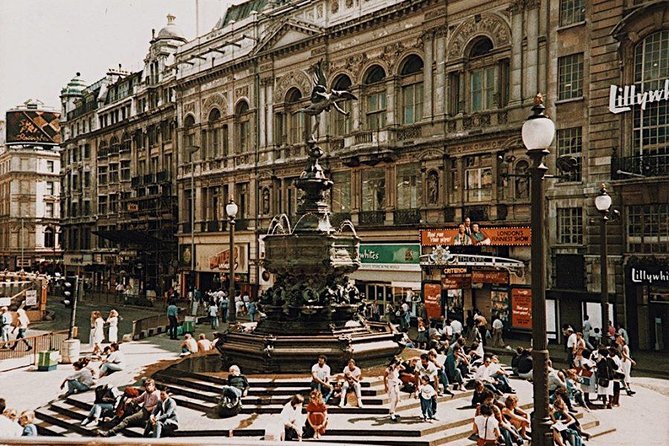
The walk starts at the Criterion Theatre, at 218 to 223 Piccadilly. That puts you right beside Piccadilly Circus, one of London’s best-known intersections. The area is famous for its large advertisements, traffic, crowds, and the Shaftesbury Memorial Fountain.
Piccadilly Circus was built in 1819 to connect Regent Street with Piccadilly. The practical point here is that you begin in a place most people already recognize, then quickly learn how the surrounding streets developed. It is a useful orientation point, especially if you are still learning central London.
The nearby statue is often called Eros, though the tour explains its connection to Anthony Ashley Cooper, the seventh Earl of Shaftesbury. The memorial honors his work as a Victorian politician and philanthropist, including efforts that replaced child labor with school education. That gives the opening section a bit more weight than a simple photo stop.
You spend about 10 minutes around Piccadilly Circus and Shaftesbury Avenue. Do not expect a long visit inside the Criterion Theatre or a formal theater tour. The focus is on the street, the architecture, the memorial, and the setting.
Golden Square and the politics of Soho
Golden Square is one of Soho’s traditional garden squares. It is thought to have been laid out according to plans by Sir Christopher Wren in the 1670s, and it became an important political and ambassadorial area in the late 17th and early 18th centuries.
The square also gives the guide a chance to discuss the women’s suffrage movement. This is one of the tour’s more valuable turns because it shows that Soho was not only a place for entertainment. Its public spaces also carried political arguments and social change.
The short stop works best if you listen closely. You will not spend a long time studying a museum display or entering a historic house. Instead, the guide uses the square itself as a setting for a story, which is the basic rhythm of the entire experience.
For me, this is where the tour earns its keep. A self-guided walk can take you to Golden Square, but it may not connect the place with the people and movements that shaped it.
Carnaby Street, the Palladium, and a changing West End
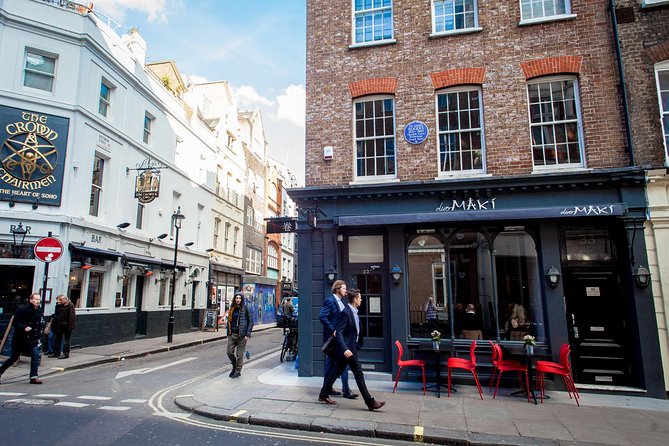
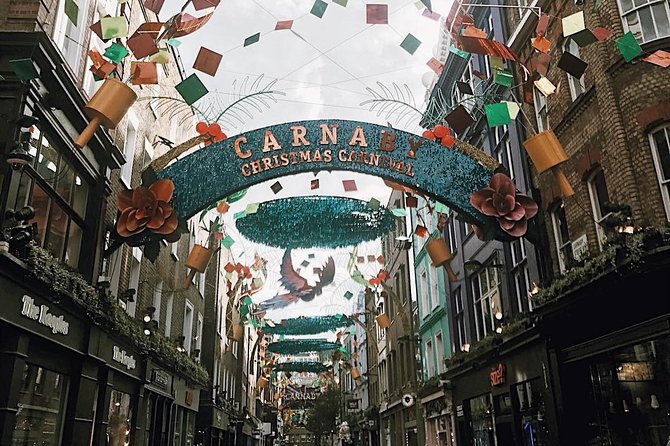
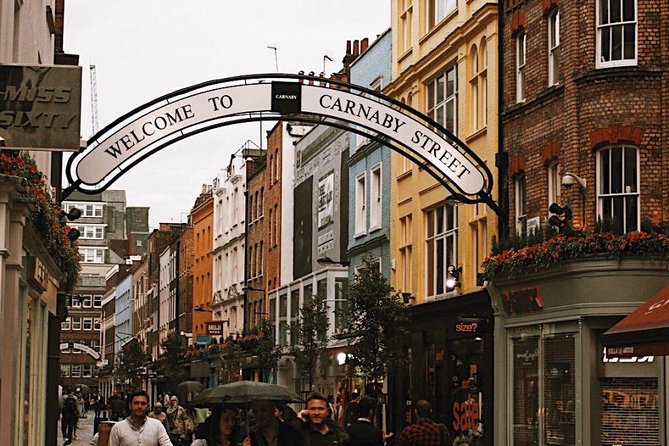
Carnaby Street brings the route into one of Soho’s best-known shopping areas. The pedestrianized street is close to Oxford Street and Regent Street, with British heritage labels, independent shops, and one-off retail concepts.
You should treat this as a short introduction, not a dedicated shopping tour. The guide places Carnaby Street within Soho’s wider cultural story, while the shops provide a lively backdrop. If you want to browse properly, return after the walk because 10 minutes is not enough for serious shopping.
The London Palladium is nearby. Built in 1910 to compete with the London Hippodrome and London Coliseum, the theater retains original features, including its own telephone system and a revolving stage. The tour does not include admission, and increased security measures mean that some attractions cannot be visited from the inside.
That limitation matters. You are mainly seeing the Palladium from outside and hearing why it matters. If you want a theater interior, check the theater’s own program separately. Still, the exterior stop helps explain why this part of London became such a powerful entertainment center.
Something different for another day:
- Stonehenge, Windsor Castle, and Bath from London
★ 4.5 · 18,662 reviews - London Big Bus Hop-On Hop-Off Tour with Optional River Cruise
★ 3.5 · 10,803 reviews - London Small Group Tour of Historical Pubs
★ 5.0 · 10,422 reviews - Stonehenge, Windsor Castle and Bath with Pub Lunch in Lacock
★ 4.5 · 7,402 reviews
Old pubs and Berwick Street Market
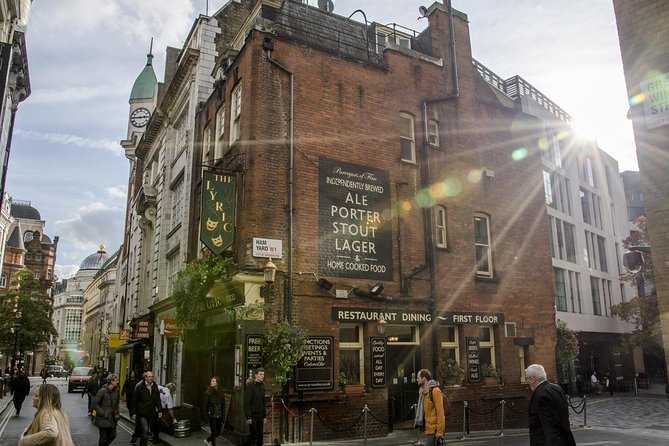
The Blue Posts offers a glimpse of Soho’s pub tradition. The building has high ceilings and large windows that have survived for about 275 years, while the current pub focuses on independently brewed cask ales, craft beers, and ciders.
This is another exterior or brief sightseeing stop rather than a scheduled drinking break. The tour price does not include drinks, and you should not assume there will be time to sit down. If you like old pubs, note the location and consider returning later.
Berwick Street Market is one of the route’s most practical stops. Dating to 1778, it is known for fruit and vegetable stalls and street food in the middle of Soho. Markets help you see how a neighborhood functions, not just how it looks in old photographs.
The market is also a natural place to ask your guide for food advice. One small group with Laurence received suggestions for delicious food stops that they would not have found alone. That does not mean food is included, but it does show how a smaller group can make the walk more responsive to your interests.
Soho Square and the district’s older face
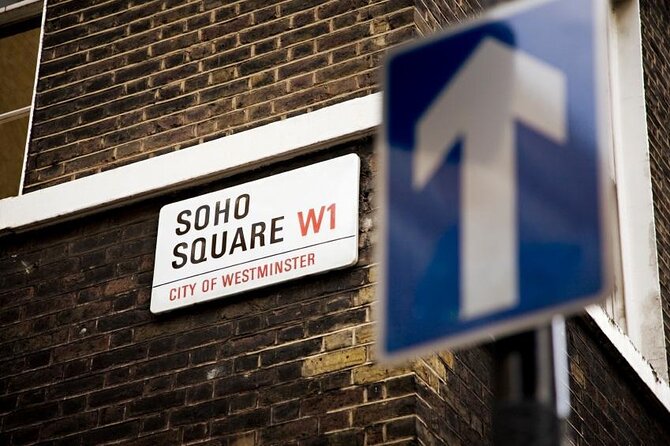
Soho Square dates from around 1681 and was once one of London’s fashionable residential addresses. Its central mock-Tudor building and traditional garden layout make it feel quite different from the busy streets around it.
I like the change of pace here. After Piccadilly’s signs, Carnaby Street’s shops, and the market’s food stalls, the square gives you room to consider how the district changed over time. Soho has not always been primarily associated with nightlife, restaurants, or music. It was also a place where people lived, worked, and sought status.
The guide’s job is especially important at this stop. The square itself may take only a few minutes to see, but the context turns it from a pleasant patch of greenery into part of the story of London’s growth.
Soho’s music trail, from Hendrix to Queen
Music fans have a clear reason to choose this walk. The route covers places linked with Jimi Hendrix’s first performance in London, the beginning of Beatlemania, and the recording of Bohemian Rhapsody.
The value is not simply in pointing toward a building. A good guide connects the place with the period, the people, and the changing role of Soho in popular culture. The music section helps explain why the district attracted performers, recording work, fans, and nightlife.
This part should appeal to you even if you are not a devoted music historian. The stories add a human scale to streets that otherwise might seem like ordinary central London. You are not just walking past a venue or studio. You are hearing how a song, performer, or movement became part of the city’s identity.
The tour also covers the squares and routes connected with major cultural events. Since the precise stops can be affected by national celebrations, the route may change on those dates. The provider says an alternative route will still cover the main highlights, but refunds or discounts are not offered for such changes.
Broad Street, Karl Marx, and Soho’s social history
The route shifts from entertainment to ideas at Broad Street and Greek Street. At Broad Street, you hear about the earliest study of epidemiology. That subject may sound distant from sightseeing, but it gives you a practical look at how London’s crowded urban life produced new ways of understanding disease.
On Greek Street, the discussion turns to Karl Marx and his philosophical work. This adds another layer to Soho’s character. The district was not only a stage for performers and a home for restaurants. It also attracted political thought, argument, and social change.
The tour then considers when the LGBT community began calling Soho home. This is an important part of the walk because it places modern Soho within a longer story of communities claiming space in central London.
The result is a more complete picture of the area. You get music, shopping, food, politics, science, philosophy, and social history in one compact district. The range is a major strength, though anyone seeking a single subject in great depth may find the pace broad rather than specialized.
Chinatown provides the final chapter
The walk ends in Chinatown, where London’s Chinese community began taking shape in the 1950s after several Chinese restaurants opened. By the 1960s and 1970s, the area had become a center for Chinese culture, and today it includes restaurants, shops, and food connected with Chinese life in London.
Ending here makes sense. Chinatown gives the route a clear final chapter about migration, community, food, and the way neighborhoods change. It also leaves you in a useful place for lunch or dinner.
The tour information points toward dumplings at the end, but your food is not included in the ticket. A guide may suggest a place or make a food stop part of a flexible small-group route, as Laurence did for one couple. Plan to pay separately and allow extra time if you want to eat.
Chinatown is also a good place to continue on your own. You finish in Soho rather than returning to the Criterion Theatre, so check your onward route before setting off. The end point is central, but it is not a hotel drop-off service.
What the 12-person limit means in practice
The group cap is one of the strongest features here. Twelve people is small enough for a guide to answer questions without turning every stop into a negotiation. You also have a better chance of hearing clearly on busy streets.
The experience can become even more personal if other bookings cancel. One couple ended up with Laurence as their guide, and he reshaped the walk around their interests and added food stops. That is a welcome possibility, but you should not book expecting a private tour every time.
The minimum is three guests. If that number is not reached, the tour will not run, and you will be offered another date or a full refund. Private tours are available in the morning and afternoon, so they may suit you better if you want a guaranteed personal schedule.
The guides receive the strongest praise for their manner and storytelling. Becky is described as charming and engaging, Nathan as highly informative, Sheldon as very well informed about Soho’s character, and Anthony as witty and well prepared. Those qualities matter because a walking tour depends more on the person leading it than on the number of stops.
Is $62.54 a fair price?
At $62.54 per person, this is not the cheapest way to walk through Soho. You can visit Piccadilly Circus, Carnaby Street, Golden Square, Soho Square, Berwick Street Market, and Chinatown without paying an admission fee.
The question is what you want from the experience. If you are comfortable researching the history yourself, the price may feel high. If you want the streets connected into one clear story, with a guide who can answer questions and point out details you would likely miss, the cost is easier to justify.
The small group also improves the value. You are paying for access to a guide in a more personal setting, not for entry to a collection of attractions. The London Palladium admission is not included, and the tour includes no hotel pickup, drop-off, food, drinks, or gratuities.
Group discounts may reduce the cost for some bookings. Private options offer more control but may cost more, so compare the choices carefully before paying.
Practical details for a comfortable walk
The meeting point is the Criterion Theatre, near Piccadilly Circus. The area is close to public transportation, but hotel pickup and drop-off are not included. An Uber or taxi is suggested if you need a direct connection.
The walk runs in rain or shine. Wear comfortable shoes, carry a bottle of water, and bring an umbrella if rain is possible. In summer, a hat is sensible. Large bags and suitcases are not allowed.
You must provide a mobile phone number with the country code. Children must be accompanied by an adult. The route requires a moderate level of physical fitness, and it is not available for people with walking disabilities or wheelchair users.
The standard cancellation rule allows a full refund if you cancel at least 24 hours before the start time. Cancellations or changes made within 24 hours are not accepted for a refund. If the experience falls short, the provider asks you to contact them within 24 hours so they can address the problem.
Who should book this Soho walk?
I would choose this tour if you are interested in how London’s culture developed at street level. It is a particularly good fit for first-time London visitors who want more than the usual royal and wartime sights, and for repeat visitors who have already seen the major landmarks.
Music fans, history fans, shoppers, food lovers, and anyone curious about Soho’s LGBT and Chinese heritage will find something useful here. The tour also suits couples or small groups who want the benefits of a guide without joining a large crowd.
I would look elsewhere if you need step-free access, want extensive indoor visits, dislike walking in poor weather, or prefer a narrow subject such as theater history alone. You should also avoid carrying luggage and should not expect meals or attraction tickets to be part of the price.
Should you book the London Soho walking tour?
Book it if you want a lively, well-connected introduction to Soho and value a guide’s local stories more than formal attraction admissions. The combination of music, science, politics, old pubs, markets, and Chinatown gives you a fuller view of central London than a simple photo walk.
The strongest reason to go is the guide. Laurence, Becky, Nathan, Sheldon, and Anthony have each been praised for warmth, wit, flexibility, or clear storytelling. If you want a polished overview with room for questions, the 12-person cap is useful.
Skip it if you are happy to follow a map, need wheelchair access, or want guaranteed private attention without booking the private option. For the right audience, this is a smart way to understand why Soho feels so different from the postcard version of London.
FAQ
Where does the Soho walking tour start?
The tour starts at the Criterion Theatre, 218 to 223 Piccadilly, London W1J 9HR, near Piccadilly Circus.
Where does the tour end?
The tour ends in Soho, London, near Chinatown.
How long does the walking tour last?
The tour lasts approximately 2 hours and 30 minutes.
What is the largest group size?
The maximum group size is 12 people.
Is the tour available as a private experience?
Yes. Private tours are available in both the morning and afternoon. The standard option is semi-private, with no more than 12 people.
Is food included in the tour price?
No. Food and drinks are not included. The walk ends in Chinatown, where you can find Chinese restaurants and shops.
Does the tour operate in bad weather?
Yes. The tour runs rain or shine. Comfortable shoes, water, and an umbrella are recommended.
Can wheelchair users join the tour?
No. The tour is not available for people with walking disabilities or those using a wheelchair. A moderate level of physical fitness is required.
Just added around London
- The Private British Museum Tour★ 5.0 · 6 reviews
- London to Southampton Cruise Port | Private Transfer★ 5.0 · 6 reviews
- London’s Chinatown Food Experience★ 4.0 · 6 reviews
- London Gatwick (LGW) Airport Departure Private Transfer – Hotel to Airport★ 4.0 · 6 reviews
- Christmas in Canterbury, Dover and Greenwich with Christmas Lunch★ 4.5 · 6 reviews
- Transfer from Heathrow Airport to London hotel on private car★ 4.5 · 6 reviews
- Jazz Notes – Jazz Jam Ticket★ 5.0 · 6 reviews
- Street Photography Workshops in London★ 5.0 · 6 reviews
Walking Tours, compared.

Oxford University Walking Tour With University Alumni Guide
Read our review →
Tour for Muggles The Ultimate Harry Potter Walking Tour in London
Read our review →

Cambridge University Walking Tour by Alumni™ Kings College Option
Read our review →
Blackbeard to Banksy – The Ultimate Walking Tour of Bristol
Read our review →
Air Raid Shelter + St. Nicholas Market Walking Tour
Read our review →
Walking Tour of Bath with Blue Badge Tourist Guide
Read our review →
Changing of the Guard Guided Walking Tour in London
Read our review →Browse the lists this tour appears in