
Reviewed · WALKING TOURS
Manchester Afternoon Walking Tour
Manchester rewards a closer look. This 2.5-hour afternoon walk links civic buildings, old streets, theatres, canals, memorials, and neighborhoods that are easy to miss from a bus. I like the strong city overview and the way the route mixes famous sights with curious details, such as the Vimto sculpture and the Alan Turing Memorial. The main drawback is simple: you cover a lot of ground on foot, with plenty of standing, so comfortable shoes and a rain jacket matter.
I also like the small-group format, capped at 25 people. Guides such as Gareth bring history to life with humor, clear explanations, and useful food and drink tips. Still, the route is ambitious, and a few stops may receive only a quick look rather than a full visit.
In This Review
- Key points at a glance
- Why this Manchester walk works well
- Starting at Central Library and Emmeline Pankhurst
- Bridgewater Hall, Manchester Central, and the canal
- Palace Theatre, 39 Sackville Street, and Vimto
- Sackville Gardens, the Gay Village, and Alan Turing
- Chinatown and Manchester Art Gallery
- Cenotaph, Albert Square, and the city’s grand center
- St Anne’s Church, St Ann’s Square, and the Royal Exchange
- The Shambles and the Corn Exchange
- Cathedral Street, Chetham’s Library, and football landmarks
- What $24.27 buys you
- Timing, weather, and practical comfort
- Who should book this walk?
- Should you book the Manchester Afternoon Walking Tour?
- FAQ
- How long is the Manchester Afternoon Walking Tour?
- What time does the tour start?
- Where does the tour begin?
- Where does the tour end?
- How much does the tour cost?
- What language is the tour offered in?
- How many people can join the tour?
- Is the tour suitable for most people?
Key points at a glance
- A fast introduction to central Manchester: You see major civic, cultural, and historic sights in one afternoon.
- Strong storytelling: Guide commentary connects Manchester’s industrial past, political history, music, theatre, football, and social change.
- A walking-only route: You reach streets and corners that are awkward to cover by car or bus.
- A lively mix of sights: Expect the Suffragette movement, the Gay Village, Chinatown, Manchester Cathedral, and football landmarks.
- Good first-day value: At $24.27 per person, it gives you a useful map of the city before you explore on your own.
- Prepare for Manchester weather: The tour runs outdoors and can be affected by poor weather, so bring warm layers and an umbrella.
Why this Manchester walk works well
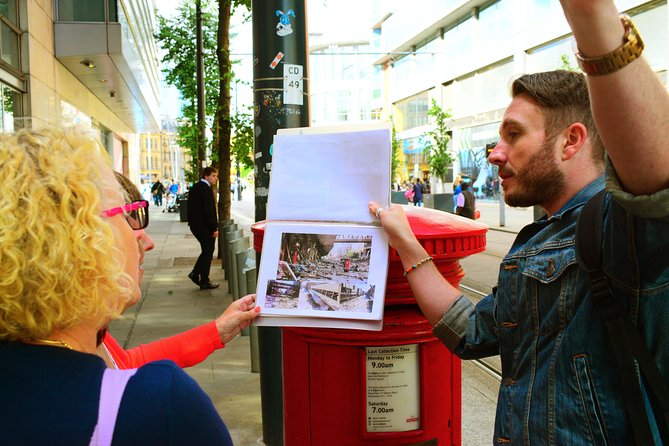
The best city walks help you understand how separate places fit together. This one moves through the center in a way that gives Manchester a clear shape. You begin among grand public buildings, pass cultural venues and memorials, then finish near the cathedral, the National Football Museum, and AO Arena.
That range is the tour’s biggest strength. In one afternoon, you encounter women’s voting rights, classical music, industrial engineering, local drinks, LGBTQ+ history, Chinese culture, art, war memorials, medieval buildings, football, and the modern entertainment industry.
You should not expect a long indoor visit at every stop. Many locations are short pauses of five to ten minutes, with the guide providing the meaning and context. That makes the tour a good orientation walk, not a substitute for visiting Manchester Art Gallery, the cathedral, or Chetham’s Library at length.
The group size can reach 25 people, though one group described having about 12. That is small enough for questions and personal recommendations, while still large enough to feel like a proper guided outing. Gareth, one of the guides associated with the tour, is praised for an easy pace, wit, strong storytelling, and practical advice about places to eat and drink.
More Walking Tours in Manchester
- Rock and Goal Manchester Walking Tour
★ 5.0 · 587 reviews - Four hour walking wine tasting tour of Manchester’s best bars
★ 5.0 · 136 reviews - Daily Manchester City Centre Walking Tour with Local Guide
★ 5.0 · 107 reviews
Starting at Central Library and Emmeline Pankhurst
Meet at Manchester Central Library at 2:00 pm. The building itself is worth noticing, with its distinctive circular form and imposing civic presence. The stop is brief, but it sets the tone for a walk that treats Manchester’s public spaces as part of the story.
From there, the tour reaches the statue of Emmeline Pankhurst. This is one of the most meaningful early stops because it introduces Manchester’s role in the campaign for women’s voting rights. You learn about suffragism rather than simply passing a statue without context.
For anyone interested in British political history, this opening section gives the walk some weight. It also shows that Manchester’s story is not only about factories and football. The city has played an important part in campaigns for social and political change.
Bridgewater Hall, Manchester Central, and the canal
The next section shifts toward music, events, and engineering. Bridgewater Hall is home to the Hallé Orchestra, one of the city’s major musical institutions. The stop is short, and entry is not included, so you should view it as an exterior landmark and a chance to hear about Manchester’s cultural life.
Manchester Central follows. Once a railway station, the building now functions as a major events venue. The brief visit helps you see how the city has reused large industrial and transport structures for modern purposes.
Then comes the Manchester Ship Canal. The route takes you along one of the first man-made canals of its kind, a reminder of the engineering that helped Manchester grow as an industrial city. This is one of the places where guide commentary matters most. A canal can look like a pleasant stretch of water, but its importance becomes clearer when you connect it to trade, factories, transport, and the city’s wider development.
The walk does not ask you to board a boat or spend a long time at the water. Instead, you get a compact explanation while moving through the center. That suits anyone who wants useful context without giving up the rest of the afternoon.
Palace Theatre, 39 Sackville Street, and Vimto
Palace Theatre brings the route back to Manchester’s performance culture. You see a notable theatre and hear about its place in the city. Admission is not included, so this is another exterior stop rather than a theatre visit.
At 39 Sackville Street, the subject changes in a distinctly Manchester way. This location is connected with a drink, and the stop leads into the story of Vimto, a local soft drink. The nearby Vimto sculpture gives you one of the tour’s more unusual photo opportunities.
You may also get to try the drink. That small taste adds a local touch that a standard list of monuments would miss. I like this part because it shows how a city’s identity can be found in ordinary products as well as grand buildings.
The stop is brief, but it breaks up the architecture and political history. If you enjoy food, drink, and local oddities, this is the sort of detail that makes a walking tour more memorable.
More Walking Tours:
- Manchester Music Walking Tour
★ 4.5 · 27 reviews - Inspirational guided walking tour of Media City & The Quays
★ 5.0 · 23 reviews - Stockport Guided Walking Food Tour
★ 5.0 · 7 reviews - Oxford University Walking Tour With University Alumni Guide
★ 5.0 · 6,905 reviews
Sackville Gardens, the Gay Village, and Alan Turing
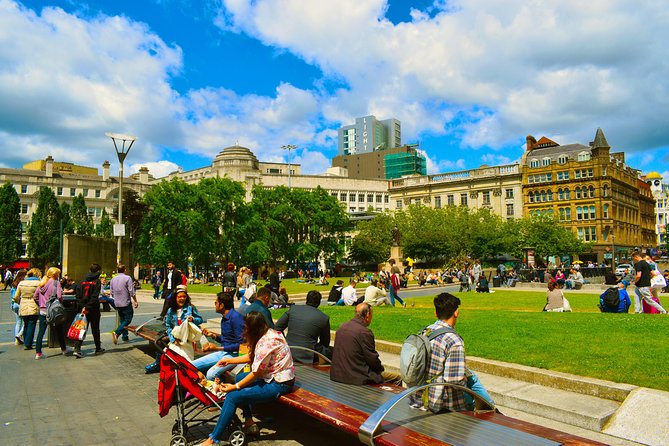
Sackville Gardens provides a quieter patch of greenery in the center and introduces Manchester’s Gay Village. The route includes colorful displays and rainbow references, giving you a sense of the area’s identity and its importance to LGBTQ+ life in the city.
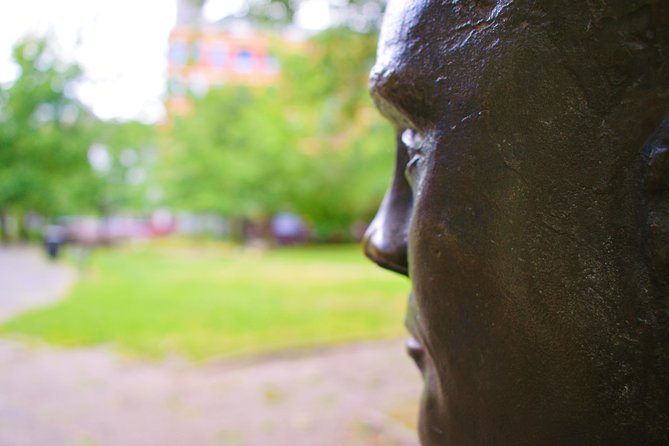
The Alan Turing Memorial is nearby. Turing is remembered for his work in computing and for helping break the Enigma code during the Second World War. The stop links scientific achievement, wartime history, and the treatment of LGBTQ+ people in Britain.
This is a thoughtful section of the walk because it asks you to consider both achievement and injustice. The guide’s role is important here. A few minutes at a memorial cannot cover every detail, but a good explanation can give you a reason to return and learn more.
The area also adds variety to the route. You move from civic architecture to a neighborhood with a very different tone, then on to one of Manchester’s best-known scientific figures.
Chinatown and Manchester Art Gallery
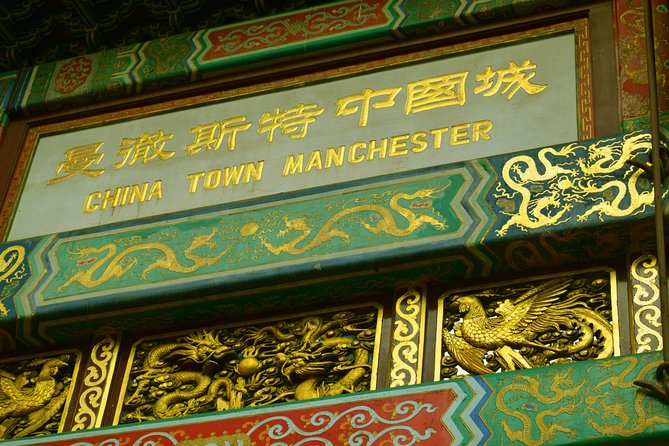
The tour continues into Chinatown, described as the second-largest Chinatown in the United Kingdom. The stop is short, so do not expect a full food tour or time to explore every restaurant. Instead, you get a quick orientation to the district and its place in Manchester’s urban mix.
Manchester Art Gallery is given a longer pause of about 15 minutes. The gallery offers a useful glimpse of the city’s cultural side, although the short schedule means this is not enough time for a serious collection visit. If art is high on your list, mark the gallery for a separate return visit.
This portion of the route works well for first-time visitors because it makes the center feel varied rather than divided into isolated attractions. You see how civic buildings, cultural institutions, and community neighborhoods sit close together.
Cenotaph, Albert Square, and the city’s grand center
Manchester Cenotaph is a brief memorial stop for soldiers who died in the First World War. It is a quiet place to pause before entering Albert Square, one of the city’s main event spaces.
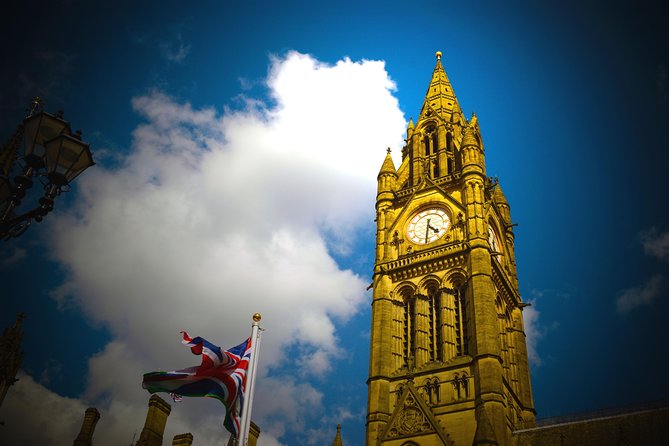
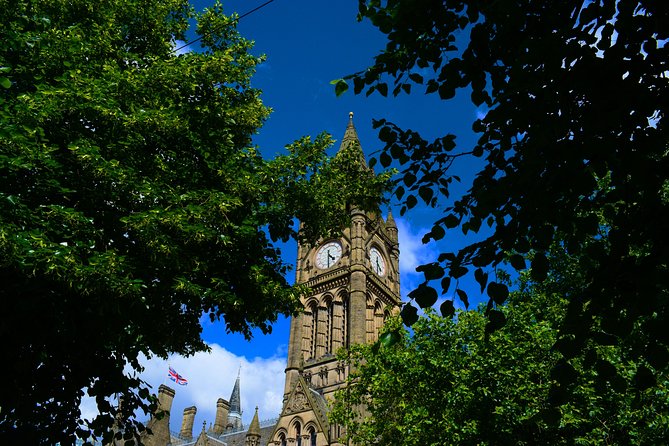
Albert Square gathers several major landmarks in one area. The Albert Memorial and Manchester Town Hall give the square its grand civic character. Entry to the town hall and memorial is not included, so you will mainly hear the stories and view the buildings from outside.
The town hall is one of the route’s major architectural highlights. Even without an interior visit, its scale and detail help explain how Manchester presented itself as a powerful industrial city. The surrounding square also gives you practical bearings for later sightseeing and city events.
This is an area where a guide can save you time. You could walk through the square alone and admire the buildings, but you might miss why they were built, what they represent, and how they connect to Manchester’s rise.
St Anne’s Church, St Ann’s Square, and the Royal Exchange
St Anne’s RC Church offers a short stop with a distinct religious and local history. You then continue to St Ann’s Square, an older central area that contrasts with the larger civic spaces around Albert Square.
The Royal Exchange Theatre adds another cultural landmark. The theatre is particularly interesting because it occupies a building associated with Manchester’s commercial past, showing how older spaces have been given new uses. Admission is included in the sense that the route reaches the venue, but you should not expect a full performance or extended interior visit.
This part of the tour is useful for understanding Manchester as a city that keeps changing while retaining visible traces of earlier eras. A modern theatre, old churches, retail spaces, and historic public squares all sit within a compact walking area.
The pace remains steady. Several people praised the walk for feeling relaxed rather than tiring, but you should still expect continuous walking and standing. If you need frequent seated breaks, this may feel demanding.
The Shambles and the Corn Exchange
The Shambles is one of the most atmospheric parts of the route. The old buildings are among the oldest in Manchester city center, and they offer a sharp contrast to the broad civic avenues and newer entertainment venues.
The stop is only about ten minutes, and admission to the buildings is not included. Still, the value comes from seeing the surviving older fabric of the center and hearing how this part of Manchester fits into the city’s development.
The Corn Exchange follows. It has been remade as a modern food and shopping destination, while retaining its connection to the historic center. Nearby references to an old newspaper factory add another layer to the story of work, trade, and urban change.
This section is especially good for you if you like cities that show their age in fragments. Manchester is not presented as a preserved museum city. Instead, the route shows old buildings beside rebuilt spaces, with the guide explaining the changes.
Cathedral Street, Chetham’s Library, and football landmarks
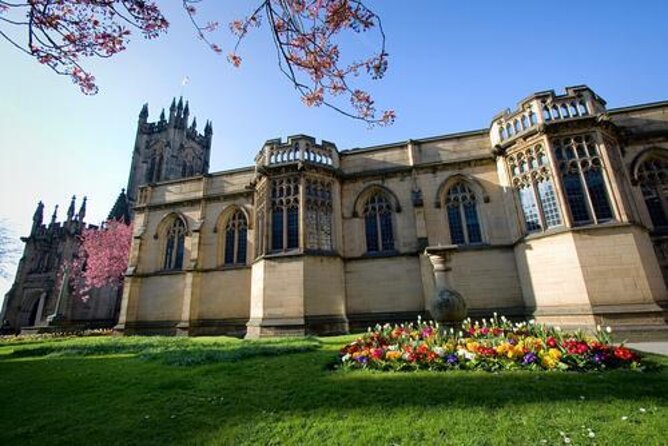
Manchester Cathedral is one of the final major stops. The visit is listed as free, making it one of the places where you may be able to see more than just an exterior, depending on the timing and conditions of the walk. Its presence gives the route a calm, historic finish after the busier central streets.
Chetham’s Library is another highlight. It is described as the oldest public library in the English-speaking world, and that alone makes it worth special attention. The walk can introduce you to the building and its importance, but ten minutes is not enough for a detailed library visit.
If this appeals to you, plan to return separately and check the available visiting arrangements. The tour gives you the reason to care, then leaves room for a longer visit later.
The National Football Museum and AO Arena bring the route into modern Manchester. The football museum receives a short stop, and admission is not included. AO Arena offers a connection to the Manchester Arena site and the city’s major events scene.
These final stops help explain why Manchester attracts more than architecture fans and industrial-history enthusiasts. Music, sport, entertainment, and public memory all form part of the modern city.
What $24.27 buys you
At $24.27 per person, the tour is fairly priced for a 2.5-hour guided orientation. You are paying less for formal entry tickets and more for the guide’s route, stories, local perspective, and ability to connect a large number of places.
That distinction matters. Most stops are short, and some venues are viewed from outside. If you want extended time inside museums, galleries, theatres, or historic buildings, you will need separate visits and possibly separate admission fees.
The included extra is a unique list of 101 things to do in Manchester. That can add real value, especially if you have only a day or two in the city. A good list helps you turn the walking tour into a plan for the rest of your stay.
The tour is often booked about 21 days ahead, so booking early is sensible if your schedule is fixed. Confirmation arrives at booking, and free cancellation is available up to 24 hours before the start time. If poor weather cancels the walk, you are offered another date or a full refund.
Timing, weather, and practical comfort
The meeting point is Manchester Central Library, and the walk ends on Cathedral Street near Manchester Cathedral. Both points are near public transportation, which makes the route practical if you are staying outside the center.
The afternoon start at 2:00 pm works well if you want a slower morning or are arriving in Manchester around midday. It also leaves you near restaurants, pubs, cultural venues, and the National Football Museum after the tour.
Wear comfortable shoes. This is a non-stop walking and standing experience, with a few steps. Several people found the pace easy, but the route covers a lot of central Manchester, so do not treat the short stop times as rest breaks.
Manchester weather can change quickly. January can be very cold, and rain is possible at any time. Bring warm clothing and an umbrella, and use a waterproof layer if you have one. The experience requires good weather, so a cancellation is possible if conditions are poor.
Service animals are allowed, and most people can take part. The maximum group size is 25. The tour may not suit very young children or older people who struggle with extended walking and standing, but the steady pace helps.
Who should book this walk?
I would choose this tour if you are visiting Manchester for the first time, have only a day or two, or want to understand the city before deciding where to spend more time. It is also useful for people who enjoy history but do not want a lecture in a museum.
You will get the most from it if you like moving between many subjects. The route covers political activism, engineering, theatre, local drinks, LGBTQ+ history, art, religion, football, and wartime memory.
It also suits repeat visitors and locals who feel they know Manchester only through work, shopping, or events. A guide can connect familiar streets in a new way, particularly around the central civic quarter and the older buildings near the cathedral.
I would hesitate if you want a slow, photo-heavy walk with long stops. The route is designed to cover many sights, and some locations receive only five or ten minutes. You should also avoid booking it without suitable footwear or a plan for wet weather.
Should you book the Manchester Afternoon Walking Tour?
Book it if you want a well-paced first look at Manchester and value a guide who can explain the city rather than simply point at buildings. The wide range of stops, the manageable price, and the practical recommendations at the end make it a strong choice for a first afternoon.
Skip it if you prefer to explore only a few attractions in depth. For everyone else, especially first-time visitors with limited time, this walk gives you a useful sense of direction and a long list of ideas for the days ahead.
FAQ
How long is the Manchester Afternoon Walking Tour?
The tour lasts approximately 2 hours and 30 minutes.
What time does the tour start?
The tour starts at 2:00 pm.
Where does the tour begin?
It begins at Manchester Central Library, Manchester M2 5PD, United Kingdom.
Where does the tour end?
It ends on Cathedral Street near Manchester Cathedral, Manchester M3 1SW, United Kingdom.
How much does the tour cost?
The listed price is $24.27 per person.
What language is the tour offered in?
The tour is offered in English.
How many people can join the tour?
The maximum group size is 25 people.
Is the tour suitable for most people?
Most people can participate, and service animals are allowed. The walk involves continuous walking and standing, with a few steps, so comfortable shoes are important.
Just added around Manchester
- Manchester Street Art: Quest Experience★ 4.0 · 6 reviews
- Manchester: Football Experience With A Local Host★ 3.5 · 6 reviews
- Stockport Guided Walking Food Tour★ 5.0 · 7 reviews
- Private Cocktail Making Class in Manchester★ 5.0 · 8 reviews
- MANCHESTER: Yorkshire Adventure – Sightseeing Day Trip Tour★ 5.0 · 9 reviews
- Manchester: Luggage Storage Central★ 5.0 · 10 reviews
- Musical MADchester Quest Experience in Manchester★ 4.0 · 14 reviews
- Murder Detective Self-Guided Tour in Manchester★ 3.5 · 16 reviews
Walking Tours, compared.

Oxford University Walking Tour With University Alumni Guide
Read our review →
Tour for Muggles The Ultimate Harry Potter Walking Tour in London
Read our review →

Cambridge University Walking Tour by Alumni™ Kings College Option
Read our review →
Blackbeard to Banksy – The Ultimate Walking Tour of Bristol
Read our review →
Air Raid Shelter + St. Nicholas Market Walking Tour
Read our review →
Walking Tour of Bath with Blue Badge Tourist Guide
Read our review →
Changing of the Guard Guided Walking Tour in London
Read our review →Browse the lists this tour appears in