
Reviewed · PHOTOGRAPHY SESSIONS
Private Night Photography Tour in London
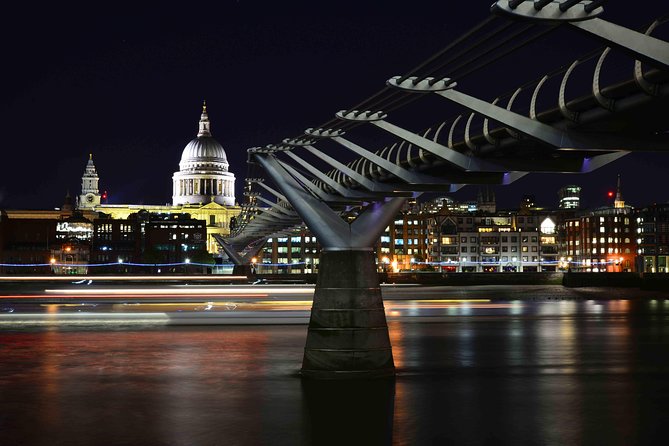
London looks different after dark. This 2.5-hour photography walk turns familiar landmarks into lessons in light, motion, and timing, with a professional photographer helping you make better images using either a DSLR or smartphone. You move from the London Eye to St. Paul’s, the City of London, and Tower Bridge, with the Thames providing reflections and passing boats.
I like the personal instruction from David, who adjusts his advice to your camera and skill level. I also like the chance to photograph more than the usual postcard views, including car-light trails, blurred boats, creative zoom effects, and less obvious city angles. The main consideration is equipment: a tripod is important for many long-exposure shots, and one participant found sharing a spare tripod less flexible than having a personal one.
The tour costs $164.52 per person, so it is not a cheap sightseeing walk. Still, the price makes better sense if you want to learn skills you can use long after London, rather than simply collect a few snapshots. The experience is listed as private, though one account describes a small group of three, so confirm the group arrangement when booking if personal instruction is your priority.
In This Review
- Key points at a glance
- Why night photography changes London
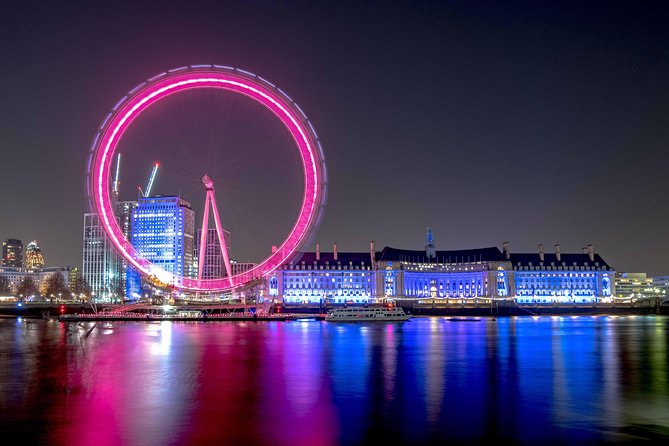
- Starting near Westminster and the London Eye
- St. Paul’s Cathedral and the value of low light
- Through the City of London for unusual angles
- Tower Bridge and the Thames reflections
- What David adds to the evening
- Is $164.52 per person good value?
- Who should book this London photo walk?
- Should you book the night photography tour?
- FAQ
- How long is the Private Night Photography Tour in London?
- How much does the tour cost?
- Is the tour private?
- Can I use a smartphone instead of a DSLR?
- Which London sights are included?
- Do I need a tripod?
- What photography skills will I learn?
- Is an e-guidebook included?
- Are food and drinks included?
- Where does the tour start and finish?
- What is the cancellation policy?
Key points at a glance
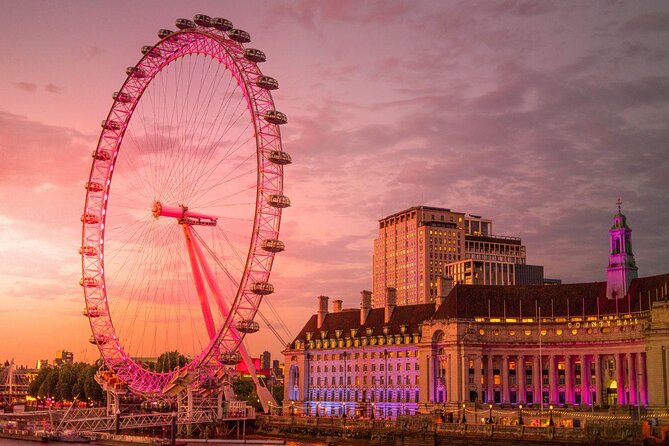
- London Eye light trails: Begin with one of the city’s easiest landmarks for experimenting with reflections, motion, and creative exposure.
- David’s hands-on teaching: Expect help with camera settings, framing, long exposures, and phone photography.
- DSLR or smartphone friendly: You do not need an expensive camera to take part or learn useful techniques.
- Four major London areas: The route links the London Eye, St. Paul’s Cathedral, the City of London, and Tower Bridge.
- Useful follow-up material: A photography e-guidebook gives you tips to revisit after the walk.
- Plan for a tripod: It matters for sharp long exposures, though a spare tripod may be available if needed.
Why night photography changes London
Daylight sightseeing is about seeing the whole city at once. Night photography asks you to slow down and notice smaller details: the orange ribbon of brake lights, a bright window reflected in the Thames, or the way a boat becomes a soft streak across the frame.
That change is the real reason to book this experience. You are not just being taken to famous places. You are learning how shutter speed, camera movement, reflections, and light affect the final image.
The tour suits a wide range of ability levels. A beginner can learn basic camera control, while an experienced photographer can work on long exposure, multiple exposure, or lens-zoom effects. One participant discovered that a camera could create a multiple exposure image and produce unusual effects by zooming the lens during a long exposure. Those are practical discoveries, not just facts to file away.
The instruction also works across devices. David has helped people use a Canon camera and an iPhone on the same outing, and another participant continued after a camera battery died by switching to an iPhone. That flexibility is useful if you are traveling light or still learning your camera.
More Photography Sessions in London:
- Professional Photoshoot in London Photographer
★ 5.0 · 102 reviews - Private landmarks photoshoot for families and couples
★ 5.0 · 92 reviews - Professional Private Photoshoot in London
★ 5.0 · 63 reviews
Starting near Westminster and the London Eye
The meeting point is Caffè Nero, Unit B, Portcullis House, 1-2 Bridge Street, London SW1A 2JH. This puts you near Westminster and within reach of the first photography stop, the London Eye.
The London Eye is a strong opening subject because it offers several ways to practice. You can work with the wheel itself, the lights around the South Bank, reflections along the Thames, and moving traffic. The attraction also gives you a clear chance to see how exposure length changes an image.
A short shutter speed can freeze detail. A longer one can soften motion and turn moving lights into lines. If you are using a phone, the exercise can help you understand night mode and how to keep the device steady. If you have a DSLR, you can work with manual settings and make more deliberate choices.
This is also where the tour’s teaching style appears to matter most. David begins with camera controls and technique, then helps you apply them to an actual London scene. That order makes sense. You learn a setting, test it immediately, and see what changes.
Do not expect the London Eye stop to be only a quick photo pause. The point is to practice. If you already know your camera well, you may spend less time on basic controls and more time trying creative effects. If you are new to photography, the opening lesson gives you a useful foundation for the rest of the evening.
St. Paul’s Cathedral and the value of low light
The route continues to St. Paul’s Cathedral, one of London’s best subjects after sunset. Its dome, stone facade, surrounding streets, and nearby light sources provide contrast between bright highlights and dark shadow.
Here you can work on the main skill of the tour: controlling low light without losing the character of the scene. A long exposure can bring out detail and smooth movement, but it also makes camera shake more obvious. This is where a tripod becomes important.
A tripod is not listed among the inclusions, so plan carefully. One person had a tripod lost with airline baggage and was able to use a spare brought by David, sharing it with another participant. That solved the problem, but having your own tripod would give you more freedom to change position and repeat a shot.
If you use a smartphone, you can still take part. You may not have the same manual controls as a DSLR, but you can learn how stability, framing, and light direction affect the result. The tour is not limited to people who own specialist equipment.
St. Paul’s is also a good place to ask for help with composition. The most useful instruction is often not which button should I press? but where should I stand, and what should I leave out? David’s guidance includes framing and camera settings, so the teaching covers both the technical and visual sides of photography.
Through the City of London for unusual angles
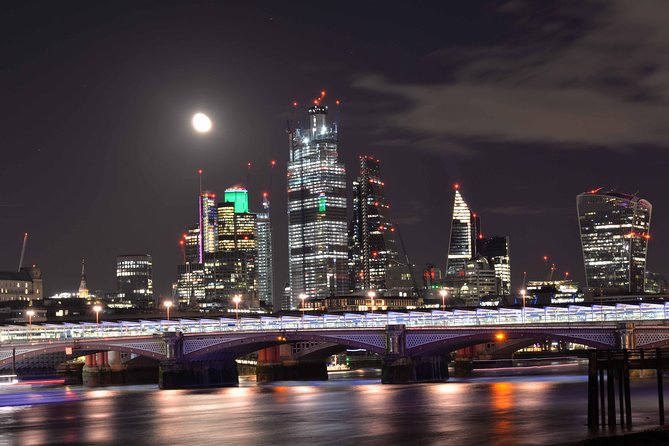
The City of London section adds variety to the route. Rather than stopping only at the grandest landmark, you may work with street details, light patterns, reflections, and less familiar viewpoints.
This part seems especially useful if you want photographs that feel personal rather than copied from a guidebook. David has taken people to smaller corners and unusual vantage points to find more artistic angles. The exact locations can depend on the evening and the light, but the goal is clear: look beyond the standard front-on view.
The City also provides moving subjects. Car lights can become bright trails, while people and vehicles may blur into the scene. Those effects depend on timing and exposure, which gives you another chance to adjust settings and compare results.
I like this part of the route because it connects photography with exploration. You are still seeing London, but you are paying attention to surfaces, lines, color, and movement. The city becomes a working subject rather than a string of photo stops.
The pace should suit someone who wants to learn, not someone rushing to tick off landmarks. You need time to set up, take several frames, check the screen, and try again. That is one reason the 2.5-hour duration matters. It is long enough to cover several areas, but not so long that the technical practice becomes exhausting.
A few more tours and experiences worth a look
- London by Night Bus Tour with Christmas Lights and Live Guide
★ 4.5 · 2,040 reviews - London by Night Sightseeing Tour – Open Top Bus
★ 4.5 · 1,060 reviews - London by Night Sightseeing Open Top Bus Tour with Live Guide
★ 4.5 · 977 reviews - River Thames Evening Cruise with Sparkling wine and Canapés
★ 4.0 · 569 reviews
Tower Bridge and the Thames reflections
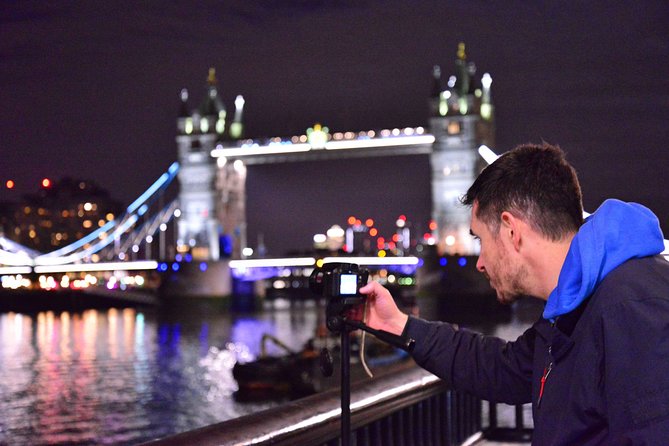
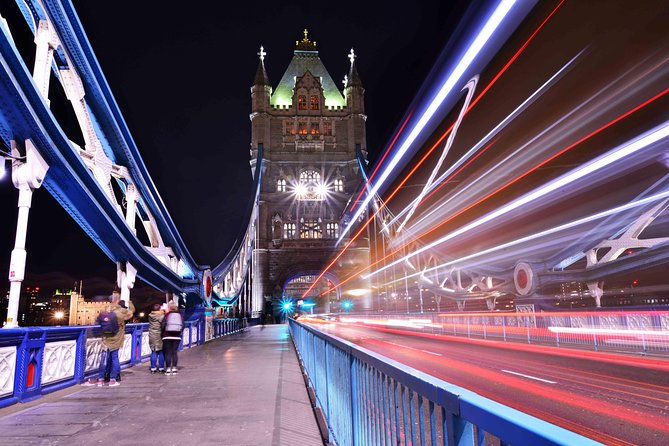
Tower Bridge is the final major stop and perhaps the most rewarding location for night photography. The illuminated bridge, dark water, reflections, and passing boats give you several subjects in one view.
Long exposures can make the Thames look smoother and turn a moving boat into a soft blur. Reflections can add a second layer to the composition, especially when the water is calm enough to catch the lights. The bridge also gives you strong lines and repeated shapes, which can help you practice framing.
This is where earlier lessons can come together. You may use a tripod for stability, adjust the shutter speed for movement, and change your position to include or exclude reflections. You can also experiment with the zoom-during-exposure technique mentioned by one participant, creating streaks and unusual effects rather than a standard architectural image.
The practical drawback is that popular landmarks do not always offer unlimited space or perfect conditions. You may need to share a setup point or work around passing people. Rain can also change the evening. One participant said David bought an umbrella when the weather turned wet, which suggests a considerate approach, but you should still dress for London at night and protect your equipment.
The tour ends back at the meeting point. The route covers major sights, but the strongest images may come from the details between them: a reflection, a passing boat, or a small change in viewpoint.
What David adds to the evening
The guide is a major part of the value here. David is described as a professional photographer, instructor, city guide, and easy conversationalist. His role is not simply to lead you from one landmark to the next. He demonstrates techniques, watches how you use your camera, and offers suggestions for improving the shot.
That personal help is especially useful when your equipment differs from his. The information provided says the tour works with DSLRs and smartphones, and specific experiences include instruction on both an iPhone and a Canon camera. A Fuji user also received useful support despite David being less familiar with that particular model, because the participant already knew the camera menus.
This points to an important distinction. You do not need the guide to know every menu on every camera. You do need to know enough about your own device to make basic changes, or be ready to learn them during the session.
David’s patience also seems to help beginners. One participant with a low battery switched to a phone and continued learning. Another person received help arranging a cab back to a motel at the end of the evening. Those small acts matter when you are carrying equipment and navigating London after dark.
The strongest praise centers on the teaching. People learned camera features they had not used before, received advice useful for daytime photography as well as night work, and came away with images they were pleased to keep.
Is $164.52 per person good value?
At $164.52 per person, this experience costs more than a standard walking tour. You are paying for a professional photographer’s time, a small-scale format, instruction, access to planned photo locations, group photos, and an e-guidebook.
The value depends on your goal. If you only want to see the London Eye and Tower Bridge at night, you can visit those places without booking a tour. If you want to understand how to photograph them, the cost is easier to justify.
A private format can also improve the experience. The information describes the activity as private, with only your group taking part. However, one account describes a three-person group and specifically calls it a group tour. I would ask for clear confirmation about the number of participants before paying, especially if you are expecting one-to-one coaching.
Group discounts are available, which may help if you are traveling with family or friends. A small group can also work well if everyone has similar interests and is happy to share some instruction. If one person wants a relaxed photography lesson while another expects a fast sightseeing tour, the pace may feel less suitable.
The included e-guidebook adds value after the evening ends. You can refer back to tips when photographing London or another city. The group and tour photos are a nice extra, though the main benefit is the instruction you can keep using.
Who should book this London photo walk?
I would recommend it most strongly to:
- Beginners who want help using a camera or phone at night
- Hobby photographers ready to try long exposures
- Couples or families who want a private activity with a shared focus
- DSLR owners who want practical help with settings and composition
- Smartphone photographers looking for better night images
- Repeat London visitors who have already seen the major sights in daylight
It may be less suitable if you dislike stopping often to adjust equipment, or if you want a purely historical walking tour. Photography is the central purpose, so the evening is built around setting up shots and trying techniques.
You should also have a moderate level of physical fitness. The route links several central London areas, and you will be walking while carrying a camera or phone. Food and drinks are not included, so plan around the 2.5-hour outing.
Bring your camera fully charged, spare power if you have it, and a tripod if you own one. Learn the basic controls of your device before arriving. You will get more from David’s advice if you can spend less time finding the shutter button and more time deciding what kind of image you want.
Should you book the night photography tour?
Book this tour if you want a practical photography lesson wrapped around London’s best-known evening views. The most valuable part is not simply reaching the London Eye, St. Paul’s, or Tower Bridge. It is learning how to use low light, reflections, moving traffic, and blurred boats to make those places look like your own photographs.
The 4.9 rating from 29 reviews and 97 percent recommendation figure support the strong impression, with repeated praise for David’s patience, creative suggestions, and camera help. The main cautions are the price, the need for a tripod for serious long exposures, and the need to confirm whether your booking will be fully private or a small group.
For a first night with a camera, this is a particularly good choice. For an experienced photographer, it works best if you want fresh London viewpoints and a professional eye to challenge your usual habits. Cancel at least 24 hours before the start time for a full refund. Otherwise, changes and refunds are not accepted.
FAQ
How long is the Private Night Photography Tour in London?
The experience lasts approximately 2 hours and 30 minutes. The description also refers to it as a three-hour night tour, so confirm the exact duration when booking.
How much does the tour cost?
The listed price is $164.52 per person. Group discounts are available.
Is the tour private?
It is described as a private activity for your group only. One account describes a group of three, so confirm the expected group size if private instruction is important to you.
Can I use a smartphone instead of a DSLR?
Yes. The tour is suitable for both DSLRs and smartphones, and specific instruction has been given on iPhones as well as Canon cameras.
Which London sights are included?
The planned stops are the London Eye, St. Paul’s Cathedral, the City of London, and Tower Bridge. Additional photographs may include Westminster Abbey and Big Ben, as noted in one account.
Do I need a tripod?
A tripod is important for many long-exposure photographs. A spare tripod may be available, but sharing one can reduce your flexibility, so bringing your own is useful if you have one.
What photography skills will I learn?
The tour covers low-light photography, long exposures, camera settings, framing, reflections, light trails, blurred boats, multiple exposure, and creative zoom effects during a long exposure.
Is an e-guidebook included?
Yes. A photography e-guidebook is included so you can continue using the tips after the tour.
Are food and drinks included?
No. Food and drinks are not included unless specifically stated.
Where does the tour start and finish?
It starts at Caffè Nero, Unit B, Portcullis House, 1-2 Bridge Street, London SW1A 2JH, United Kingdom, and ends back at the meeting point.
What is the cancellation policy?
You can cancel up to 24 hours before the experience start time for a full refund. Cancellations or changes made less than 24 hours before the start time are not accepted.
Just added around London
- The Private British Museum Tour★ 5.0 · 6 reviews
- London to Southampton Cruise Port | Private Transfer★ 5.0 · 6 reviews
- London’s Chinatown Food Experience★ 4.0 · 6 reviews
- Christmas in Canterbury, Dover and Greenwich with Christmas Lunch★ 4.5 · 6 reviews
- Transfer from Heathrow Airport to London hotel on private car★ 4.5 · 6 reviews
- London Gatwick (LGW) Airport Departure Private Transfer – Hotel to Airport★ 4.0 · 6 reviews
- Jazz Notes – Jazz Jam Ticket★ 5.0 · 6 reviews
- Transfer from London Stansted Airport to Central London★ 5.0 · 6 reviews
Photography Sessions, compared.
Professional Photoshoot in London Photographer
Read our review →
Private landmarks photoshoot for families and couples
Read our review →
Private Landmarks with a Professional Photographer
Read our review →
Private Tour: Personal Travel Photographer Tour in London
Read our review →
Browse the lists this tour appears in