
Reviewed · ROYAL HERITAGE TOURS
Royal Observatory Greenwich & Prime Meridian Entry Ticket London
Time begins on a hill. The Royal Observatory Greenwich brings GMT, longitude, astronomy, and old-fashioned clockmaking to life in a compact visit above Greenwich Park. I especially like the chance to pose with one foot in each hemisphere and the close look at Harrison’s clocks, but the steep uphill walk and limited accessibility deserve serious thought before you book.
This is a self-guided visit, not a traditional guided tour. You receive admission and an audio guide, with occasional staff or volunteer talks adding extra color. I also like how easily you can pair the observatory with the free National Maritime Museum and Queen’s House, though the ticket itself does not include transport or a planetarium show.
In This Review
- Key things to know before you go
- Why the Royal Observatory matters
- Reaching the observatory through Greenwich Park
- The Meridian Courtyard and the famous photo
- Flamsteed House and the Astronomers Royal
- Harrison’s clocks and the problem of longitude
- The Shepherd Gate Clock and the Time Ball
- The Great Equatorial Telescope
- Audio guide or live explanation?
- How much time should you allow?
- Is the $33.90 ticket good value?
- Who will enjoy this experience most?
- Booking, cancellation, and practical details
- Should you book the Royal Observatory Greenwich ticket?
- FAQ
- How long does the Royal Observatory Greenwich visit take?
- Is the Prime Meridian Line included with admission?
- Is transportation included in the ticket?
- Is the tour guided by a person?
- Are the National Maritime Museum and Queen’s House included?
- Are children and visitors with mobility needs accommodated?
Key things to know before you go
- The Prime Meridian is the headline moment: Stand astride the line dividing east from west in the Meridian Courtyard.
- Harrison’s clocks explain why time matters: These precise machines helped solve the deadly problem of finding longitude at sea.
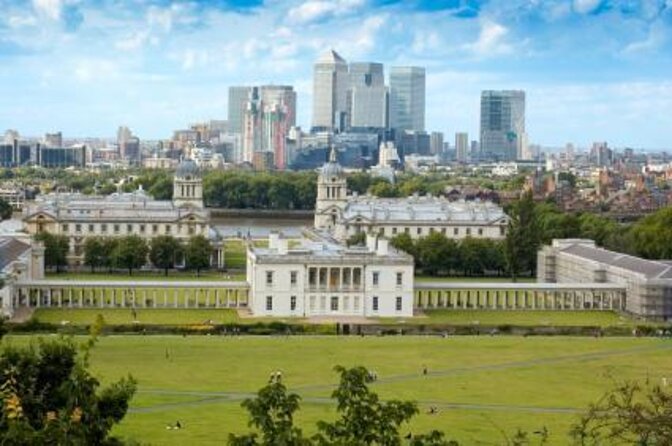
- Greenwich Park adds a steep approach: The observatory sits on a hill, with fine views but a demanding climb.
- The audio guide keeps the visit flexible: You can move at your own pace rather than follow a fixed group.
- The Octagon Room is a small architectural treasure: Sir Christopher Wren designed this elegant interior in Flamsteed House.
- Plan more than two hours if possible: The nearby museums, park, Cutty Sark, and Greenwich town can turn this into a full day.
Why the Royal Observatory matters
The Royal Observatory is not simply a place to take a photograph beside a painted line. Its importance comes from the practical problems solved here: how to measure time accurately, how to calculate position at sea, and how to make sense of the night sky.
Greenwich Mean Time became a reference point for clocks around the world. The Prime Meridian, traditionally marked here, became the starting line for measuring longitude east and west. Those ideas sound ordinary now because they work so well. Inside the observatory, you see the long process that made them possible.
I find the subject most rewarding if you give it a little attention. If you only want a quick photo, you can finish the main attraction fairly fast. If you listen to the audio guide and study the clocks, you begin to understand how much effort went into creating reliable timekeeping.
The site is part of Maritime Greenwich, a UNESCO World Heritage Site. That gives your visit a larger setting, with the park, river, historic buildings, museums, and Cutty Sark all close by.
More Greenwich days out:
- Westminster to Greenwich Sightseeing Thames Cruise in London
★ 4.5 · 2,969 reviews - Leeds Castle, Canterbury, Dover & Greenwich Boat ride
★ 4.5 · 604 reviews - Leeds Castle, Canterbury, Dover & Greenwich Cruise from London
★ 4.0 · 369 reviews
Reaching the observatory through Greenwich Park
The observatory sits at the top of a hill in Greenwich Royal Park. That location gives you one of the best reasons to visit, but it also creates the main physical challenge.
As you walk upward, you get broad views over Greenwich Park, the River Thames, and London. On a clear day, the City of London forms a dramatic backdrop. The view is worth pausing for, especially if you need a rest before reaching the entrance.
Do not underestimate the slope. Several people find the walk longer or steeper than expected, and the approach can be uncomfortable for anyone with limited mobility. There are also stairs in parts of the attraction. The site is not fully accessible, so contact the attraction in advance if you need help planning your route.
You can reach the area by public transport, and the observatory is near other major Greenwich sights. Some visitors find the exact approach confusing, even with a map app. Ride-hailing pickup can also be awkward around the park and hill, so allow extra time rather than arranging a car for the last minute.
A Thames ferry is another pleasant way to reach Greenwich, and one visitor specifically found it a good option. The river approach gives you a useful sense of how Greenwich fits into London before you climb to the observatory.
The Meridian Courtyard and the famous photo
Your visit begins in the Meridian Courtyard. This is where you stand astride the Prime Meridian Line, with one foot in the eastern hemisphere and one in the western hemisphere.
The photo is fun, but the meaning behind it is better than the gimmick. This line represents the reference point used to measure longitude. It is a simple way to connect an abstract idea with a physical place.
Go to the courtyard early if the photograph matters to you. The line can become crowded quickly, especially after the gates open. Taking your picture first lets you enjoy the rest of the buildings without wondering if you will get another clear turn.
You may also notice that the Prime Meridian is not just a single universal concept in the way a casual photograph suggests. For this attraction, the marked line is the point visitors come to see and photograph. The historical role of Greenwich makes it meaningful, even if your main memory is one foot east and one foot west.
Flamsteed House and the Astronomers Royal

Flamsteed House is the oldest part of the observatory visit and the place where the story becomes personal. You follow in the footsteps of the Astronomers Royal and see rooms tied to the work of measuring the heavens.
The Octagon Room, designed by Sir Christopher Wren, is a highlight. It is one of the best-preserved Wren interiors in London, and its graceful proportions offer a welcome change from the technical displays. Take a moment to look beyond the instruments and notice the room itself.
The observatory’s story includes scientists and inventors such as John Harrison, Isaac Newton, Edmond Halley, James Bradley, Annie Maunder, George Airy, and Albert Einstein. The audio guide helps explain how their work connects to astronomy, time, observation, and measurement.
This is not a large museum with endless galleries. You are getting a focused collection in historic rooms. That makes the visit manageable in about two hours, but it also means you should not expect a full-scale science museum or a broad planetarium experience.
More Royal Heritage Tours in London:
- Tower of London and Crown Jewels Exhibition Ticket
★ 4.5 · 6,677 reviews - Tower of London: Crown Jewels & Beefeater Opening Ceremony
★ 4.5 · 969 reviews - The Kensington Palace Gardens Royal High Tea
★ 4.5 · 934 reviews - VIP Tower of London and Crown Jewels Tour with Private Beefeater Meet & Greet
★ 4.5 · 849 reviews
Harrison’s clocks and the problem of longitude

For many people, the clocks are the most satisfying part of the visit. John Harrison’s inventions helped solve one of navigation’s greatest problems: finding longitude at sea.
Latitude can be estimated by observing the height of the sun or stars. Longitude requires knowing the time at a fixed reference point while you are somewhere else. A reliable clock could provide that reference, but creating a clock that remained accurate on a moving ship was extremely difficult.
Harrison’s clocks show the patience and precision needed to tackle the problem. You can see the machines at close range and follow the story of how timekeeping developed. Even if you arrive knowing little about horology, the displays make the subject approachable.
I would give the clocks more time than the Prime Meridian photo. The line gives you a memorable image. Harrison’s work gives you the reason Greenwich became so important. The combination is what makes the observatory more than a quick stop.
Volunteer talks may be available during your visit, and these can add a more human explanation to the displays. One particularly positive account praised a guide named Ross for making the subject interesting and answering questions. Since staffing and talks can vary, treat them as a welcome extra rather than something guaranteed.
The Shepherd Gate Clock and the Time Ball
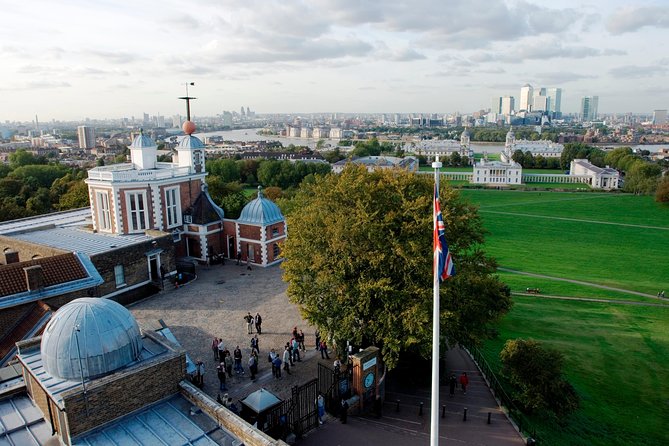
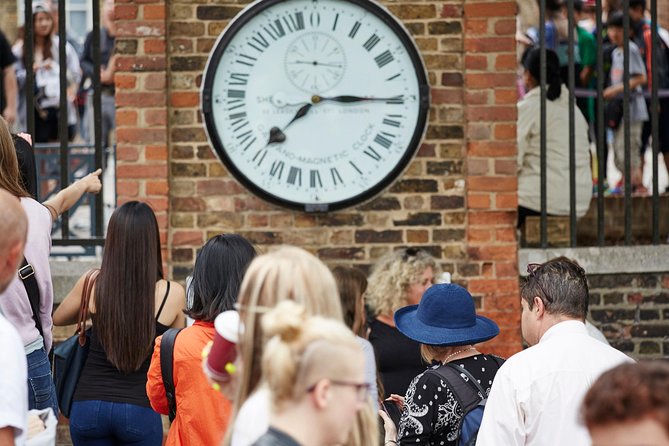
Outside Flamsteed House, look for the Shepherd Gate Clock. It was the first clock to show Greenwich Mean Time to the public. Its position outside the building makes the idea of public time especially clear: this was not only a scientific tool for astronomers, but information ordinary people could use.
Above Flamsteed House, the bright red Time Ball is hard to miss. It was first used in 1833 as one of the earliest public time signals and still operates today. The ball connected the observatory to ships on the Thames and to anyone who needed a dependable visual time cue.
These details reward a slow walk around the buildings. They are easy to overlook if you hurry straight to the Prime Meridian. Listen to the audio guide and look upward as well as ahead.
The Great Equatorial Telescope
The Great Equatorial Telescope sits beneath the observatory’s large onion-shaped dome. It gave astronomers new views of the universe more than a century ago and remains one of the site’s most striking objects.
The telescope helps balance the visit. The first half focuses heavily on clocks, time, and longitude. The telescope shifts your attention toward observation and the scale of the universe.
You should not expect a modern stargazing session from this admission. The attraction presents the telescope as a historic instrument and part of the observatory story. That is still worthwhile, especially if you are interested in how astronomers worked before today’s technology.
The dome itself is part of the appeal. From the outside, it gives the observatory its unmistakable profile. Inside, the telescope makes the building feel like a working place of science rather than only a museum.
Audio guide or live explanation?
Admission includes a free downloadable audio guide, and the attraction also provides an audio guide at the observatory. The supplied information gives different language counts, listing seven languages in one place and ten in another, so check the current options before your visit if language access is important.
The audio format suits this attraction well. You can stop beside a clock, listen, move on, and return to a display if you need more time. It also helps when the rooms are crowded and you cannot easily hear a talk nearby.
This is not a fixed guided tour with a guide leading you from room to room. The experience is mainly self-guided. That distinction matters because anyone expecting a fully narrated group tour may feel disappointed.
The audio guide also allows you to adjust the visit to your interests. You can focus on navigation, astronomy, architecture, or the development of time. Families can split up briefly and regroup without holding back an entire group.
How much time should you allow?
The stated visit lasts about two hours, and that is enough for a sensible first look at the observatory. You can visit the courtyard, walk through Flamsteed House, see the Octagon Room, study the clocks, view the Shepherd Gate Clock and Time Ball, and reach the Great Equatorial Telescope.
I would allow at least 1.5 to 2 hours if you want to listen to the audio guide rather than race through. Add extra time for photographs, the hill, outdoor views, and any volunteer talk.
The larger Greenwich area deserves more than a quick observatory visit. The National Maritime Museum and Queen’s House are both free and within a short walk. Cutty Sark, the surviving tea clipper and now a museum experience, is another major stop nearby.
A practical plan could look like this:
- Arrive through Greenwich Park and pause for the London views.
- Take your Prime Meridian photograph early.
- Spend about two hours inside with the audio guide.
- Walk down toward the National Maritime Museum and Queen’s House.
- Add Cutty Sark, a park walk, and a pub lunch if you have the day.
This area works especially well as a full-day outing. A short ticket visit can feel limited if you ignore the surrounding sights.
Is the $33.90 ticket good value?
At $33.90 per person, the ticket is reasonable if you care about the Prime Meridian, historical clocks, or the observatory’s scientific story. The audio guide and admission are included, and you are paying for access to a UNESCO World Heritage setting as well as the displays.
The value is less convincing if you only want a photograph. The attraction is compact, and some visitors find the museum portion limited. You are not buying transport, and the free nearby museums offer strong additions without another admission charge.
Advance booking can be useful because the attraction is popular, with reservations made about 35 days ahead on average. Still, one important practical warning comes from ticket handling. Some visitors have had trouble getting third-party vouchers or barcodes scanned, including problems accessing tickets through a phone app. Others found it easier to buy at the entrance.
I cannot promise that this problem will occur, but I would prepare carefully. Save the ticket before arriving, keep the confirmation available offline, and check that the barcode displays properly on your phone. If you prefer the simplest possible entry and same-day tickets are available, the attraction’s own box office may be worth considering.
The free National Maritime Museum and Queen’s House improve the overall value. You can build a full Greenwich day around the observatory without paying for every stop.
Who will enjoy this experience most?
I would recommend the observatory to:
- People curious about time zones, longitude, navigation, or astronomy
- Families with children old enough to follow a self-guided museum visit
- Couples and solo visitors who enjoy historic instruments and scenic views
- Anyone interested in London’s connection to maritime science
- Visitors planning a full day in Greenwich
Children under four enter free, and children must be accompanied by an adult. Most people can participate, but the hill, stairs, and incomplete accessibility make the visit harder for some older visitors and anyone with mobility limits.
You do not need to be an astronomer. The Prime Meridian provides an easy hook, while the clocks and audio guide supply the substance. But if you expect a large planetarium or a modern space center, check your expectations carefully. The main experience is the historic observatory and its explanation of timekeeping.
Weather also matters. Much of the approach and several memorable parts of the visit involve being outdoors. Rain can make the walk and views less enjoyable, while a dry day lets you appreciate Greenwich Park and the skyline.
Booking, cancellation, and practical details
Your confirmation is provided at booking, and the ticket is mobile. The experience is offered in English, with a downloadable audio guide available in multiple languages. Service animals are allowed, and the attraction is near public transportation.
Free cancellation is available up to 24 hours before the scheduled start time. If you cancel later than that, you do not receive a refund, and changes made within 24 hours are not accepted. The cutoff uses local London time.
Because the attraction is on a hill, wear comfortable shoes and leave a little time for the approach. If someone in your group has difficulty with stairs or steep paths, contact the attraction before booking rather than assuming the site can accommodate every need.
Should you book the Royal Observatory Greenwich ticket?
Book it if you want the Prime Meridian photograph with real historical context, enjoy old scientific instruments, and can manage the uphill approach. The clocks, Octagon Room, Time Ball, telescope, and London views make this a thoughtful two-hour visit, not just a photo stop.
I would pair it with the free National Maritime Museum and Queen’s House, and add Cutty Sark if you have a full day. For the best experience, arrive early, take your Meridian photo first, download or save your ticket before reaching the entrance, and use the audio guide at an unhurried pace.
Skip it, or choose carefully, if you need a fully accessible attraction, expect a planetarium to be included, or only want a quick line photo. For everyone else, the observatory offers a memorable way to understand why Greenwich became the world’s clock-and-longitude reference point.
FAQ
How long does the Royal Observatory Greenwich visit take?
The visit lasts approximately two hours. Allow at least 1.5 to 2 hours if you want to use the audio guide and spend time with the historic displays.
Is the Prime Meridian Line included with admission?
Yes. Admission includes access to the Meridian Courtyard, where you can stand astride the Prime Meridian Line with one foot in each hemisphere.
Is transportation included in the ticket?
No. Transportation to and from the Royal Observatory is not included. The attraction is near public transportation.
Is the tour guided by a person?
The main experience is self-guided with an audio guide. Volunteer talks or staff assistance may be available, but a traditional guided tour is not part of the standard admission described here.
Are the National Maritime Museum and Queen’s House included?
Both are free to visit and located within a short walking distance of the Royal Observatory. Their admission does not depend on this ticket.
Are children and visitors with mobility needs accommodated?
Children under four enter free, and children must be accompanied by an adult. Some parts of the attraction are not fully accessible, with a steep hill and stairs, so contact the attraction in advance if you need assistance planning your visit.
Just added around London
- The Private British Museum Tour★ 5.0 · 6 reviews
- London to Southampton Cruise Port | Private Transfer★ 5.0 · 6 reviews
- London’s Chinatown Food Experience★ 4.0 · 6 reviews
- London Gatwick (LGW) Airport Departure Private Transfer – Hotel to Airport★ 4.0 · 6 reviews
- Transfer from Heathrow Airport to London hotel on private car★ 4.5 · 6 reviews
- Christmas in Canterbury, Dover and Greenwich with Christmas Lunch★ 4.5 · 6 reviews
- Jazz Notes – Jazz Jam Ticket★ 5.0 · 6 reviews
- Transfer from London Stansted Airport to Central London★ 5.0 · 6 reviews
Royal Heritage Tours, compared.

Tower of London and Crown Jewels Exhibition Ticket
Read our review →
Tower of London: Crown Jewels & Beefeater Opening Ceremony
Read our review →

VIP Tower of London and Crown Jewels Tour with Private Beefeater Meet & Greet
Read our review →
Royal Historic Pubs Walking Guided Tour in London
Read our review →
Highlights of Royal London Bike Tour including Hyde Park
Read our review →
Royal Liver Building 360 – Tower Tour and Experience
Read our review →
Browse the lists this tour appears in