

Reviewed · SHAKESPEARE TOURS
Shakespeare’s Schoolroom & Guildhall Entry Ticket and Tour
School was a serious business in Shakespeare’s Stratford. This small, hands-on attraction lets you sit where the young William Shakespeare studied, try Tudor writing with a quill, and hear lively stories about his family and town. I especially like the interactive Tudor lesson and the chance to see the Council Chamber where Shakespeare’s father served as Bailiff, or mayor. The main drawback is that the experience can feel uneven if a school group is present or if the opening part of the tour does not hold children’s attention.
At about $18.02 per person, this is a fair buy for Shakespeare fans and families who prefer doing something over simply reading display panels. The visit is advertised at roughly 30 minutes to one hour, though you may spend longer if you take your time with the films, rooms, activities, and lesson.
In This Review
- Key details before you go
- Why this small attraction matters in Stratford
- Entering the Guildhall and learning the town’s story
- The Council Chamber and Shakespeare’s family link
- Sitting in the 1570s schoolroom
- Quill, ink, Tudor games, and costumes
- How much time should you allow?
- Is $18.02 good value?
- Who will enjoy this most?
- Booking, cancellation, and practical points
- Should you book Shakespeare’s Schoolroom?
- FAQ
- Where is Shakespeare’s Schoolroom and Guildhall?
- How long does the experience last?
- What are the opening hours?
- Is the Tudor lesson included?
- Can I use a mobile ticket?
- Is the tour offered in English?
- Can children take part?
Key details before you go

- Write with a Tudor quill: You can handle ink and a feather pen rather than only looking at old objects behind glass.
- Sit in Shakespeare’s classroom: The schoolroom is the actual setting associated with his education in the 1570s.
- Meet the schoolmaster: The Tudor lesson, led by a costumed master such as Master Jenkins, is the most praised part of the experience.
- Enter a medieval civic building: The Guildhall dates from 1420 and is one of only a few surviving medieval Guildhalls in England.
- See the Shakespeare family connection: Shakespeare’s father served as Bailiff in the Council Chamber.
- Plan for a flexible visit: Opening hours are 11:00 a.m. to 4:30 p.m. daily, and a mobile ticket is accepted.
Why this small attraction matters in Stratford
Stratford-upon-Avon offers plenty of Shakespeare-related sights, but this one focuses on the playwright before the famous plays. You are not being asked to picture Shakespeare as a celebrated writer. Instead, you see the boy who studied Latin, sat through lessons, and grew up in a town where public life and performance were closely linked.
That shift in focus gives the visit its appeal. The schoolroom connects Shakespeare to daily life. The Guildhall connects him to Stratford’s government, trade, religion, and entertainment. Together, the rooms help explain the town that shaped him.
The building itself adds weight to the experience. Constructed in 1420, the Guildhall is a rare surviving medieval structure. Its age is not just a number on a sign. It is the reason the rooms feel important. You are walking through a place that served Stratford’s civic life for centuries, long before it became a stop on the Shakespeare trail.
The attraction also points out medieval wall paintings. These are easy to overlook if you rush toward the lesson, so I would make a point of studying them before settling into the schoolroom. The films provide useful background on the building and Shakespeare’s school days, especially if you arrive with only a general idea of his early life.
More Shakespeare trips:
- Shakespeare Distillery Tour – 1pm Ticket
★ 5.0 · 598 reviews - The Sinister Side of Shakespeare’s Stratford Walking Tour
★ 5.0 · 279 reviews - Shakespeare Distillery Tour – 11am Ticket
★ 5.0 · 136 reviews
Entering the Guildhall and learning the town’s story
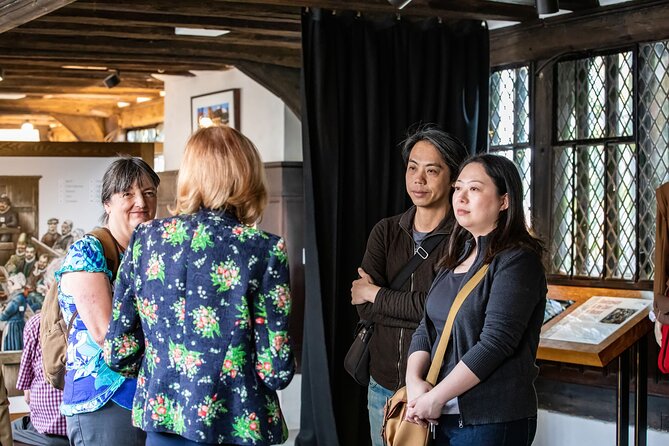
Your visit begins with the Guildhall, where guides explain the building’s role in Stratford. The information covers more than Shakespeare. You also learn how the Guildhall functioned as part of the town’s civic life over the centuries and how the Shakespeare family fitted into that story.
This first part may appeal most to adults and older children. It gives the setting context before the school lesson begins, but it is also the section most likely to feel slow for younger children. One family found that the opening portion held less interest for the children than the upstairs schoolroom. If you are visiting with impatient youngsters, head toward the classroom activities as soon as the staff direct you, then return to the earlier material if time allows.
The guides make a real difference here. Regina has been praised for bringing the period to life with useful facts about Shakespeare’s era, while other staff members have been described as friendly, professional, and quick to answer questions. The tone is generally conversational rather than academic, which helps keep the building from feeling like a dry history lesson.
You may also find the pace changes with the crowd. On a quiet visit, the staff can give you more individual attention. When school groups and family groups arrive together, the rooms can feel busy, and you may need to wait for a clear view of an exhibit or video. Staff have been known to check on smaller groups even during crowded periods, but the experience is less calm when several classes are moving through at once.
The Council Chamber and Shakespeare’s family link
The Council Chamber is one of the most useful stops because it gives Shakespeare a direct family connection to the building. His father served as Bailiff, the town’s mayor, and this is the room where that civic role is presented.
For me, this is more meaningful than simply seeing another room connected to Shakespeare. It shows that his family was part of Stratford’s public life. John Shakespeare was not an unknown figure in the town, and the young William had a close view of local power and administration.
The Guildhall also hosted performances. Shakespeare is said to have witnessed performances by some of the country’s leading actors in the building. That detail provides a pleasing link between the schoolboy and the playwright. Before Shakespeare wrote plays, he could watch professional performers in a room tied to his own family and education.
The attraction does not need to claim that this single room created Shakespeare. It is more useful than that. It shows how education, local government, and theatre existed side by side in his early world.
Sitting in the 1570s schoolroom

The schoolroom is the heart of the visit. You sit in the place where Shakespeare was educated in the 1570s and learn about the subjects expected of a Tudor schoolboy, including Latin.
The room is small, which works in its favor. You can picture a concentrated classroom rather than a grand institution. That scale makes the lesson feel immediate. You are not simply viewing a reconstruction from a distance. The staff invite you to take part.
The Tudor lesson is included with admission. A schoolmaster leads the session, explains the period, and brings in humor as well as instruction. Master Jenkins has received especially warm praise for his lively teaching, Latin exercises, and quill-writing demonstration. The lesson is aimed at all ages, so adults can enjoy it without feeling that the entire experience has been designed only for children.
Expect a mix of explanation and participation. You may be asked to brush up on Latin, listen to the schoolmaster’s instructions, and consider how different education felt in Shakespeare’s day. The lesson gives the attraction its character. Without it, you would have a historic room and some information. With it, the schoolroom becomes an activity.
Timing can vary. The official estimate is around 30 minutes to one hour, but some people have spent closer to two hours when they took part fully and moved through the displays at a relaxed pace. You should not assume the whole visit will always last that long. A short visit is possible, especially if you arrive between scheduled teaching moments or move quickly through the material.
A few more tours and experiences worth a look
- Warwick Castle Admission Ticket
★ 4.0 · 2,096 reviews - Tudor World Museum Entrance Ticket
★ 4.5 · 45 reviews - Tower of London and Crown Jewels Exhibition Ticket
★ 4.5 · 6,677 reviews - Thorpe Park Admission Ticket
★ 4.0 · 5,915 reviews
Quill, ink, Tudor games, and costumes
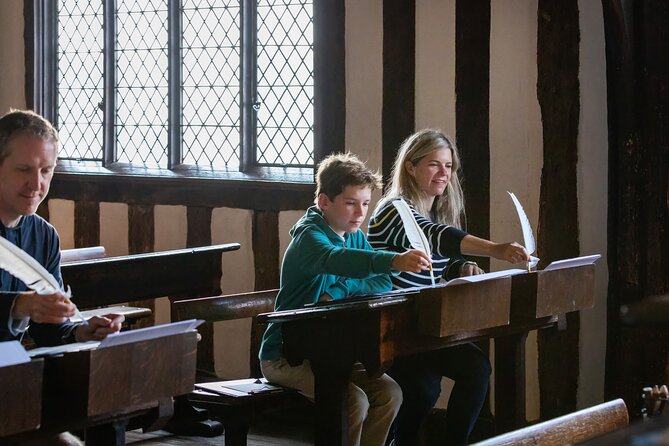
The hands-on activities are the strongest reason to bring children, though adults often enjoy them just as much. You can try writing with a quill and ink, which is far less tidy than using a modern pen. The mess is part of the fun, and the activity gives you a small sense of the patience required for historical writing.
The quill is not a long workshop. Some people felt they were moved out of the schoolroom too quickly after using it. If this activity matters to you, pay attention to the staff instructions and take your turn promptly. Crowds can shorten the amount of time available in the classroom.
Tudor games add another simple way to connect with the period. You can also dress in Tudor-style clothing for a photograph. The costume opportunity is lighthearted, but it breaks up the history and gives children a reason to stay engaged while adults listen to the explanations.
These activities are valuable because they turn abstract facts into physical memories. Latin is easier to remember after you have tried to repeat it in a classroom setting. Tudor writing makes the past feel less polished and more practical. Even the costume selfie helps you picture the period rather than treating it as a distant chapter in a book.
The staff are central to how well these features work. A warm schoolmaster can make the session funny and memorable. A less engaging presentation can have the opposite effect. One unhappy experience found the guide difficult to follow and left early, so this is not an attraction where the personality of the presenter is a minor detail.
How much time should you allow?
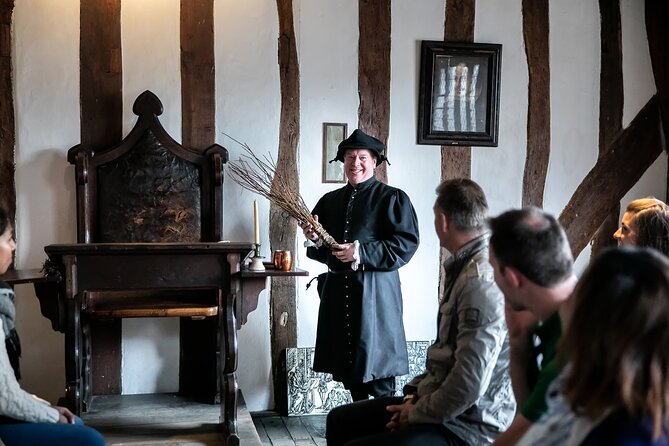
If you are fitting the Guildhall between other Stratford sights, allow at least one hour. That gives you time for the main explanations, the schoolroom, and the lesson without forcing every part of the visit.
A 30-minute visit may be enough if you are mainly interested in seeing the rooms and joining a brief activity. It is not the best plan if you want to watch the films, examine the wall paintings, take part in the lesson, try the quill, and ask questions.
I would allow extra time for a family visit. Children often need a moment to try the writing, see the costumes, and settle into the lesson. The advertised opening hours are 11:00 a.m. to 4:30 p.m. every day, so you have a useful daytime window, but do not arrive at the very end and expect a leisurely session.
The attraction is booked around 17 days ahead on average. That suggests some advance planning is sensible, especially during popular periods, although the ticket is mobile and the experience may allow entry at a time that suits your schedule. Check the exact booking details for your date.
Is $18.02 good value?
At $18.02, the price is reasonable if you want more than a quick photo stop. You get entry to a rare medieval Guildhall, guided interpretation, the schoolroom, and the Tudor lesson. The activities give the ticket more substance than a standard room-and-panel museum visit.
The best value comes from joining the teaching session. If you only walk through the building quickly, the cost may feel high for a small attraction. If you take part in the Latin lesson, handle a quill, explore the films, and ask questions, the visit feels much better priced.
The attraction also works well as a compact addition to a day in Stratford. You do not need to give it half a day, and it offers a change of pace from larger houses and formal museum displays. Shakespeare enthusiasts will find useful details about his early setting, while families get a practical activity that does not depend on already knowing the plays.
I would not choose it solely for grand interiors or a long guided tour. The building is historic, but the venue is small. Its value lies in the combination of place, story, and participation.
Who will enjoy this most?

I would recommend it most strongly to families with school-age children, Shakespeare fans, and adults who like historic sites with a human guide. The schoolroom makes the subject accessible even if you have not read many plays.
It suits children particularly well when they enjoy dressing up, asking questions, and trying practical tasks. Children must be accompanied by an adult, and some younger visitors may find the first part less engaging before the lesson begins.
It also suits solo visitors and couples who want a focused stop. You can learn about Shakespeare’s early life without committing to a long tour. The guides have been praised for answering questions and adding facts that go beyond the plays, so the experience can reward visitors who already know Shakespeare well.
You should be aware that group conditions affect the visit. School parties may make the Guildhall noisier and reduce the feeling of personal space. If a calm, slow visit matters to you, try to choose a less crowded time within the published opening hours.
The attraction is near public transportation, and service animals are allowed. Most people can participate, but the available information does not provide detailed access notes for every room, so contact the provider directly if you have specific mobility needs.
Booking, cancellation, and practical points
You receive confirmation when booking, and a mobile ticket is available. The experience is offered in English, with a guide and Tudor lesson included.
Free cancellation is available up to 24 hours before the start time for a full refund. Changes or cancellations made less than 24 hours before the experience are not accepted for a refund, and the cut-off uses local time.
Children need an accompanying adult. Service animals are permitted. Since opening hours are 11:00 a.m. to 4:30 p.m. daily for the stated periods, check your selected date before setting out.
Should you book Shakespeare’s Schoolroom?
I would book this experience if you want a lively, compact look at Shakespeare’s early life rather than another display about his famous plays. The schoolroom lesson, led by engaging figures such as Master Jenkins, is the main reason to go. Quill writing, Tudor dress, Latin, and the Council Chamber give the visit enough variety for a family outing.
I would be more cautious if you dislike costumed teaching, small museums, or guided interpretation that depends on the presenter. The first half may test younger children’s patience, and busy school groups can make the rooms feel rushed.
For most people spending a day in Stratford-upon-Avon, the price is fair and the experience adds context you will not get from the plays alone. Go with at least an hour available, aim to take part in the lesson, and do not hurry past the Guildhall’s medieval details. That is when this modest attraction earns its place on your itinerary.
FAQ
Where is Shakespeare’s Schoolroom and Guildhall?
It is in Stratford-upon-Avon, England.
How long does the experience last?
The approximate duration is 30 minutes to one hour. Some visits may take longer if you spend extra time with the films, activities, displays, and Tudor lesson.
What are the opening hours?
The attraction is open Monday through Sunday from 11:00 a.m. to 4:30 p.m. for the stated periods from April 1, 2024, through March 31, 2027.
Is the Tudor lesson included?
Yes. Admission includes a guide and the Tudor lesson.
Can I use a mobile ticket?
Yes. The experience accepts a mobile ticket.
Is the tour offered in English?
Yes. The experience is offered in English.
Can children take part?
Yes. Most people can participate, and the activities suit children, but children must be accompanied by an adult.
Just added around Stratford upon Avon
- Warwickshire & Stratford-Upon-Avon Self-Guided Audio Tours★ 5.0 · 6 reviews
- Cotswolds Walking Tour from Stratford-on-Avon or Moreton-in-Marsh★ 5.0 · 10 reviews
- Pasta Making Experience – Cooking Class★ 5.0 · 11 reviews
- Private Walking Tour in Warwick★ 5.0 · 13 reviews
- 1 Hour Archery Session in Warwick★ 5.0 · 14 reviews
- A Historical tour of Warwick with Queen Elizabeth’s Secret Lover★ 5.0 · 20 reviews
- Traditional Afternoon Tea Experience and Baking Class in Stratford-upon-Avon★ 5.0 · 23 reviews
- Clay Shooting Experience in Warwickshire★ 5.0 · 28 reviews
Shakespeare Tours, compared.



Shakespeare’s Stratford-upon-Avon Day Trip by Coach
Read our review →
The Sinister Side of Shakespeare’s Stratford Walking Tour
Read our review →
Full Day Cotswolds Tour & Shakespeare’s Stratford From London
Read our review →

Shakespeare in the City Walk – In Shakespeare’s footsteps North of the Thames
Read our review →
Stratford-Upon-Avon Audio Walking Tour: Shakespeare’s Life
Read our review →Browse the lists this tour appears in