
Reviewed · RIVER THAMES CRUISES
Thames Beachcombing
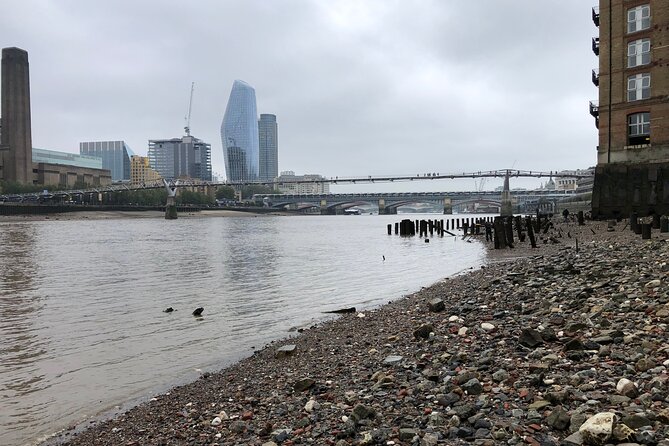
London keeps its secrets in the mud. Thames beachcombing lets you search for them by hand, walking the river foreshore at low tide with a local guide who can explain what you find. I like the hands-on format and the chance to spot genuine fragments of London’s past, including clay pipes, pottery, tiles, and objects linked to earlier centuries. I also like the small-group setup, which gives you a fair chance to ask questions.
The main catch is that the exact foreshore location and start time change through the year. You will not know the meeting details until the guide contacts you, and the quality of the search can vary from one stretch of riverbank to another. If you expect a guaranteed haul of spectacular artifacts, you may be disappointed. If you enjoy the search itself, this is a lively and unusual way to spend two hours in London.
In This Review
- Key points about Thames Beachcombing
- What mudlarking on the Thames is really like
- Why the changing meeting point matters
- The first few minutes: gloves, bags, and a lesson in looking
- Searching the foreshore for pottery, pipes, and tiles
- Robert’s role at the end of the search
- How much history will you actually find?
- Boots, fitness, and family considerations
- Is $41.41 a fair price?
- The weather and cancellation issue
- Who will enjoy this Thames experience most?
- Should you book Thames Beachcombing?
- FAQ
- Where does Thames Beachcombing take place?
- How long does the activity last?
- What is mudlarking?
- What might I find?
- Are gloves and bags provided?
- What should I wear?
- Can children join the activity?
- How large is the group?
- What happens if bad weather cancels the tour?
Key points about Thames Beachcombing
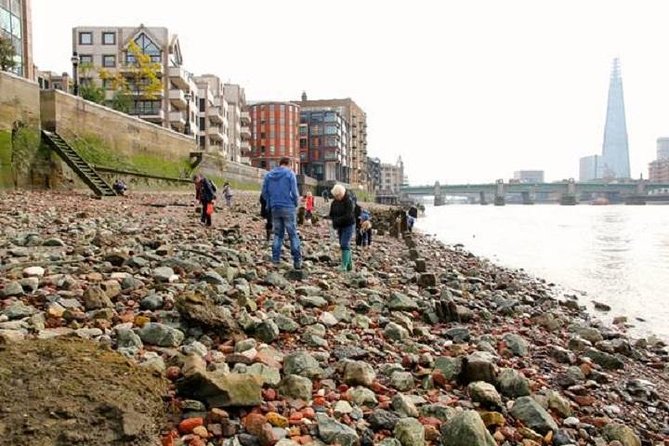
- Low-tide searching: Walk the Thames foreshore for about 1.5 hours, looking for objects exposed by the receding water.
- Finds with a London story: You might spot clay pipes, pottery fragments, roof tiles, ceramics, and other small pieces washed onto the shore.
- Guide Robert’s personal help: Robert has helped visitors identify finds, sort the interesting pieces from ordinary debris, and connect objects with London’s past.
- Small-group feel: The advertised group limit is no more than 20 people, with the tour often described as small enough for individual attention.
- Simple equipment provided: Gloves and plastic bags are included, but you need sturdy wellington boots or hiking boots.
- A family-friendly hunt: Children under 16 can join with an adult, and children as young as five have enjoyed the search, though the supplied gloves may be too large for very small hands.
What mudlarking on the Thames is really like
Mudlarking is part treasure hunt, part history lesson, and part slow walk along a very uneven riverbank. The Thames foreshore is exposed only at low tide, so the timing matters. As the water drops, bits of pottery, tile, glass, clay pipe, and other discarded objects can appear among the stones and mud.
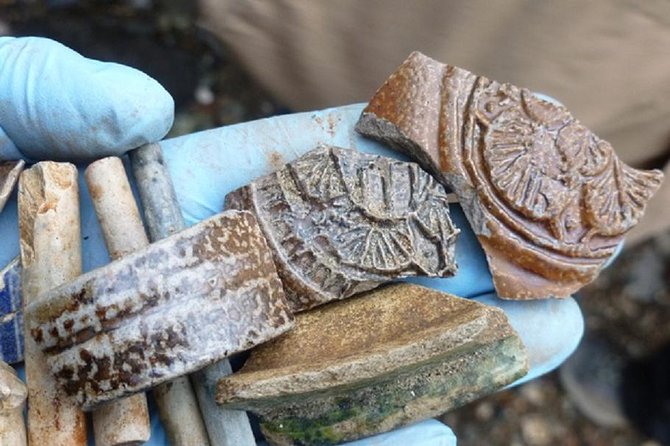
You are not heading out with a metal detector or digging equipment. The activity is based on looking carefully with your eyes and picking up suitable objects from the surface. That makes the experience simple, accessible, and surprisingly absorbing. You may spend several minutes finding nothing more exciting than modern debris, then notice a shaped piece of ceramic or a small clay-pipe fragment under your boots.
Your guide provides gloves and plastic bags at the start. The gloves are useful because the foreshore can be muddy and the objects are not always clean. They also make it easier to handle small finds without immediately coating your hands in Thames mud.
The search lasts about 1.5 hours within a two-hour experience. That gives you enough time to settle into the rhythm of scanning the ground, moving along the shore, and comparing finds with the people around you. The pace is described as leisurely rather than rushed, which suits the activity. You need time to train your eyes.
More cruises on the Thames:
- London Big Bus Hop-On Hop-Off Tour with Optional River Cruise
★ 3.5 · 10,803 reviews - High-Speed Thames River Speedboat in London
★ 5.0 · 3,971 reviews - London Tootbus Hop on Hop off Bus Tour and Thames River Cruise
★ 4.0 · 3,834 reviews
Why the changing meeting point matters
This is not a standard London tour with a fixed departure point every morning. The group visits different parts of the Thames foreshore during the year, and the guide provides the exact place and time after booking.
That flexibility can be useful. Different sections of the river expose different material, and changing the location gives the guide room to work with the tide and conditions. It also means you may search near a different London landmark or riverside district than you expected.
The tradeoff is planning. You should not assume that the tour starts below a particular bridge or near one famous riverside attraction. Wait for the guide’s message, then check your route carefully. The meeting point is in London, close to public transportation, and the activity ends back where it begins.
This changing schedule is one reason I would not book the tour as a tight connection between two other appointments. Tide times and meeting details shape the morning, and you will enjoy it more if you leave room before and after.
The first few minutes: gloves, bags, and a lesson in looking
At the meeting point, the guide gives you gloves and a bag, then explains what to look for. This introduction matters more than it may sound. A broken tile can look like ordinary rubble until someone points out its age or explains how its shape and surface offer clues.
Robert has used photographs to show children and adults the kinds of things they might find. That small bit of preparation helps you get your eyes working. Instead of wandering without a clue, you begin scanning for colors, edges, markings, and unusual shapes.
The guide also helps set expectations. There may be plenty of objects on the shore, but not every piece is worth keeping or even old. The most useful part of the final discussion is learning how to separate an interesting fragment from plain junk.
The group limit is listed as a maximum of 20 people, while the experience is also promoted as a small-group activity of no more than 15. In practice, the key point is that this is not designed as a giant crowd. Some groups have looked fairly large, yet there was still enough room for people to search without being packed together.
Searching the foreshore for pottery, pipes, and tiles
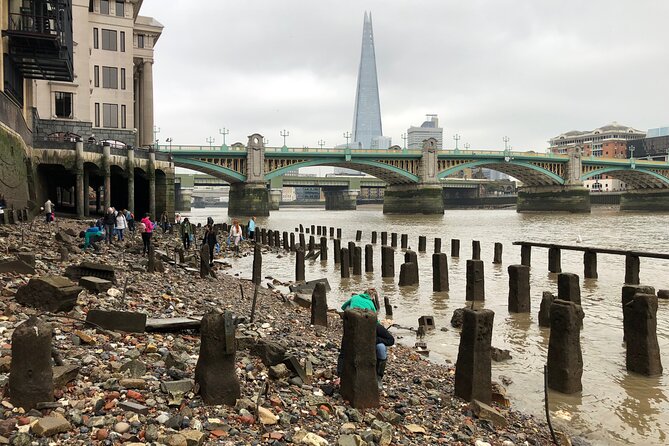
The central part of the experience is wonderfully basic: you walk, look down, and search. The foreshore is stony and can be muddy, so you should expect an uneven surface rather than a smooth riverside path.
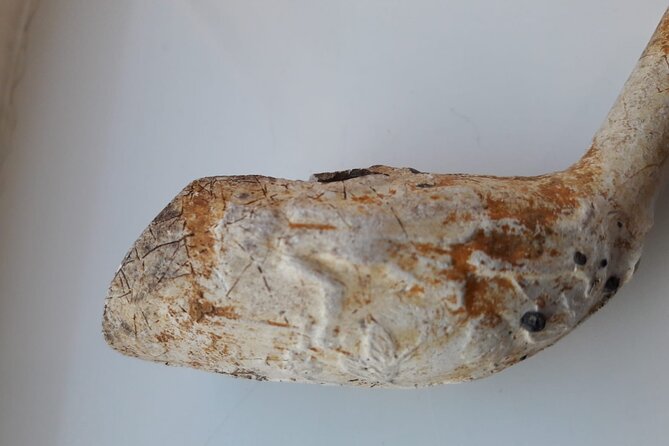
You might find fragments of pottery, roof tiles, ceramics, clay pipes, and other small objects. Some pieces may be only a few centimeters across. Their appeal comes from their age, shape, or connection to ordinary life in earlier London. A broken bowl handle with a fingerprint impression can tell a more intimate story than a grand monument. It suggests the person who shaped the clay by hand.
Some particularly memorable finds described during this experience include tiles dating from before the Great Fire of London. That does not mean every outing will produce a pre-fire object. The foreshore is unpredictable, and the quality of the finds depends partly on the stretch of river being visited and what the tide has revealed.
This uncertainty is central to the fun. You are not walking toward a guaranteed display case. You are searching through fragments and learning to notice details. If you like hunting for small clues, the activity can feel almost meditative. If you need constant narration or a sure historical prize, the slower pace may test your patience.
Something different for another day:
- Stonehenge, Windsor Castle, and Bath from London
★ 4.5 · 18,662 reviews - London Small Group Tour of Historical Pubs
★ 5.0 · 10,422 reviews - Stonehenge, Windsor Castle and Bath with Pub Lunch in Lacock
★ 4.5 · 7,402 reviews - Tower of London and Crown Jewels Exhibition Ticket
★ 4.5 · 6,677 reviews
Robert’s role at the end of the search
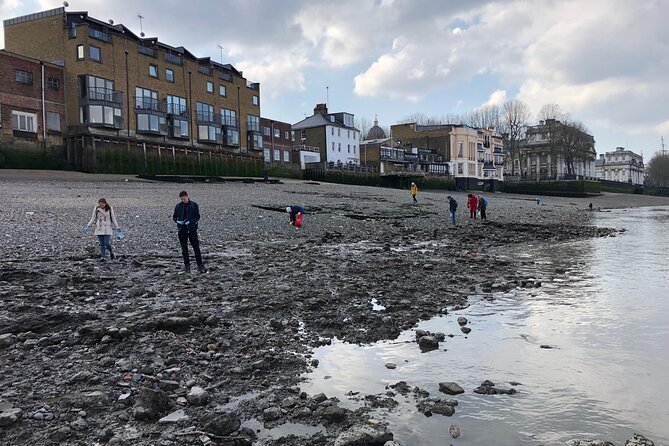
The guide’s help becomes especially valuable when everyone returns with a bag of fragments. Robert examines the objects, explains what they may be, and gives historical context. He can help distinguish pottery from tile, identify clay-pipe pieces, and sort more notable finds from common debris.
This final session turns a pleasant walk into a proper learning experience. You hear about your own objects, but you also learn from what other people have found. One person may have a tile, another a ceramic fragment, and someone else a small piece that shows how an item was made. Taken together, the collection gives you a clearer sense of the river as a place where centuries of daily life have gathered.
The strongest praise for this tour centers on the guide’s approachable manner and ability to explain finds. That is important because mudlarking without interpretation can become simple beachcombing. The guide supplies the missing context.
There is some variation in the experience. One outing at Putney Bridge was described as enjoyable but less inspiring because the guide did not bring much energy. That is a useful warning: the quality of the commentary can affect the experience, even though the search itself remains in your hands.
How much history will you actually find?
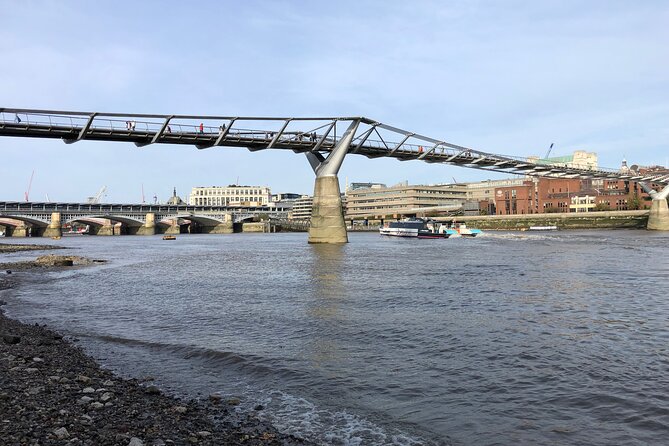
You may find something old. You may also find very little. Both outcomes fit the nature of the activity.
The Thames has received discarded objects for centuries, but the foreshore is not an archaeological display arranged for easy viewing. Mud, stones, water, light, and location all affect what you notice. A skilled guide improves your odds by showing you what to look for, but cannot promise a particular object.
The best finds are not always the oldest or most dramatic. A fragment with a visible fingerprint, a patterned piece of pottery, or a tile from before the Great Fire can make the past feel close and human. You are not simply hearing a date. You are holding part of an object made and used by someone long ago.
I would bring a sense of curiosity rather than a collector’s checklist. The activity works best when the search is the main event and the find is a bonus. Even an outing with modest discoveries can be worthwhile if Robert gives clear explanations and you enjoy learning how to read the shore.
Boots, fitness, and family considerations
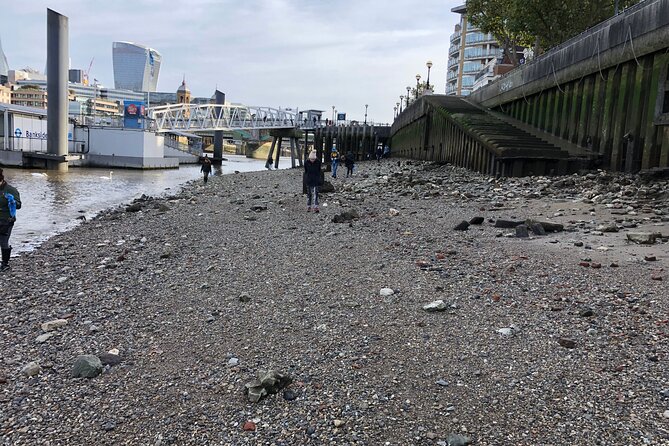
Wear wellington boots or hiking boots. This is not optional fashion advice. The foreshore is stony and may be muddy, and ordinary city shoes will make the walk less comfortable. Clothing that can tolerate a splash or smear of mud is sensible.
You should have a moderate level of physical fitness. The activity involves walking on uneven ground and spending time looking down, bending, and moving across stones. It is not described as a strenuous hike, but it is more demanding than a flat pavement stroll.
Children under 16 must be accompanied by an adult. Families have successfully brought children aged five, eight, and nine, with the hunt holding their attention for the full session. The activity gives children a direct way to connect with London’s past, especially when they find a clay pipe or an unusual piece of pottery.
The supplied gloves may be too large for a five-year-old. If you are bringing a very young child, consider bringing a smaller pair from home. That simple preparation can prevent constant glove slipping and keep the search fun.
Is $41.41 a fair price?
At $41.41 per person, the value comes from the guide, the access to a tidal foreshore activity, and the interpretation of your finds. Gloves and bags are included, and there are no extra admission charges listed.
The price is reasonable if you want an unusual, hands-on London experience rather than another view from a museum gallery. You are paying for about two hours, with roughly 1.5 hours devoted to searching and the rest used for setup and identifying objects.
The value is weaker if you measure tours by the number of major sights visited or by guaranteed souvenirs. This is a focused activity. You spend most of your time on one stretch of riverbank, and the reward depends on your patience and luck.
I see it as good value for people who enjoy small discoveries and guided interpretation. It is less suitable for anyone who wants a packed sightseeing program or a certain number of valuable artifacts.
The weather and cancellation issue
The experience requires good weather. If poor weather causes a cancellation, you are offered a different date or a full refund.
That policy is sensible for an activity on an exposed, muddy foreshore, but it adds some uncertainty to your schedule. I would avoid booking it on the only available morning of a short London visit if a cancellation would cause major problems.
You can cancel for a full refund up to 24 hours before the start time. Changes or cancellations made less than 24 hours before the experience are not accepted for a refund. The cut-off uses local London time, so keep that in mind if you are booking from another time zone.
Who will enjoy this Thames experience most?
I would recommend Thames Beachcombing to:
- People who like history in small, tangible pieces
- Families with children who enjoy searching and collecting
- Visitors who have already seen London’s major sights and want something different
- Anyone interested in pottery, ceramics, old building materials, or clay pipes
- People who prefer a slow, hands-on activity to a formal guided walk
- Repeat visitors looking for a new way to see the Thames
I would hesitate to recommend it to anyone with difficulty walking on uneven ground, anyone unwilling to get muddy, or anyone expecting a guaranteed archaeological discovery. The experience depends on curiosity, patience, and conditions.
Should you book Thames Beachcombing?
Book it if the idea of finding a small piece of London beneath your boots sounds more exciting than ticking off another attraction. The strongest parts are the hands-on search, Robert’s help identifying objects, the relaxed pace, and the chance to find items such as pottery fragments, clay pipes, or pre-Great Fire tiles.
Before booking, accept three facts: the meeting location changes, the shore can be muddy and stony, and no one can promise a spectacular find. Bring suitable boots, leave space in your schedule, and treat the object hunt as the experience rather than a guaranteed haul.
For about $41.41, this is a distinctive and fairly priced London activity for curious adults and families. It offers a direct connection with the city’s past, one fragment at a time.
FAQ
Where does Thames Beachcombing take place?
The group visits different sections of the River Thames foreshore during the year. The guide provides the exact meeting location and start time after booking.
How long does the activity last?
The experience lasts approximately two hours. About 1.5 hours is spent searching the foreshore for objects.
What is mudlarking?
Mudlarking is beachcombing along the Thames foreshore at low tide, looking for objects exposed or washed ashore.
What might I find?
You might find clay pipes, pottery fragments, tiles, roof tiles, ceramics, and other objects visible on the foreshore.
Are gloves and bags provided?
Yes. Gloves and plastic bags are included.
What should I wear?
You should wear wellington boots or hiking boots because the foreshore is stony and can be muddy.
Can children join the activity?
Yes. Children under 16 must be accompanied by an adult.
How large is the group?
The maximum listed group size is 20 people. The experience is also described as a small-group activity with no more than 15 people.
What happens if bad weather cancels the tour?
You will be offered a different date or a full refund if the experience is canceled because of poor weather.
Just added around London
- The Private British Museum Tour★ 5.0 · 6 reviews
- London to Southampton Cruise Port | Private Transfer★ 5.0 · 6 reviews
- London’s Chinatown Food Experience★ 4.0 · 6 reviews
- London Gatwick (LGW) Airport Departure Private Transfer – Hotel to Airport★ 4.0 · 6 reviews
- Christmas in Canterbury, Dover and Greenwich with Christmas Lunch★ 4.5 · 6 reviews
- Transfer from Heathrow Airport to London hotel on private car★ 4.5 · 6 reviews
- Jazz Notes – Jazz Jam Ticket★ 5.0 · 6 reviews
- Street Photography Workshops in London★ 5.0 · 6 reviews
River Thames Cruises, compared.

London Big Bus Hop-On Hop-Off Tour with Optional River Cruise
Read our review →

London Tootbus Hop on Hop off Bus Tour and Thames River Cruise
Read our review →
Westminster to Greenwich Sightseeing Thames Cruise in London
Read our review →

London In One Day Tour with River Cruise & London Eye Option
Read our review →
Uber Boat – Single Journey River Thames Cruise
Read our review →
Browse the lists this tour appears in