
Reviewed · CANTERBURY TOURS
The Canterbury Classic Tour
Canterbury rewards slow footsteps. This 90-minute walking tour links the city’s best-known landmarks with odd little details, from a dove flying into a pope’s ear to a bull’s head on Butchery Lane. I especially like the small group limit of 10 and guide Sam’s mix of solid facts, legends, architecture, and humor. The main drawback is that most stops last about five minutes, so you get a lively overview rather than long visits inside major attractions.
The tour also gives you a useful first look at Canterbury beyond its cathedral. You’ll hear about Geoffrey Chaucer, Christopher Marlowe, Thomas Becket, Roman Canterbury, wartime discoveries, and medieval defenses in a compact walk through the city center. Since it is almost entirely outdoors, weather matters, and admission fees for places such as Westgate Towers are not included.
In This Review
- Key points at a glance
- Starting beside The Beaney House
- Geoffrey Chaucer and the city’s literary identity
- Westgate Towers and medieval city defense
- Christopher Marlowe beside the modern theatre
- Christ Church Gate and Tudor surprises
- Roman Canterbury on Butchery Lane
- Thomas Becket and the city’s defining story
- St George’s Tower and a city that keeps changing
- What makes Sam’s guiding effective
- Price, pace, and practical value
- Who should book the Canterbury Classic Tour?
- Should you book it?
- FAQ
- Where does the Canterbury Classic Tour start?
- Where does the tour finish?
- How long does the tour last?
- How much does the tour cost?
- How many people can join the tour?
- Is the tour offered in English?
- Are attraction admission fees included?
- Is the tour suitable for most people?
- Can I cancel for a refund?
Key points at a glance
- Small groups capped at 10: You get a better chance to ask questions and hear the guide clearly.
- A smart first-day introduction: The route helps you decide which museums, gardens, walls, and historic sites to explore later.
- Stories behind ordinary streets: Shopping lanes and city buildings become clues to Canterbury’s Roman, medieval, Tudor, and modern past.
- A lively guide named Sam: His storytelling, humor, and ability to involve children are the experience’s most praised features.
- A compact central route: The walk begins beside The Beaney and ends beneath St George’s Tower, with no transport needed between stops.
- Good value at $19.44: For the price of a casual meal or less, you get personal commentary across roughly an hour and a half.
Starting beside The Beaney House
The meeting point is outside The Beaney House of Art and Knowledge at 18 High Street. This is a practical place to begin because it sits in the city center and has facilities you can use before the walk starts.
You do not spend the tour inside The Beaney, but its location sets the tone. Canterbury is not just a cathedral town. Art, literature, civic buildings, old lanes, churches, and commercial streets all overlap here, and the walk begins in the middle of that mix.
A small group makes a difference right away. With no more than 10 people, you should be able to stay close to the guide and ask about details that catch your eye. A larger group can turn a walking tour into a slow procession, but this format is better suited to conversation.
The tour is offered in English and uses a mobile ticket. It lasts approximately one hour and 30 minutes, though one account describes a slightly longer experience of about one hour and 45 minutes. I would plan for at least 90 minutes and avoid scheduling a tight connection immediately afterward.
Other England trips people book alongside this one:
- Stonehenge, Windsor Castle, and Bath from London
★ 4.5 · 18,662 reviews - London Big Bus Hop-On Hop-Off Tour with Optional River Cruise
★ 3.5 · 10,803 reviews - London Small Group Tour of Historical Pubs
★ 5.0 · 10,422 reviews
Geoffrey Chaucer and the city’s literary identity
The first formal stop is the statue of Geoffrey Chaucer. He wrote The Canterbury Tales, the work most closely linked with the city in English literature, so this is a natural opening point.
The value here is not simply learning who Chaucer was. The stop places Canterbury in the tradition of pilgrimage, storytelling, and travel writing. You begin to see the city as a place shaped not only by kings and bishops, but also by the people who passed through it and told stories about what they saw.
This is also a good example of the tour’s approach. You are not asked to memorize a long lecture. Instead, the guide uses a visible landmark as a doorway into a larger subject. The statue gives you a fixed point, while the story gives the surrounding streets more meaning.
Westgate Towers and medieval city defense
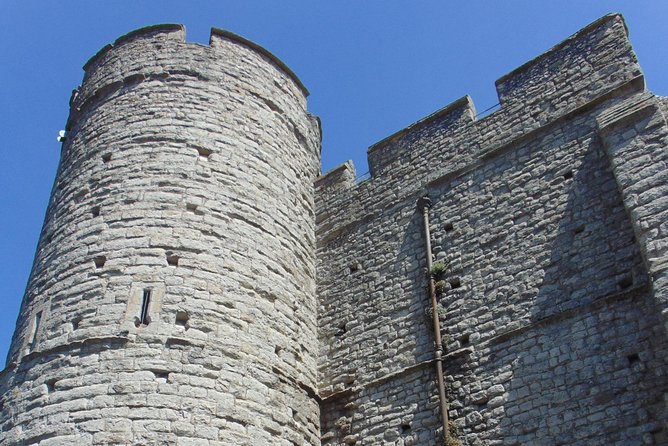
Westgate Towers is one of the route’s strongest visual stops. Built during a turbulent period, it is the largest surviving medieval city gate in the United Kingdom. The guide explains how attackers might approach and how the tower’s design helped defend the city.
You will hear about several methods of attack and defense, including a story connected with the gate’s later use as a prison. That detail helps the building feel less like a silent stone monument and more like a working part of Canterbury’s public life.
The tour stops outside the museum and viewpoint. Admission is not included, so you should treat the walk as an introduction rather than a substitute for going inside. If you want to explore the tower’s displays or views, set aside extra time and pay separately.
This is one of the clearest places where the tour’s short-stop format has a limit. Five minutes is enough to understand why Westgate matters, but not enough for a full visit. The guide gives you the reason to return.
Christopher Marlowe beside the modern theatre
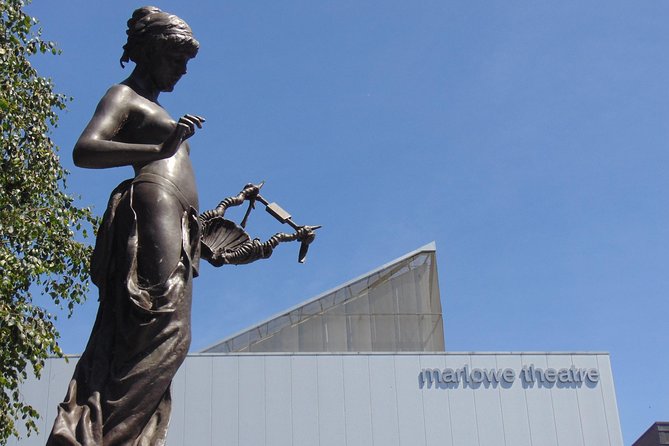
The route then passes The Marlowe Theatre, a modern building with a name tied to one of Canterbury’s most intriguing figures. Christopher Marlowe was a playwright, but his life also involved spying, danger, and hard living.
The guide uses Marlowe to show how Canterbury’s cultural past is not confined to medieval religious history. The written word has shaped the city across several centuries, from Chaucer to Marlowe and beyond.
You do not go into the theatre, and no admission is included. That is not a problem if you see this stop as a brief piece of context. It adds variety to the walk and keeps the focus on the city as a whole rather than on one period.
I particularly like this change of pace. After medieval stonework and religious stories, Marlowe brings drama, theater, and a darker human edge. His story is likely to appeal to adults and older teenagers who enjoy historical figures with complicated lives.
Something different for another day:
- Beatles Magical Mystery Tour
★ 5.0 · 9,266 reviews - Liverpool: “Blue Route” – City & Beatles Tour
★ 5.0 · 8,562 reviews - Stonehenge, Windsor Castle and Bath with Pub Lunch in Lacock
★ 4.5 · 7,402 reviews - Oxford University Walking Tour With University Alumni Guide
★ 5.0 · 6,905 reviews
Christ Church Gate and Tudor surprises
Christ Church Gate marks the entrance to the cathedral precinct. It was completed to honor a Tudor prince and his Spanish bride, though not the royal couple many people first assume.
That small correction is exactly the kind of detail that makes a guided walk useful. You may know the gate is old and important, but a guide can explain why it was built, whom it commemorated, and how its role changed over time.
The stop is outside the gate, with no cathedral admission included. This keeps the tour inexpensive, but you should know that the famous cathedral itself is not part of the walking-tour ticket. If Canterbury Cathedral is a main reason for your visit, plan a separate visit.
Christ Church Gate also helps you understand Canterbury’s layers. Roman foundations, medieval religious power, Tudor politics, and modern tourism all meet within a short distance. The tour keeps showing you how today’s city grew around older uses.
Roman Canterbury on Butchery Lane
Outside the Canterbury Roman Museum, the guide explains the Roman city and how it was rediscovered after the Second World War. The wartime connection gives this section a strong sense of surprise. Ancient remains were not simply sitting untouched for centuries, waiting to be admired. Their recovery depended on later events and changing views of the city.
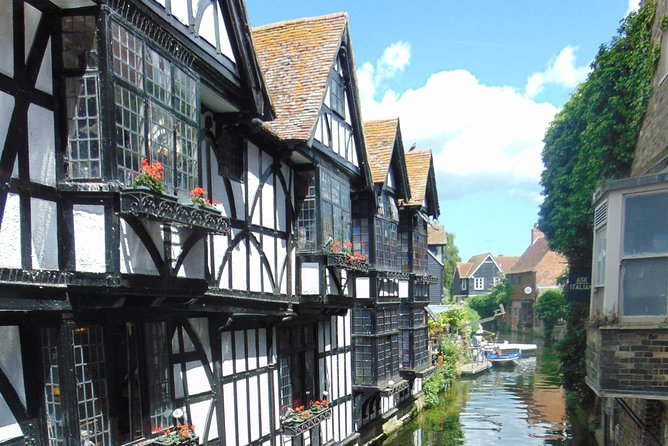
Butchery Lane adds several quick visual clues. You may look up toward Bell Harry Tower at the cathedral, notice the city coat of arms, and hear why a bull’s head appears in the area. These details reward attention. You might walk past them alone without asking what they mean.
The Roman Museum itself is not included in the tour. Five minutes outside is enough to point you toward it, but not enough to see its collections. I would consider returning if Roman Canterbury interests you, especially because the walk gives you a reason to connect the museum with the streets outside.
This section also illustrates the tour’s broad time span. In a short distance, you move from Roman urban life to medieval religion and later city traditions. The guide’s job is to connect those periods without making the walk feel like a classroom lesson.
Thomas Becket and the city’s defining story
At St Thomas of Canterbury Roman Catholic Church, the subject turns to Thomas Becket. He is perhaps the most famous person associated with Canterbury, although he was not born there.
The guide presents the full story of Becket and his importance to the city. You also hear about the place where the knights stayed before killing him, a detail that brings the famous event down to street level. Instead of treating the murder as a distant textbook episode, the tour connects it to actual places you can see.
This is likely to be one of the most substantial historical stops. Becket’s death changed Canterbury’s importance as a destination and shaped the city’s religious identity for centuries. The tour does not take you into the cathedral, but it gives you useful context before you visit it.
There is also a wonderfully strange detail nearby: Pope Gregory the Great is shown with a dove flying into his ear. The image sounds improbable until you see it, and it captures the tour’s balance between serious history and Canterbury’s odd visual surprises.
St George’s Tower and a city that keeps changing
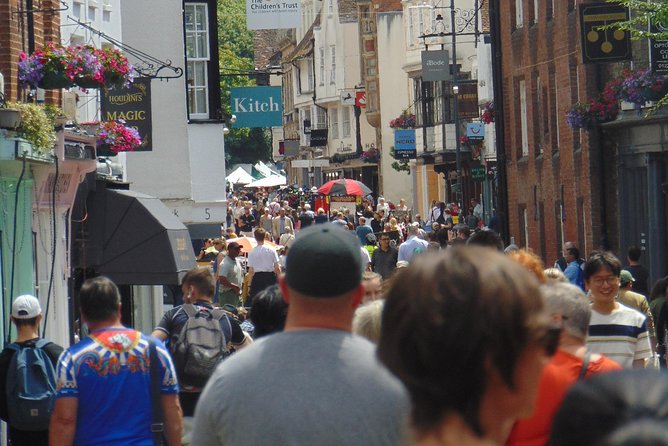
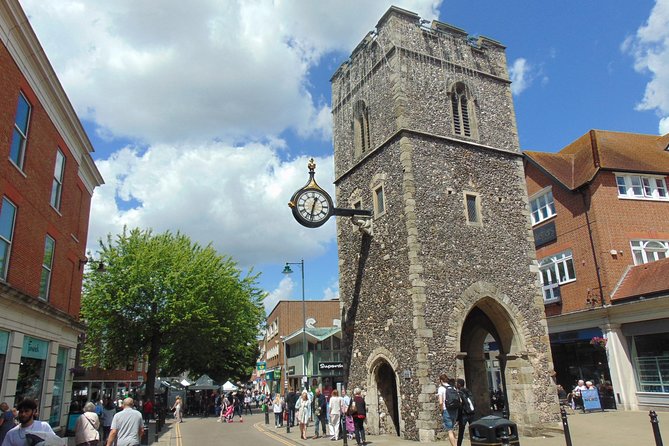
The walk ends beneath St George’s Tower at 27 St George’s Street. This curious clock tower is the remaining feature of the former St George’s Church, now surrounded by shops and everyday city activity.
Ending here makes sense. The tower shows how Canterbury’s past has not been preserved in one sealed historic quarter. Old structures remain in the middle of streets people use for shopping and errands. The guide explains how the tower became a reminder of the past while the surrounding area changed around it.
The endpoint is central, so you can continue exploring after the tour. The experience does not return you to The Beaney, but the starting and ending points are both within the city center. That makes the route convenient for combining with other Canterbury plans.
What makes Sam’s guiding effective
Sam receives the strongest praise for being entertaining, friendly, and well prepared. The important point is not just that he knows facts. He explains them through stories, questions, architecture, legends, and small observations that keep you looking around.
His relaxed style appears to work for different ages. Families describe children aged six, 10, 11, and teenagers staying involved, which is useful if you are planning a walk with young people. Historical tours can lose children quickly, but short stops and unusual details such as the dove and bull’s head give them things to watch for.
Sam also appears comfortable with questions. A small group makes that easier, and one-person departures have still received the same energy as larger groups. That matters if you are visiting outside the busiest periods and worry that a tour may feel awkward with a very small turnout.
The guide’s enthusiasm is especially valuable in Canterbury, where many important buildings are easy to pass without understanding. A stone gate, church tower, theater, coat of arms, or old street can look attractive but mute. Good commentary gives each one a reason to matter.
Price, pace, and practical value
At $19.44 per person, this is a strong-value introduction to Canterbury. You get approximately 90 minutes of live guiding, a route covering literary, Roman, medieval, Tudor, religious, and modern subjects, and a group capped at 10.
The price is most useful if you are new to the city. You can learn the layout, hear which places deserve more of your time, and avoid spending your first few hours wandering without context. Several people use walks like this at the start of a visit, and that is the approach I recommend here.
The tour does not include entry to Westgate Towers Museum, the Canterbury Roman Museum, or Canterbury Cathedral. That keeps the cost down, but you should add those admission costs if you want to see the interiors.
The pace is gentle enough for most people. Canterbury is compact and described as flat, so the route is manageable for many participants. Still, you are on foot for the full experience, and uneven historic streets or cold, wet weather may affect comfort. Wear sensible shoes and bring protection from rain or cold.
Service animals are allowed, and the tour is near public transportation. Most people can take part, though the supplied information does not give a detailed step-free route or specific mobility arrangements. If you need those details, confirm them before booking.
Free cancellation is available if you cancel at least 24 hours before the start time. Changes or cancellations made within 24 hours are not accepted for a refund.
Who should book the Canterbury Classic Tour?
I would choose this walk if you are visiting Canterbury for the first time, especially if you want orientation before selecting museums and historic interiors. It also suits families, couples, solo visitors, and anyone who prefers stories over a long formal lecture.
It is a good fit for people who enjoy details. You will not only see the main landmarks. You will hear why a gate was built, how a prison entered the story, where Roman remains were found, and why an unexpected bull and dove appear in the city’s visual record.
You may want something else if you prefer extended time inside museums or a cathedral tour. This is a city walk with short commentary stops, not an admission-inclusive experience. You should also think twice about booking on a day when cold or wet weather would spoil an outdoor activity.
The tour is often booked about 33 days ahead, so planning early is sensible if your dates are fixed. The 10-person cap is a real part of the value, not just a marketing detail. A small group gives Sam room to answer questions and adjust his storytelling to the people in front of him.
Should you book it?
Book the Canterbury Classic Tour if you want a friendly, story-led introduction to a compact historic city. At $19.44, it gives you a useful framework for the cathedral, Roman museum, city gates, churches, theaters, and streets you will see afterward.
I would schedule it near the beginning of your stay, bring comfortable shoes, and leave time after the walk for at least one interior visit. You will get the most from it if you treat the tour as a key to Canterbury rather than the whole collection of sights.
FAQ
Where does the Canterbury Classic Tour start?
It starts outside The Beaney House of Art and Knowledge at 18 High Street, Canterbury, CT1 2RA.
Where does the tour finish?
It finishes beneath St George’s Tower at 27 St George’s Street, Canterbury, CT1 2LE. The endpoint is beneath the clock tower of the former St George’s Church.
How long does the tour last?
The tour lasts approximately one hour and 30 minutes. One account describes a duration of about one hour and 45 minutes, so allow a little extra time.
How much does the tour cost?
The listed price is $19.44 per person.
How many people can join the tour?
The group is capped at 10 travelers.
Is the tour offered in English?
Yes. The tour is offered in English.
Are attraction admission fees included?
No. Admission to places such as Westgate Towers Museum and the Canterbury Roman Museum is not included. The route also passes outside these attractions.
Is the tour suitable for most people?
Most travelers can participate, and the route is near public transportation. Canterbury is described as flat and compact. Service animals are allowed.
Can I cancel for a refund?
Yes, if you cancel at least 24 hours before the experience start time. Cancellations or changes made less than 24 hours before the start time are not accepted for a refund.
Just added around England
- The Private British Museum Tour★ 5.0 · 6 reviews
- London’s Chinatown Food Experience★ 4.0 · 6 reviews
- London to Southampton Cruise Port | Private Transfer★ 5.0 · 6 reviews
- London Gatwick (LGW) Airport Departure Private Transfer – Hotel to Airport★ 4.0 · 6 reviews
- Christmas in Canterbury, Dover and Greenwich with Christmas Lunch★ 4.5 · 6 reviews
- Transfer from Heathrow Airport to London hotel on private car★ 4.5 · 6 reviews
- Bristol private pub hopping and sightseeing with local guide★ 5.0 · 6 reviews
- Isle of Wight Tour App, Hidden Gems Game and Big Britain Quiz (7 Day Pass) UK★ 4.0 · 6 reviews
Canterbury Tours, compared.
Official Canterbury Guided Walking Tour – 11.00 Tour
Read our review →
Official Canterbury Guided Walking Tour – 14.00 Tour
Read our review →

Cultural Homestay Exploring London, Oxford and National Parks
Read our review →


Browse the lists this tour appears in