
Reviewed · WALKING TOURS
Women of Whitechapel 2 hour Walking Tour
Women changed Whitechapel in ways easy to miss. This walking tour brings those stories into view, from women active in wartime resistance to philanthropists, anarchists, workers, and lone residents of eighteenth-century Spitalfields. I like the focused theme and the way the route links ordinary streets with major social change. I also like the convenient start near Whitechapel Road and finish at Liverpool Street Station.
The main consideration is the walking. The tour lasts about two to three hours, with several stops across East London, so good shoes and weather-ready clothing matter. The route includes busy streets, market areas, and historic lanes, and the experience requires a moderate level of fitness.
In This Review
- Key points to know before you book
- Why women’s history changes the way you see Whitechapel
- Whitechapel Road: resistance, charity, and anarchist ideas
- Brick Lane: migration, work, and quiet revolutions
- Princelet Street: Huguenot houses and women living alone
- Spitalfields Market: revolution in a market district
- Stepney Green: private lives and the anarchist headquarters
- What the $27.53 price really buys you
- Timing, clothing, and the walking effort
- Who will get the most from this Whitechapel walk
- Should you book Women of Whitechapel?
- FAQ
- How long does the Women of Whitechapel tour last?
- Where does the tour begin?
- Where does the tour end?
- What areas does the tour visit?
- Who guides the tour?
- What does the tour focus on?
- Is food or drink included?
- Can I cancel for a full refund?
Key points to know before you book
- Women’s stories take center stage: Learn about Sylvia Pankhurst, Mary Wollstonecraft, Sara Wesker, philanthropists, workers, and women connected with resistance movements.
- The route covers five distinct areas: Whitechapel Road, Brick Lane, Princelet Street, Spitalfields Market, and Stepney Green.
- Mandy leads the walk: Her style is warm, engaging, and packed with details about overlooked landmarks, women, food, and London life.
- It begins at 277 Whitechapel Road: The meeting point is near public transport, and the walk ends at Liverpool Street Station.
- The group can reach 30 people: That keeps the price low, though a larger group may feel less personal than a private walk.
- The price is about $27.53 per person: For a two to three hour guided walk, that is a fair price if you enjoy social history and careful local interpretation.
Why women’s history changes the way you see Whitechapel
Whitechapel is often reduced to a few familiar subjects: Jack the Ripper, poverty, immigration, and old markets. This walk takes a better route. It asks who lived, worked, organized, fed families, resisted authority, and shaped local life, with women at the center of the story.
I like that approach because it gives you more than a string of famous names. You hear about women connected with the First World War resistance, female philanthropists in the late 1800s, anarchist circles in the 1890s, and women who made quiet changes in their homes and communities. The focus is social history, not just grand buildings.
Your guide is Mandy, whose style comes through as friendly and engaging. Her explanations cover women, food, and London, and she points out landmarks that are easy to walk past without noticing. That makes this a good choice if you want a local guide to interpret the streets rather than simply lead you from one postcard view to another.
The tour has a 4.9 rating from 15 reviews, with all listed recommendations positive. That is a small sample, so I would not treat the number as a guarantee. Still, the praise is consistent: Mandy is described as kind, fun, informative, and able to make a group feel at ease.
More Walking Tours in London
- Tour for Muggles The Ultimate Harry Potter Walking Tour in London
★ 5.0 · 4,684 reviews - London Jack The Ripper Guided Walking Tour
★ 5.0 · 3,131 reviews - Changing of the Guard Guided Walking Tour in London
★ 5.0 · 1,793 reviews
Whitechapel Road: resistance, charity, and anarchist ideas
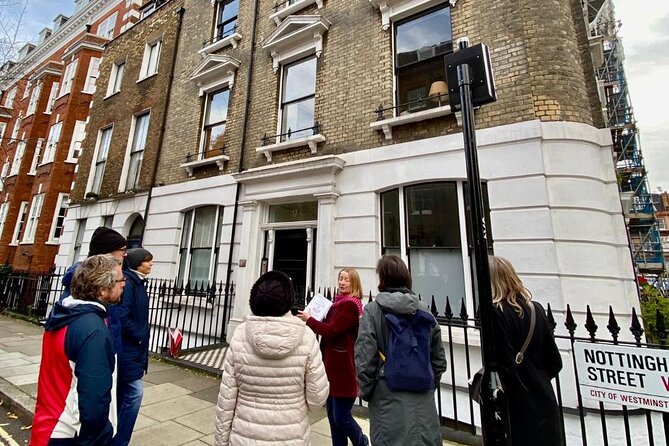
The walk begins at 277 Whitechapel Road, at a meeting point that is easy to reach by public transport. From here, you enter the high street and begin with the physical setting: grade II listed houses, churches, and mosques mixed into a busy East London thoroughfare.
This opening hour gives the tour its broadest historical sweep. You hear about brave women involved in First World War resistance and about female philanthropists working in the late nineteenth century. These subjects help explain how women acted in public life, even when they had limited power or few formal routes into politics.
The stop also takes you into the anarchist movement of the 1890s. That adds an important edge to the walk. Whitechapel was not only a place of hardship or immigration. It was also a meeting ground for people questioning the political and economic order of the day.
I would expect this section to offer the most context, but it is also the longest part of the route. If you prefer a quick succession of famous sights, an hour of discussion along a city street may feel slow. If you like connecting buildings and neighborhoods with political ideas, it is a strong beginning.
The area contains religious buildings and listed homes, but this is not a sightseeing tour built around entering major attractions. The value comes from what Mandy explains as you move through the streets. Bring your attention to doorways, facades, and small clues rather than expecting a series of formal admissions.
Brick Lane: migration, work, and quiet revolutions
Brick Lane receives about 20 minutes, but the subject reaches across several centuries. The area is linked with Monica Ali’s novel of the same name and with successive waves of migration, including Huguenot weavers, Jewish tailors, and Bangladeshi restaurant owners.
That sequence gives you a useful way to read the street. Brick Lane is not a place with one fixed identity. Its character has been shaped by people arriving, working, building communities, and changing the businesses and food of the area.
The women’s focus is especially useful here. Instead of treating migration as a story led only by male workers or public figures, the tour looks at women who acted as quiet revolutionaries. You may come away with a better sense of how family life, labor, food, and community networks affect a neighborhood over time.
The short stop means you will not receive an exhaustive account of every group that lived here. That is a fair trade on a route covering five areas. The guide’s job is to select stories that support the central theme, not to turn Brick Lane into a full standalone lecture.
If you enjoy food history, pay close attention. The tour connects women’s stories with the changing food culture of East London. Tea and coffee are available at a Huguenot shop during the walk, but the cost is not included, so carry money or a payment method if you want to stop.
Princelet Street: Huguenot houses and women living alone
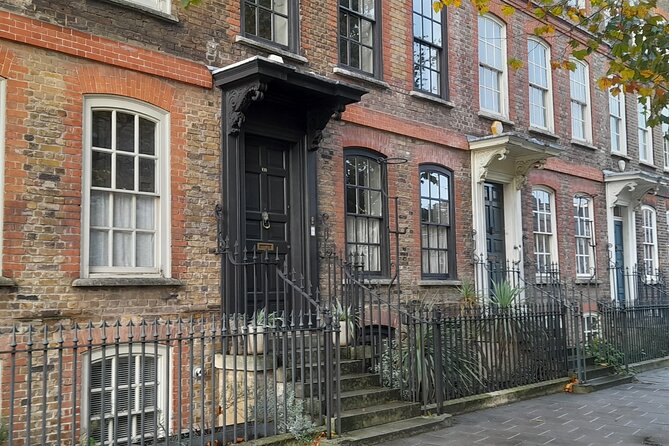
Princelet Street is a short stop of about 10 minutes, yet it offers some of the most atmospheric surroundings on the route. The street has appeared in films, and its houses retain an old-fashioned look, with pretty facades and wooden shutters associated with Huguenot residents.
Here the tour turns to women who lived alone in the 1700s. That detail is striking because it challenges easy assumptions about women’s lives in the past. A woman living alone was not necessarily famous, wealthy, or part of a major political movement. Her presence still tells you something about work, independence, housing, and the choices available in an earlier London.
The setting does much of the work. Princelet Street has a feel of times gone by, and the close grouping of the houses makes it easier to imagine the area as a lived-in neighborhood rather than a film location.
The drawback is the limited time. Ten minutes allows Mandy to point out the street and frame its stories, but not to examine every house or explain every phase of its development. I would treat this stop as a sharp, memorable snapshot within the larger walk.
Something different for another day:
- Stonehenge, Windsor Castle, and Bath from London
★ 4.5 · 18,662 reviews - London Big Bus Hop-On Hop-Off Tour with Optional River Cruise
★ 3.5 · 10,803 reviews - London Small Group Tour of Historical Pubs
★ 5.0 · 10,422 reviews - Stonehenge, Windsor Castle and Bath with Pub Lunch in Lacock
★ 4.5 · 7,402 reviews
Spitalfields Market: revolution in a market district
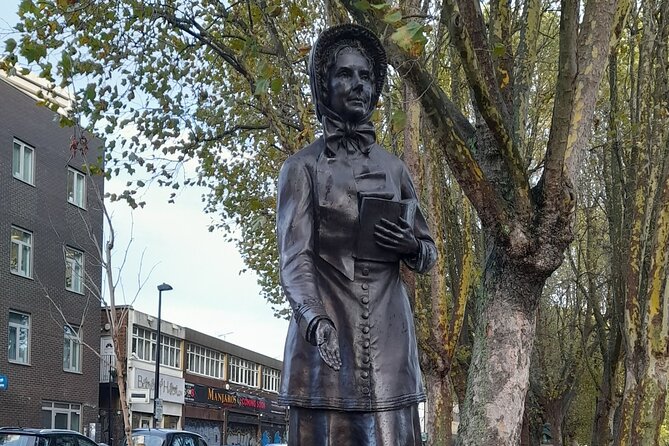
The route then reaches Spitalfields Market, where you spend around 30 minutes. The market was opened by Queen Victoria, and the streets around it connect with women such as Sylvia Pankhurst, Mary Wollstonecraft, and Sara Wesker.
This is likely to be the most recognizable stop for many people, but the tour keeps its attention on the surrounding streets and their political connections. Sylvia Pankhurst brings the women’s suffrage movement into the story. Mary Wollstonecraft represents an earlier challenge to accepted ideas about women, education, and independence. Sara Wesker adds another layer through working-class and Jewish women’s activism.
Together, these names create a long view of women’s political action over three centuries. You are not simply told that important women once lived or worked nearby. You are shown how the district became associated with reform, protest, labor, and demands for a fairer society.
Spitalfields Market can be a lively place, so this part may feel less quiet than Princelet Street. The benefit is that you see the history in a working urban setting rather than in an isolated museum room. The possible downside is that market activity can make listening harder, especially if the group reaches the full limit of 30 people.
Stepney Green: private lives and the anarchist headquarters
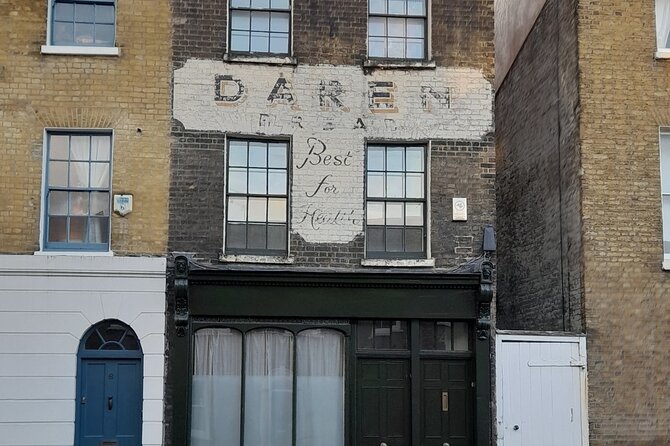
The final area is Stepney Green, covered in about 10 minutes. The stories here range from the widow of an East India employee to a prostitute who made a name for herself. The range is important: women appear not as one social type but as people with different backgrounds, reputations, and routes through life.
Stepney Green was also connected with anarchist activity and has appeared in Call the Midwife. That combination gives the stop a useful mix of political and popular history. You get a sense of how this part of East London has carried many identities at once.
Because the stop is brief, I would expect a few carefully chosen stories rather than a full account of Stepney Green. It works as a closing reminder that women’s history is found in personal lives as much as in formal movements.
The tour finishes at Liverpool Street Station, which is practical for continuing your day. You can connect with public transport or continue exploring the City and East London without needing to return to Whitechapel.
What the $27.53 price really buys you
At about $27.53 per person, this is priced as an accessible guided walk rather than a luxury private experience. For two to three hours of interpretation across five areas, I consider it good value if you actively enjoy history, neighborhoods, and social themes.
You are paying for Mandy’s preparation and storytelling, not for entry to paid attractions. Every listed stop is free, and coffee or tea at the Huguenot shop costs extra. That keeps the base price clear, but you should not expect the ticket to cover refreshments.
The maximum group size is 30 people. That is manageable for a street walk, though it is not intimate. A larger group can make it harder to ask questions or hear every word in a noisy section of Whitechapel or Brick Lane. On the other hand, the group format can make it easy to meet people while walking, which is one of the tour’s stated pleasures.
The strongest value comes from the subject. You can walk these neighborhoods on your own for free, but you would likely miss the links between a doorway, a woman’s working life, an immigrant community, and a political movement. If that interpretation matters to you, the fee is modest.
Timing, clothing, and the walking effort
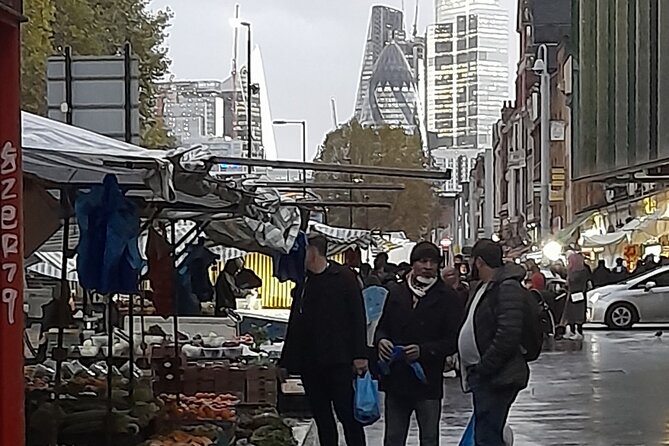
The experience is described as a two-hour tour, with an approximate duration of two to three hours. Allow the longer estimate when planning your day. The walk takes place on public streets and includes several areas, so wear comfortable walking shoes.
Dress for London weather. The experience requires good weather and may be canceled if conditions are poor. You can then choose another date or receive a full refund. A moderate level of physical fitness is recommended, which suggests you should be comfortable walking for several hours rather than treating this as a short stroll between attractions.
The meeting point is 277 Whitechapel Road, London E1 1BY. The end point is Liverpool Street Station, London EC2M 7QA. Having different start and finish points is helpful because you do not waste time retracing your steps.
The available opening information lists Mondays from 2:00 PM to 4:00 PM, with dates shown from March 15, 2023 through December 8, 2026. Check the exact date and time when booking because the schedule is limited. Confirmation is sent at booking, and service animals are allowed.
You can cancel for a full refund up to 24 hours before the start time. Changes or cancellations inside that period are not accepted for a refund. The tour also requires a minimum number of participants, so a cancellation by the operator is possible if that number is not reached.
Who will get the most from this Whitechapel walk
I would choose this tour if you want women’s history treated as the main subject, not as a brief addition to a general London walk. It suits people interested in social reform, migration, labor, political movements, historic homes, and the everyday lives behind famous neighborhoods.
It is also a good fit if you have already seen London’s headline attractions and want a more local route. Mandy’s attention to overlooked landmarks can change how you read streets you might otherwise pass without a second glance.
The walk may be less suitable if you need step-free access details, dislike outdoor tours in uncertain weather, or want to spend most of your time inside buildings. The supplied information confirms public transport access and service animals, but it does not provide a detailed route accessibility statement. Contact the provider if that matters to you.
You should also be comfortable with a group of up to 30 people and with a guide-led pace. This is not a self-guided audio walk where you can stop whenever you wish. The reward is the chance to hear connected stories from one person and ask questions as the route unfolds.
Should you book Women of Whitechapel?
I would book it if your idea of a good London afternoon includes streets, overlooked buildings, political history, and the women who helped shape East London. The strongest reasons are the clear theme, the range of subjects, Mandy’s warm presentation, and the convenient route from Whitechapel Road to Liverpool Street.
Book with realistic expectations. You are getting a walking conversation across public streets, not museum entry, a private tour, or a complete history of every neighborhood. Wear proper shoes, allow up to three hours, and budget separately for tea or coffee.
At $27.53, the tour offers a solid introduction to Whitechapel through women’s lives. For anyone who wants London history to include workers, migrants, organizers, philanthropists, rebels, and women living outside the usual spotlight, it is an easy recommendation.
FAQ
How long does the Women of Whitechapel tour last?
The tour lasts approximately two to three hours. The experience is also described as a two-hour guided tour, so allow extra time when planning your day.
Where does the tour begin?
The walk begins at 277 Whitechapel Road, London E1 1BY, UK. The meeting point is at the door and is near public transportation.
Where does the tour end?
The tour ends at Liverpool Street Station, London EC2M 7QA.
What areas does the tour visit?
The route includes Whitechapel Road, Brick Lane, Princelet Street, Spitalfields Market, and Stepney Green.
Who guides the tour?
The guide is Mandy from London Herstory Guided Walks.
What does the tour focus on?
It focuses on the history of women in Whitechapel, including women connected with resistance, philanthropy, anarchist movements, migration, labor, and social reform.
Is food or drink included?
No. The group stops at a Huguenot tea and coffee shop, but refreshments are entirely at your own cost.
Can I cancel for a full refund?
Yes. You can cancel at least 24 hours before the experience start time for a full refund. Cancellations or changes made less than 24 hours before the start time are not accepted for a refund.
Just added around London
- The Private British Museum Tour★ 5.0 · 6 reviews
- London to Southampton Cruise Port | Private Transfer★ 5.0 · 6 reviews
- London’s Chinatown Food Experience★ 4.0 · 6 reviews
- London Gatwick (LGW) Airport Departure Private Transfer – Hotel to Airport★ 4.0 · 6 reviews
- Christmas in Canterbury, Dover and Greenwich with Christmas Lunch★ 4.5 · 6 reviews
- Transfer from Heathrow Airport to London hotel on private car★ 4.5 · 6 reviews
- Jazz Notes – Jazz Jam Ticket★ 5.0 · 6 reviews
- Transfer from London Stansted Airport to Central London★ 5.0 · 6 reviews
Walking Tours, compared.

Oxford University Walking Tour With University Alumni Guide
Read our review →
Tour for Muggles The Ultimate Harry Potter Walking Tour in London
Read our review →

Cambridge University Walking Tour by Alumni™ Kings College Option
Read our review →
Blackbeard to Banksy – The Ultimate Walking Tour of Bristol
Read our review →
Air Raid Shelter + St. Nicholas Market Walking Tour
Read our review →
Walking Tour of Bath with Blue Badge Tourist Guide
Read our review →
Changing of the Guard Guided Walking Tour in London
Read our review →Browse the lists this tour appears in