
Reviewed · WALKING TOURS
Best of Bath Walking Tours – Georgian Tour
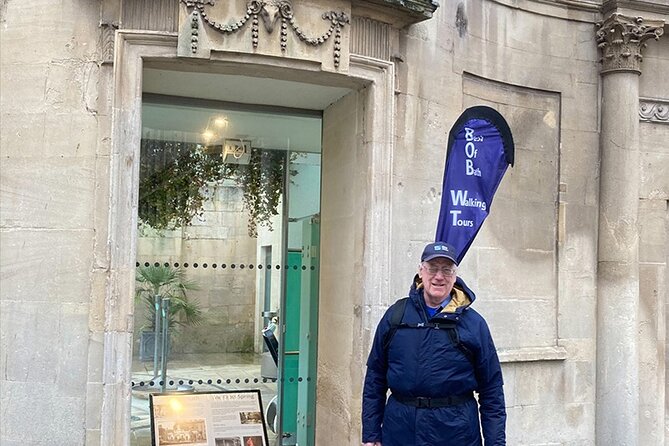
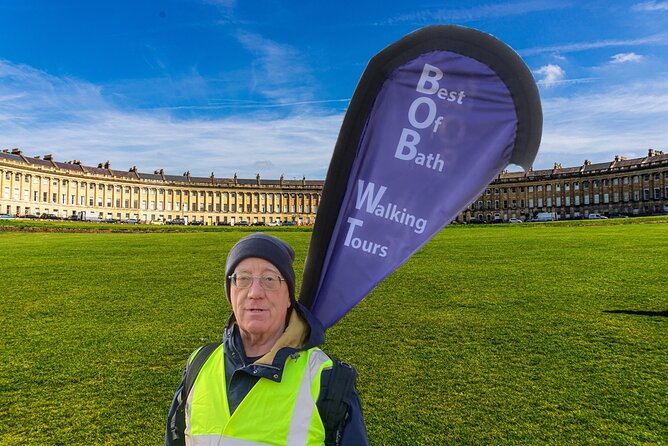
Bath reveals its best details on foot. This two-hour Georgian walking tour follows guide Bob through the city’s grand squares, crescents, bridges, markets, and hot springs, adding the stories that make the stone buildings easier to understand. I like the small maximum of 15 people, and I like that Bob’s style is informal, humorous, and open to questions.
The tour costs $27.73 per person, which is good value if you want an organized introduction without paying for several attraction admissions. The main consideration is weather: the walk can be canceled in poor conditions, and you will need a moderate level of fitness for two to three hours on city streets.
In This Review
- Key things to know before you book
- Why Georgian Bath makes such a good walking tour
- Starting beside Bath Abbey in Abbey Churchyard
- Hot springs, city walls, and the Roman Baths area
- Queen Square and the architecture of a planned city
- The Assembly Rooms and Bath’s social world
- The Circus, where Georgian design turns theatrical
- Royal Crescent and the view from No. 1
- Gravel Walk and Bath’s quieter side
- Pulteney Bridge and the River Avon
- Guildhall Market and a practical finish
- Bob’s guiding style and the small-group advantage
- Is $27.73 good value for Bath?
- Who will enjoy this walk most?
- Should you book Best of Bath Georgian Tour?
- FAQ
- Where does the Georgian Tour begin?
- What time does the tour start?
- Where does the tour finish?
- How long does the walk last?
- How much does the tour cost?
- Is the tour offered in English?
- How large is the group?
- Are attraction admission tickets included?
- Is the tour suitable for people with limited mobility?
- Can I cancel for a refund?
Key things to know before you book
- Bob makes the architecture personal: He explains not only who designed Bath’s buildings, but also who lived in them and why they were built.
- The route covers Bath’s big sights: You see Bath Abbey, Queen Square, the Circus, Royal Crescent, Pulteney Bridge, the Roman Baths area, and Guildhall Market.
- It is mostly an exterior walking tour: Admission to the Roman Baths, Assembly Rooms, Royal Mineral Water Hospital, and No. 1 Royal Crescent is not included.
- The pace is gentle but active: The walk usually lasts about two hours, though it can run longer when the group has questions.
- The group stays small: A maximum of 15 people gives you a better chance to hear Bob and ask about details you would miss alone.
- It starts and ends in the Abbey Churchyard: The 1:00 pm meeting time works well for an afternoon introduction to Bath.
Why Georgian Bath makes such a good walking tour
Bath is often treated as a collection of pretty honey-colored buildings. That is only half the story. The city’s Georgian architecture was designed as a social machine, with squares for display, assembly rooms for courtship and gossip, and crescents that gave fashionable residents a grand address.
A good guide helps you see the plan behind the beauty. On this walk, Bob connects Queen Square, the Circus, and the Royal Crescent as parts of one architectural sequence. You are not simply ticking off three famous photo stops. You are watching Bath’s design grow from a formal square into a circular composition and then a sweeping crescent.
I especially like the human angle. The strongest feedback about Bob points to his stories about the people who built and lived in Bath, not just dates and building names. He also explains why certain façades look the way they do and identifies features that are easy to miss when you wander alone.
His humor matters, too. Several comments describe him as witty, friendly, and engaging, with a habit of answering questions rather than rushing through a prepared speech. If you want a lecture packed with technical architectural terms, this may feel relaxed. If you want history to stick in your memory, that relaxed approach is a strength.
More Walking Tours in Bath
- Walking Tour of Bath with Blue Badge Tourist Guide
★ 5.0 · 1,877 reviews - Roman Baths and Bath City Walking Tour
★ 4.5 · 762 reviews - Bad of Bath fun Walking Tour of Bath
★ 5.0 · 402 reviews
Starting beside Bath Abbey in Abbey Churchyard
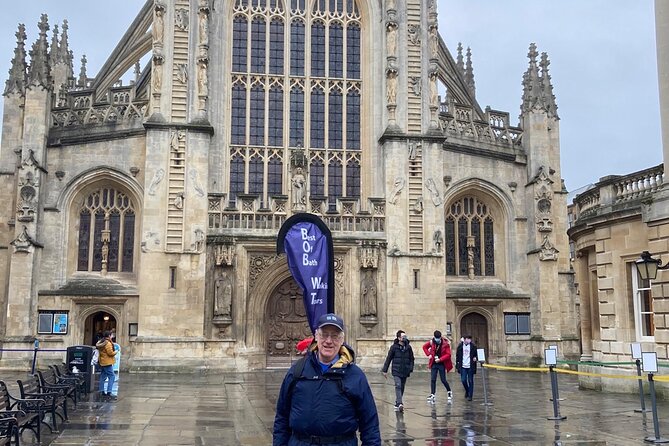
The tour begins at 1:00 pm in front of Bath Abbey, formally the Church of Saint Peter and Saint Paul. Abbey Churchyard is an easy landmark in the center of Bath, and starting here gives you immediate context for the city’s long timeline.
Bath Abbey began in the 7th century, was reorganized in the 10th century, and was rebuilt in the 12th and 16th centuries. That makes it a useful starting point for understanding Bath as a city shaped by several eras, not only the Georgian period.
The group spends about 10 minutes here before moving on. You should arrive ready to walk, since this is not a seated orientation talk. The end point is also Abbey Churchyard, where you can continue asking Bob about Bath after the formal walk finishes.
Hot springs, city walls, and the Roman Baths area
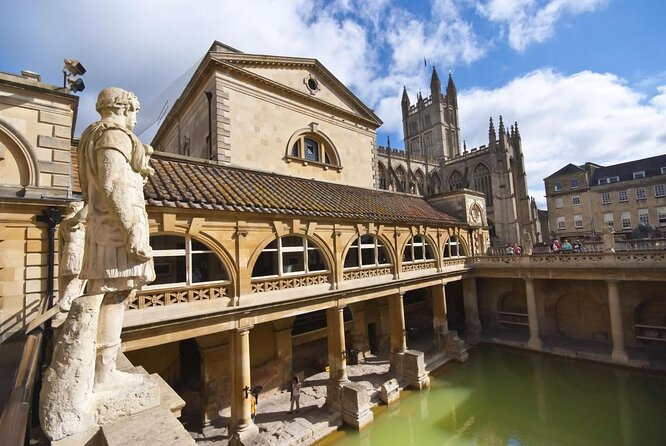
The route takes you through the heart of Bath and includes the hot springs, the old city wall, the Roman Baths area, and the Mineral Hospital. These stops explain why anyone built a major city here in the first place.
The Roman Baths began with a temple constructed between AD 60 and 70, during the first decades of Roman Britain. The original baths later fell into ruin, and the area around the natural springs was redeveloped more than once during the medieval period.
You spend only about five minutes at the Roman Baths stop, so plan on seeing the exterior and hearing the historical setting rather than taking a full museum visit. Entrance is not included. If you want to explore the Roman Baths indoors, buy a separate ticket and allow extra time before or after the walk.
The Royal Mineral Water Hospital adds a later chapter. Construction began in 1737, when faith in the healing power of Bath’s mineral waters was joined by growing scientific interest. Again, admission is not included, but the outside setting helps explain how Bath’s springs continued to shape the city long after the Roman era.
Queen Square and the architecture of a planned city
Queen Square is one of the most useful stops for anyone trying to understand Georgian Bath. Every building in the square is Grade I listed, and the square forms the first part of the architectural sequence that continues through the Circus to the Royal Crescent.
You spend about five minutes here, but the point is not simply to admire a row of houses. Bob’s explanations help you notice the way Georgian planners used symmetry, proportion, and a shared façade to create a unified public space.
This is also where the tour becomes especially useful for people who like buildings but do not have formal training in architecture. You can ask why a particular feature appears, how the square was intended to work, or which people shaped Bath’s expansion. The pace allows questions, and that is one reason the tour can sometimes last longer than the advertised two hours.
Something different for another day:
- Stonehenge, Avebury & the Cotswolds from Bath (Small group)
★ 5.0 · 798 reviews - Fully Guided Bath Ghost Tours
★ 5.0 · 539 reviews - The Cotswolds Tour From Bath (Small group)
★ 5.0 · 349 reviews - Bath Tootbus Hop-on Hop-off Sightseeing Bus Tour
★ 4.5 · 247 reviews
The Assembly Rooms and Bath’s social world
The Assembly Rooms were built for the fashionable life that made Georgian Bath famous. The upper Assembly Rooms opened in 1771 with a grand ball and became a center for dances, concerts, and gambling.
Jane Austen and Charles Dickens were among the well-known figures connected with Bath’s social world, along with the nobility of the period. The building is therefore more than another elegant façade. It helps you picture the city as a place where people came to meet, show off, find connections, and spend money.
The stop lasts about five minutes, and admission is not included. You may find this a little brief if you are eager to see inside, but the walk’s focus is the wider city rather than a full tour of individual interiors.
I like this balance for a first visit. You get enough background to understand why Bath’s squares and terraces were built, then keep moving instead of spending the whole afternoon in one attraction.
The Circus, where Georgian design turns theatrical
The Circus is one of Bath’s most memorable spaces. This ring of large townhouses was designed by John Wood the Elder and built between 1754 and 1768. Three entrances break the circle, and each segment is arranged so that a classical façade faces you directly as you enter.
That planning trick is easy to miss unless someone points it out. The Circus feels grand because it was designed to perform, presenting a carefully controlled view from each approach.
The group spends around 10 minutes here. There is no admission charge, and you have time to look around while Bob explains the design. This is one of the best places on the route for photographs, though the value of the stop lies in learning how the space was composed, not only in taking a picture.
Royal Crescent and the view from No. 1
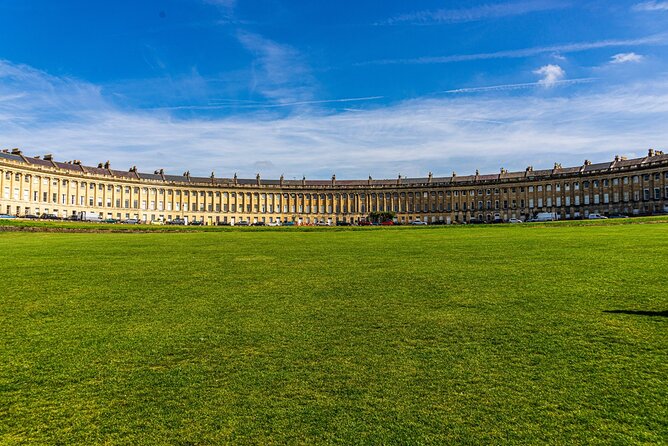
The Royal Crescent is Bath’s most recognizable Georgian address, a sweeping row of 30 terraced houses designed by John Wood the Younger. Construction took place from 1767 to 1774, and the building is Grade I listed.
The walk includes about 10 minutes at the Royal Crescent and No. 1 Royal Crescent. Admission to No. 1 is not included, so you should not expect a full interior visit as part of the tour. Instead, Bob gives you the setting and the architectural story from outside.
This stop rewards a slower look. From a distance, the Royal Crescent appears to be one continuous palace-like building. In reality, it is a terrace of separate homes joined by a carefully unified front. The arrangement says a great deal about Georgian ambition: private residences could borrow the appearance of a grand civic monument.
If you have already seen Bath’s main sights by yourself, this is where a guide can still add real value. Small details in the façade and the relationship between the houses become easier to notice when someone directs your attention.
Gravel Walk and Bath’s quieter side
The route includes Gravel Walk, a less obvious part of the city’s Georgian setting. This is a useful change of pace after the spectacle of the Royal Crescent.
The walk does not treat Bath as a string of isolated monuments. It links the large showpiece buildings with paths and spaces that helped people move through the city. One detailed account of the tour describes Bob pointing out a medieval path below, running toward the river beside the ancient city walls. Details like this are easy to miss without a guide who pays attention to the layers underfoot.
You should expect some uneven or ordinary city walking rather than a polished sightseeing route from one grand façade to another. That is part of the appeal, but it also explains the moderate fitness recommendation.
Pulteney Bridge and the River Avon
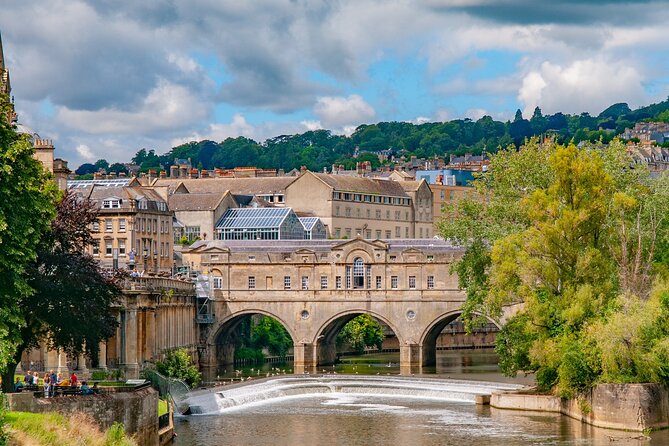
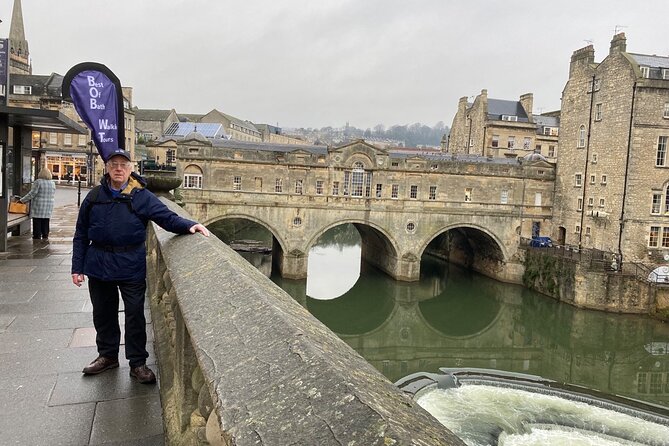
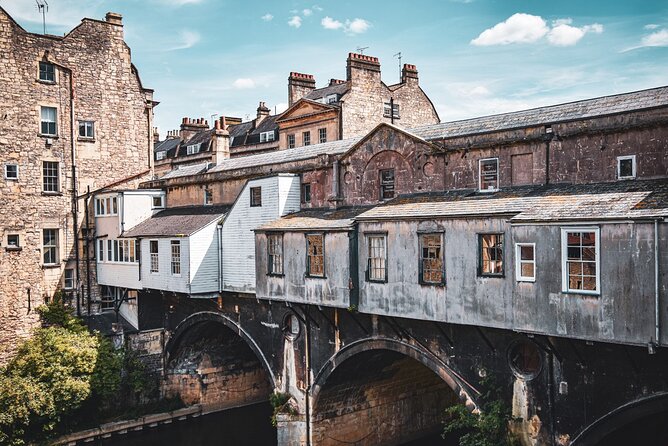
Pulteney Bridge is one of the route’s most unusual sights. Completed by 1774, it crosses the River Avon and was built to connect Bath with land owned by the Pulteney family, which planned to develop the area.
Robert Adam designed the bridge in a Palladian style. Its most striking feature is the line of shops built across the full span on both sides. Few bridges look like a street with a river running underneath, and this one deserves more than a quick glance.
The stop lasts about five minutes and is free. It is a short visit, but the bridge gives the tour a change of scene and helps you understand Bath’s connection to the river. You can also ask Bob about the bridge’s design and the development plans behind it.
Guildhall Market and a practical finish
The final sightseeing stop is Bath Guildhall Market, an indoor market housed in a handsome building. The market has existed since 1284, and its stalls give you a more everyday view of the city after the grand Georgian set pieces.
You spend about five minutes here, so think of it as a brief wander rather than a shopping session. The market is a useful reminder that Bath is not only a museum of architecture. It is also a working city with places where people buy and sell ordinary goods.
The walk then returns to Abbey Churchyard. Bob stays available for further discussion, and you can take as much time as you like to ask about points of interest in Bath. That informal ending is useful if you are deciding what to visit next.
Bob’s guiding style and the small-group advantage
Bob is the main reason this experience feels different from following a printed route. His approach is described as friendly, patient, and full of good stories, with humor used to keep the history from becoming heavy.
He also appears comfortable admitting when he does not know an answer. That is a positive sign. You get a guide who is interested in the city rather than someone trying to sound certain about every minor detail.
The small maximum of 15 people matters on a walking tour. You are more likely to hear the explanation clearly, stay together through busy areas, and ask a question without holding up a large crowd. Bob has also been praised for checking that everyone is keeping up and for maintaining a comfortable pace.
The route can be especially helpful during crowded periods, including the Christmas market season. Bob has guided groups through busy conditions while keeping them together. Still, city-center crowds can make any walking tour less calm, so choose your footwear and allow room for the pace to change.
The walk is offered in English only. Service animals are allowed, and the meeting point is near public transportation. The tour is recommended for people with moderate physical fitness, so it may not suit anyone who needs a fully seated or very short sightseeing experience.
Is $27.73 good value for Bath?
At $27.73 per person, the tour is priced fairly for a two to three hour guided walk, especially with a group capped at 15. You are paying for local interpretation, route planning, and the ability to ask questions, not for entry into Bath’s major attractions.
That distinction is important. Tickets for the Roman Baths, Assembly Rooms, Royal Mineral Water Hospital, and No. 1 Royal Crescent are not included. If you want to go inside those buildings, budget for separate admission and additional time.
The value is strongest if you are new to Bath, have only an afternoon, or already walked around but feel you missed the meaning behind the façades. It is less compelling if you want a series of indoor visits or a detailed examination of every attraction.
The free cancellation policy also gives you some flexibility. You can cancel at least 24 hours before the 1:00 pm start for a full refund. Poor weather or failure to reach the minimum number of participants can also lead to a rescheduled experience or full refund.
Who will enjoy this walk most?
I would choose this tour if you want a clear introduction to Bath’s Georgian design without committing to a full-day sightseeing program. It suits first-time visitors, architecture fans, history lovers, and anyone who prefers stories about people alongside dates and building names.
It is also a good choice if you have a gap before catching a train. The route lasts about two hours in a typical case, and one especially useful feature is the gentle pace. Some walks hurry from landmark to landmark. This one leaves room for questions and may run beyond the allotted time if the group is engaged.
Families and mixed-age groups may appreciate the humor and straightforward storytelling, though everyone should be comfortable walking for at least two hours. Film and television fans may also enjoy the chance to identify Bath locations used in Bridgerton, which Bob has pointed out during the route.
You may want a different plan if your priority is entering the Roman Baths or touring No. 1 Royal Crescent. This experience provides context from the streets, not admission to the interiors.
Should you book Best of Bath Georgian Tour?
Book it if you want Bath’s famous architecture explained in a warm, human way. Bob’s strongest qualities are his enthusiasm, humor, patience, and command of Bath’s story, while the compact group keeps the walk personal.
The tour is particularly worthwhile on your first day in Bath. It helps you get your bearings, shows you the major Georgian sights, and gives you ideas for what to revisit at your own pace. At $27.73, it is a sensible introduction, provided you understand that attraction tickets are separate.
Skip it only if you dislike walking tours, need extensive indoor access, or already want a specialist architectural lecture. For most visitors seeking an easy, informative afternoon walk, this is a strong way to see the city beyond its postcard views.
FAQ
Where does the Georgian Tour begin?
It begins in Abbey Churchyard, Bath BA1, in front of Bath Abbey.
What time does the tour start?
The scheduled start time is 1:00 pm.
Where does the tour finish?
The tour finishes back at the Abbey Churchyard meeting point.
How long does the walk last?
The tour lasts approximately two to three hours. The main walk is described as about two hours, and it may continue longer when the group has questions.
How much does the tour cost?
The listed price is $27.73 per person.
Is the tour offered in English?
Yes. The tour is offered in English.
How large is the group?
The tour has a maximum of 15 participants.
Are attraction admission tickets included?
No. Admission is not included for the Roman Baths, Royal Mineral Water Hospital, Assembly Rooms, or No. 1 Royal Crescent.
Is the tour suitable for people with limited mobility?
The tour recommends a moderate level of physical fitness. Specific accessibility details beyond service animals being allowed are not provided.
Can I cancel for a refund?
Yes. You can cancel at least 24 hours before the start time for a full refund. Cancellations or changes made less than 24 hours before the start time are not refunded or accepted.
Just added around Bath
- Full-Day Private Tour of Stonehenge and Bath with Pickup★ 5.0 · 6 reviews
- Bridgerton’s Filming Locations in Bath Audio Guide★ 5.0 · 7 reviews
- Private Guided Tour of Jane Austen’s Bath★ 5.0 · 7 reviews
- Private Day Tour from Bath to Stonehenge and Salisbury with Pickup★ 5.0 · 9 reviews
- Wells, Cheddar Cheese and Cheddar Gorge – Private Day Trip from Bath★ 5.0 · 10 reviews
- The Beatles in Bath June 10th 1963★ 4.5 · 10 reviews
- Bath Private Guided Walking Tour★ 5.0 · 10 reviews
- Private Cotswolds tour from Bath★ 5.0 · 12 reviews
Walking Tours, compared.

Oxford University Walking Tour With University Alumni Guide
Read our review →
Tour for Muggles The Ultimate Harry Potter Walking Tour in London
Read our review →

Cambridge University Walking Tour by Alumni™ Kings College Option
Read our review →
Blackbeard to Banksy – The Ultimate Walking Tour of Bristol
Read our review →
Air Raid Shelter + St. Nicholas Market Walking Tour
Read our review →
Walking Tour of Bath with Blue Badge Tourist Guide
Read our review →
Changing of the Guard Guided Walking Tour in London
Read our review →Browse the lists this tour appears in