
Reviewed · STREET ART
East End London Instagrammable Street Art and Graffiti Tour
Look up, and London changes completely. This two-hour walk through Shoreditch and the East End follows huge murals, small stickers, bold lettering, Banksy pieces, and constantly changing graffiti that most sightseeing routes skip. I like the excellent variety of art and the way the guide explains the people, neighborhoods, and conflicts behind it. I also like that you get a chance to make your own street art, rather than only taking photographs.
The main thing to consider is the pace. You cover many locations in about two hours, with most stops lasting only five minutes. Art changes quickly, too, so a favorite piece may be painted over or altered by the time you arrive. Still, the tour earns its strong reputation, with a 5 out of 5 rating and 100 percent recommendation from the available feedback.
In This Review
- Key points to know before booking
- Why East London is the right place for this walk
- Heneage Street starts with giant figures and small spaces
- Brick Lane teaches you to move closer
- Princelet, Hanbury, and Dray Walk show the area’s many voices
- Allen Gardens is the tour’s best lesson in change
- Ebor Street shifts from rough walls to polished style
- Rivington Street brings in Banksy and the graffiti wars
- A Banksy wall fragment and Shakespeare add surprises
- New Inn Broadway finishes with a wall of many styles
- Price, pace, and what the $49 fee buys you
- Who will enjoy this East End walk most
- Should you book this street art tour?
- FAQ
- How long is the East End London street art tour?
- Where does the tour begin?
- Where does the tour finish?
- Does the tour include Banksy artwork?
- Can I make my own street art?
- What is the cancellation policy?
Key points to know before booking
- Seventeen East London stops: The route moves from Whitechapel High Street through Brick Lane, Shoreditch, and toward Liverpool Street Station.
- Banksy and major street artists: You may see protected Banksy works, pieces by ROA, Stik, Ben Eine, Thierry Noir, Martin Ron, and others.
- A changing outdoor gallery: Some walls remain for years, while works at Allen Gardens can change within days.
- Hands-on art: The tour includes an opportunity to leave your own small piece of street art.
- Small maximum group: The tour accepts up to 20 people, which helps the guide manage narrow yards and busy streets.
- Easy city connection: The walk begins near Whitechapel and usually ends within walking distance of Liverpool Street Station.
Why East London is the right place for this walk
East London street art works best as a walking experience because the artwork is woven into ordinary streets. You are not moving between formal galleries. You are looking at walls, doors, shutters, yards, bridges, and old industrial buildings that still carry traces of daily life.
The route also shows how different street art can be. One wall may feature a carefully planned animal mural. The next may carry a few words, a sticker, or a piece of lettering so elaborate that you cannot read it. That contrast is part of the appeal.
The area has a strong connection with immigrant communities, old markets, nightlife, design, and changing property prices. The art reflects all of those forces. At Princelet Street, for instance, a simple Stik figure honors the Muslim community and its long connection with Shoreditch. The work has been damaged and repainted, giving it a meaning that reaches beyond decoration.
I would not book this tour expecting a quiet stroll. Brick Lane and Shoreditch can feel crowded, and parts of the route pass through narrow or untidy yards. That roughness is part of what makes the area interesting, but it may not suit someone looking for polished streets and formal art explanations.
A few more tours and experiences worth a look
- London Bike Tour: Landmarks, Secret Gems, Pub Stop & Street Art
★ 5.0 · 943 reviews - Shoreditch Street Art Tour London
★ 5.0 · 481 reviews - The Original London Street Art Tour
★ 5.0 · 303 reviews
Heneage Street starts with giant figures and small spaces
The walk begins at 80 Whitechapel High Street at 11:00 a.m., then heads toward Heneage Street. In small backyards, two large works cover almost entire building walls.
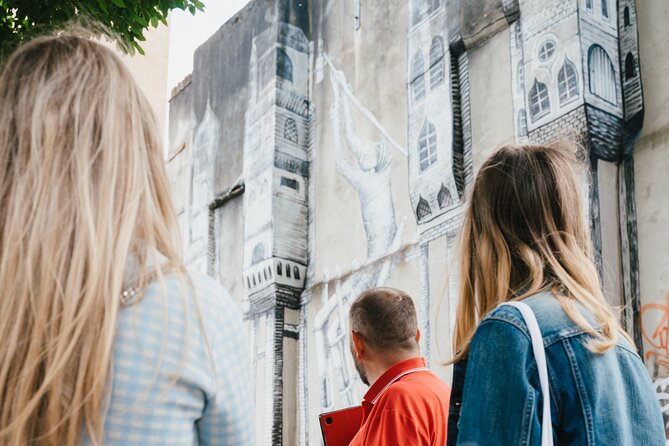
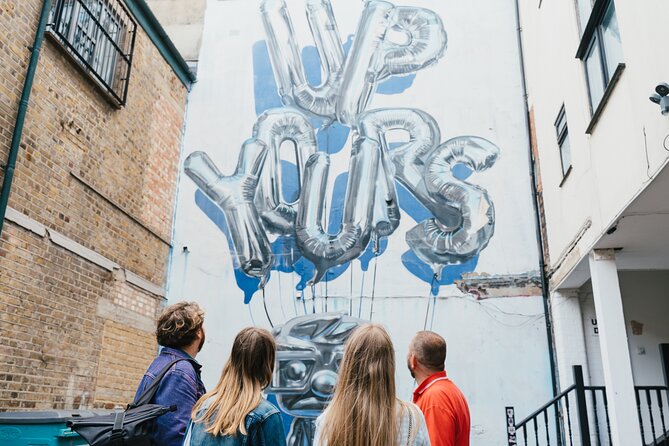
Phlegm’s piece features his familiar thin, long creatures, including figures walking on stilts above layers of tags. The scale is impressive, but you need to look closely to catch the smaller details. Across the street, FanakaPan offers a different style, using silver helium balloons based on an animated classic and giving the idea a strange new turn.
This opening section sets up one of the tour’s best lessons: street art is often easy to miss from the main road. You may need to step into a side space, look upward, and find the right angle. Bring a phone with enough storage, because these early walls are strong photo subjects.
Brick Lane teaches you to move closer
Brick Lane is one of London’s best-known street art areas, but the tour does not simply point at the largest wall and move on. At works by Dan Kitchener and Perspicere, the guide encourages you to view the pieces from a distance and then approach them.
That change in scale matters. These works appear on doors rather than massive building fronts, so the technical details become clearer when you stand close. You also learn how perspective changes the way a piece reads.
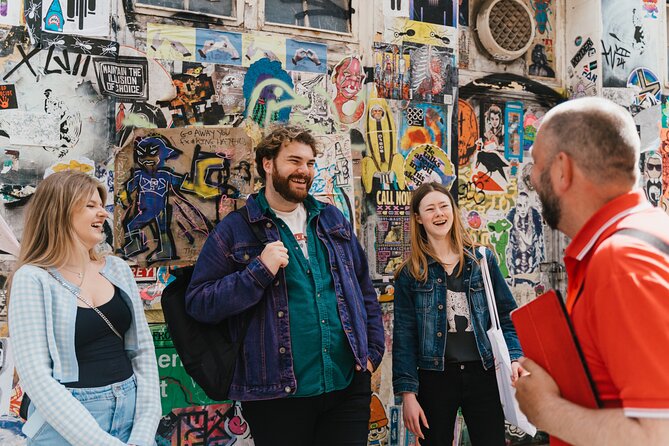
At The Seven Stars, the focus shifts to stickers. A narrow, dirty yard may not look inviting at first, but its walls show how small, fast-applied pieces can form an art scene of their own. You are invited to become the eighth star by adding a little art yourself.
This is a playful part of the walk, though you should keep your expectations sensible. The tour includes the chance to create something, but it is not a full studio workshop with a long lesson or individual art supplies described in detail.
Princelet, Hanbury, and Dray Walk show the area’s many voices
Princelet Street brings a social side to the walk. Stik’s simple, colorful figures are easy to recognize, yet the story behind the Muslim community piece gives it extra weight. The fact that it has been defaced and repainted makes the wall part of an ongoing local conversation.
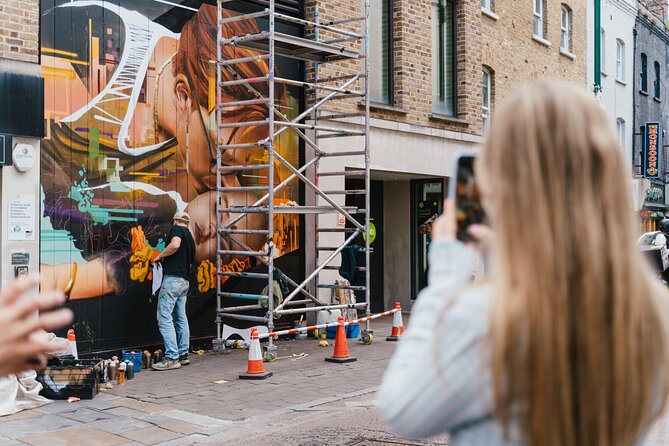
On Hanbury Street, a huge bird by ROA draws you down a side street. Nearby, Martin Ron’s upside-down man appears to balance on his hands across a large wall. The artist used parts of the building itself in the design, so the structure becomes part of the figure.
Hanbury Street also has stickers, black-and-white slogans by Wrdsmth, and smaller colorful works that can change often. You may find yourself looking in several directions at once. The stop is short, but it packs in a lot.
At Dray Walk, look for broccoli. Adrian Boswell began placing broccoli images around Brick Lane, and the vegetable has appeared in realistic forms and bright colors. The joke became strong enough that part of the street gained the nickname Broccoli Lane. Boswell now has a gallery and sells framed broccoli art, a fine example of how an odd visual idea can become a local signature.
Something different for another day:
- Stonehenge, Windsor Castle, and Bath from London
★ 4.5 · 18,662 reviews - London Big Bus Hop-On Hop-Off Tour with Optional River Cruise
★ 3.5 · 10,803 reviews - London Small Group Tour of Historical Pubs
★ 5.0 · 10,422 reviews - Stonehenge, Windsor Castle and Bath with Pub Lunch in Lacock
★ 4.5 · 7,402 reviews
Allen Gardens is the tour’s best lesson in change
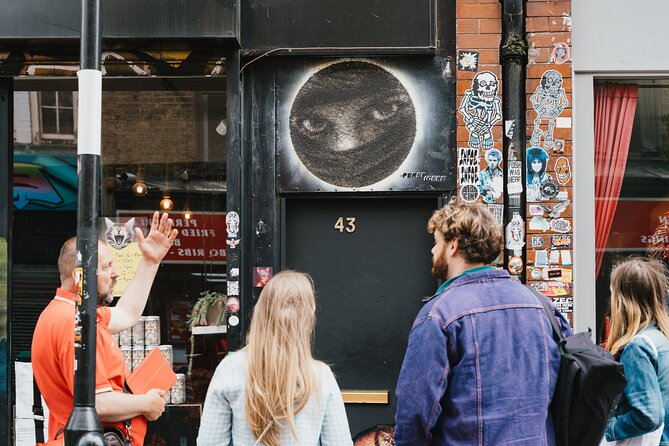
Allen Gardens functions as an outdoor graffiti park, with walls covered in work by graffiti writers. In this setting, graffiti writing usually means letter-based art, but the letters can be so complex that they are nearly impossible to read.
That unreadability is intentional in many cases. The challenge is not always to communicate a clear word. It can be about color, shape, rhythm, and the skill needed to build a piece that works as an almost abstract image.
This is one of the most useful stops for understanding why street art cannot be treated like a permanent museum collection. Some pieces may be replaced within a few days. Take your photos when you see something you like, since it may not be there later.
As you leave the gardens near Buxton Street, look up for the number 5. The wall combines work by more than one artist, and the guide uses it to introduce additional styles. It is a short stop, but collaborations help explain how these walls become shared spaces rather than single-author paintings.
Ebor Street shifts from rough walls to polished style
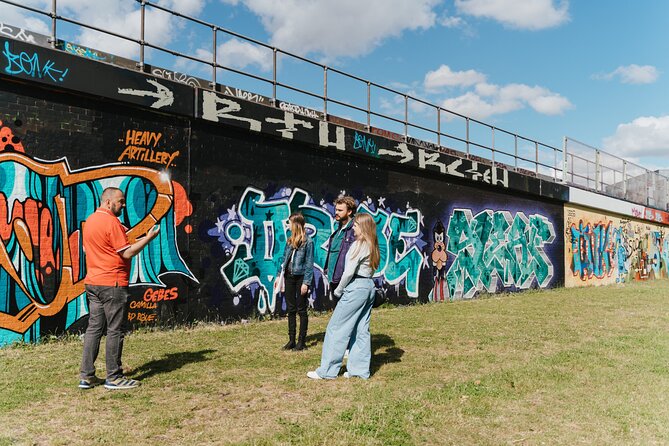
Ebor Street marks a move toward the newer, more fashionable side of the district. You still find large painted advertisements and small independent pieces, but the surroundings begin to feel more modern.
Look for Neon’s pink portraits, made with a light spray technique that gives the faces a misty quality. The portraits seem soft compared with the hard-edged lettering found elsewhere. They are especially good for photographs because the faces have clear expressions and a strong color identity.
On the opposite end is Ben Eine, known for large, readable letters. His work may use curved, old-fashioned forms, sharp modern fonts, or simple square shapes. The letters are easy to see from a distance, making them a useful counterpoint to the complicated graffiti writing at Allen Gardens.
If you enjoy taking photos, Ebor Street offers some of the easiest compositions on the route. The pieces are large, colorful, and readable. If you prefer learning about technique, the contrast between spray-painted portraits and carefully designed lettering gives the guide plenty to explain.
Rivington Street brings in Banksy and the graffiti wars
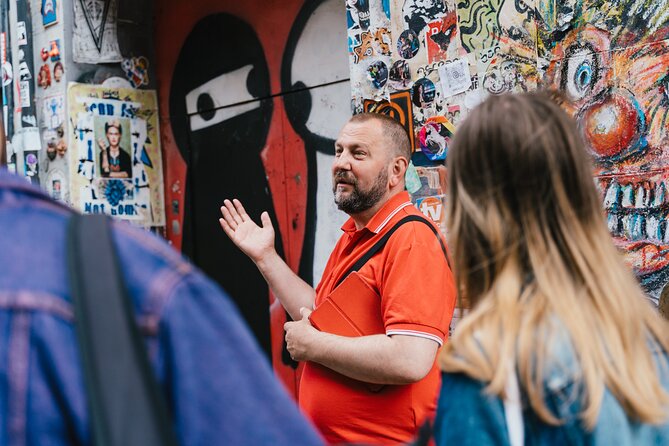
No London street art walk would feel complete without a Banksy stop, and Rivington Street provides one. The remaining Banksy works are protected behind glass panels, alongside pieces by artists who may be less famous but are equally interesting to look at.
The glass raises a useful question: does protecting a street artwork save it, or change its meaning? The tour invites discussion about art markets, public space, trends, and personal taste. That is more valuable than simply checking Banksy off a list.
Nearby, Otto Schade’s work includes a half-seen soldier that becomes complete when you stand on the corner. His recognizable ribbon-like forms appear in another piece as well. The shapes may look hollow, but their lines give them energy and movement. This is a good reminder that your position matters. A wall can reveal itself only when you stand in the right place.
Further along, Thierry Noir’s colorful heads add a cheerful note. Noir became known for painting bright characters on the Berlin Wall in the 1980s, and his London pieces carry the same simple, bold spirit. After more complicated works, these faces are refreshingly direct.
The tour also discusses the graffiti wars, a conflict connected with competing artists and changing attitudes toward public walls. The final part of the walk returns to this subject, so the story develops as you move through the neighborhood rather than arriving as one long lecture.
A Banksy wall fragment and Shakespeare add surprises
At art’otel London Hoxton, a section of wall painted long ago by Banksy has been removed from its original site and installed for public viewing outside the hotel. This is an unusual compromise between street art and preservation. The piece is now easier to protect and see, but its original setting has changed.
You do not need to stay at the hotel to view it. It remains outside, where you can look at it, photograph it, and decide how you feel about relocating public art.
At Hewett Street, the route takes an unexpected turn into theater history. A statue of William Shakespeare sits on a bench marking the site of his Curtain Theatre. You can sit beside him, then look toward a striking Romeo and Juliet graffiti piece connected with the place where that story was first performed.
This stop gives the tour a broader sense of London. East London is not only a modern art district. Older layers of theater, migration, commerce, and urban change sit beside the paint.
New Inn Broadway finishes with a wall of many styles
At New Inn Broadway, one building is covered by work from several artists. The colors and styles differ, yet they form a single wall of graffiti. You may spot everything from small figures to a tiny policeman, with each artist adding something distinct.
The appeal here is not one famous name. It is the way multiple contributions can work together. After seeing single-artist murals, collaborations, stickers, lettering, and stencil work, this wall feels like a final group portrait of the neighborhood.
The walk then heads toward Shoreditch High Street and the edge of the City, where glass and metal buildings replace the older brick and rougher walls. The route normally finishes within walking distance of Liverpool Street Station, though the exact endpoint can change as the art changes.
Price, pace, and what the $49 fee buys you
At $49 per person, this is not the cheapest way to see Brick Lane. You can walk through the area on your own for free, and plenty of the artwork is visible without a ticket.
The value comes from the route and the explanations. A guide helps you find works tucked into yards and side streets, recognize artists by their visual signatures, understand the difference between graffiti writers and mural artists, and connect the art with local events. The chance to make your own street art adds something that a self-guided walk cannot provide.
The group maximum is 20 people. That is large enough to keep the cost reasonable but small enough for a guide to lead people through narrow spaces. With 17 stops in roughly two hours, you will spend about five to ten minutes at most locations. I would treat this as a fast introduction rather than a slow photography session.
Book well ahead if your dates are fixed. The tour is booked, on average, about 91 days before the start date, which suggests that popular times can fill early. You receive confirmation at booking, and free cancellation is available up to 24 hours before the start time. The tour needs a minimum number of participants, so a cancellation for that reason comes with a different date, another experience, or a full refund.
Who will enjoy this East End walk most
I would recommend this tour if you like contemporary art, urban photography, local stories, or neighborhoods that do not fit a polished postcard image of London. It also works well for first-time visitors who want to see Shoreditch with some structure.
You will get the most from it if you:
- Enjoy taking photographs and looking for unusual angles
- Want to see more than only Banksy
- Like learning how artists use walls, doors, lettering, and building shapes
- Can walk for two hours and keep up with frequent short stops
- Appreciate art that changes, disappears, or remains open to debate
It may not suit you if you need a slow pace, dislike graffiti, or want a formal art museum setting. The route includes narrow yards, untidy spaces, and walls that may look different from the advertised examples because outdoor art is always changing.
Most people can participate, and service animals are allowed. The tour runs near public transportation, starts at Whitechapel High Street, and finishes near Liverpool Street Station, making it easy to connect with the rest of London afterward.
Should you book this street art tour?
Yes, if you want a guided introduction to East London’s creative side and do not mind paying for context around artwork you could technically see for free. The strongest parts are the tucked-away Heneage Street murals, the changing walls of Allen Gardens, the Banksy discussions, and the chance to make a piece of your own.
I would book it early, wear comfortable walking shoes, and bring a charged phone. Keep an open mind about what counts as art. Some pieces are grand and polished. Others are tiny, messy, funny, political, or almost impossible to read. That mix is exactly what makes this two-hour walk worthwhile.
FAQ
How long is the East End London street art tour?
The tour lasts approximately two hours and includes 17 stops through Whitechapel, Brick Lane, Shoreditch, and the area near Liverpool Street Station.
Where does the tour begin?
The meeting point is 80 Whitechapel High Street, London E1 7QX, UK. The scheduled start time is 11:00 a.m.
Where does the tour finish?
The usual finishing area is within walking distance of Liverpool Street Station. The exact endpoint can change depending on where the artwork is located.
Does the tour include Banksy artwork?
Yes. The route includes older Banksy works on Rivington Street and a Banksy wall fragment displayed outside art’otel London Hoxton.
Can I make my own street art?
Yes. The tour includes an opportunity to create your own street art, including a chance to leave a small piece at The Seven Stars stop.
What is the cancellation policy?
You can cancel up to 24 hours before the experience start time for a full refund. Changes or cancellations made less than 24 hours before the start are not accepted or refunded.
Just added around London
- The Private British Museum Tour★ 5.0 · 6 reviews
- London to Southampton Cruise Port | Private Transfer★ 5.0 · 6 reviews
- London’s Chinatown Food Experience★ 4.0 · 6 reviews
- Transfer from Heathrow Airport to London hotel on private car★ 4.5 · 6 reviews
- Christmas in Canterbury, Dover and Greenwich with Christmas Lunch★ 4.5 · 6 reviews
- London Gatwick (LGW) Airport Departure Private Transfer – Hotel to Airport★ 4.0 · 6 reviews
- Jazz Notes – Jazz Jam Ticket★ 5.0 · 6 reviews
- Transfer from London Stansted Airport to Central London★ 5.0 · 6 reviews
Street Art, compared.
London Bike Tour: Landmarks, Secret Gems, Pub Stop & Street Art
Read our review →
Shoreditch Street Art and Graffiti Tour (Private Group Booking)
Read our review →
Street Art: The Modern History of the Northern Quarter
Read our review →
Street Art Tour and Spray Painting Workshop in London
Read our review →
Bristol Street Art: Banksy Exploration Game and Tour
Read our review →Browse the lists this tour appears in