
Reviewed · BIRMINGHAM TOURS
Best of Birmingham 12km Running Tour
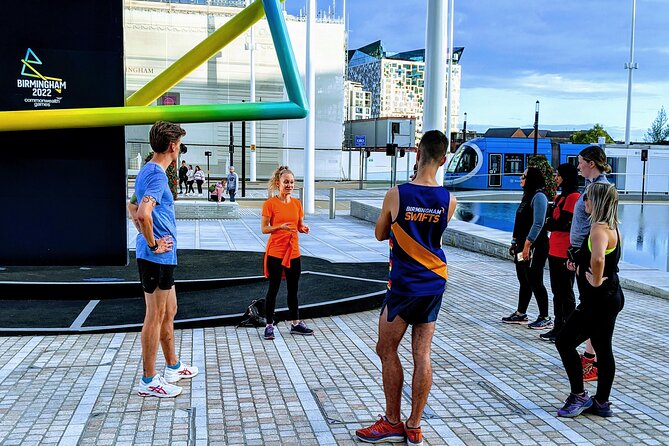
See Birmingham at running pace. This private 12km sightseeing run links canals, industrial districts, civic squares, shopping areas, and Birmingham’s famous Bull in about two and a half hours. I like the clever route, which reaches far more of the city than a standard walking tour, and the friendly, personal format led by an England Athletics Run Leader.
I also like the stops between running sections. You get time to hear stories, catch your breath, take photos, and enjoy provided snacks. The main consideration is the $548.51 per-person price, which is steep for a two-and-a-half-hour activity, especially since bottled water is not included and you must bring your own.
In This Review
- Key things to know before you book
- What this Birmingham running tour is really like
- Starting beside Roundhouse Birmingham
- Centenary Square and Birmingham’s modern civic centre
- Jewellery Quarter: makers, cemeteries, and the FA Cup
- Digbeth and Birmingham’s industrial canal routes
- The Gay Village, China Town, and Theatreland
- Birmingham Bull, Selfridges, and the old market
- Victoria Square’s civic buildings and local nicknames
- The Mailbox and the final canal return
- Is the $548.51 price good value?
- Pace, equipment, and practical planning
- Who should book this running tour?
- Should you book the Best of Birmingham 12km Running Tour?
- FAQ
- Where does the Birmingham running tour begin?
- Where does the tour finish?
- How long does the experience last?
- How far do you run?
- What language is the tour offered in?
- Is this a private tour?
- Is bottled water included?
- Are snacks provided?
- What happens if bad weather cancels the tour?
Key things to know before you book
- Run through several sides of Birmingham: The route connects the canals, Centenary Square, Jewellery Quarter, Digbeth, the Gay Village, Bullring, Victoria Square, and The Mailbox.
- Expect a stop-and-run format: Short explanations and photo breaks divide the running into manageable sections.
- Meet at Roundhouse Birmingham: The start and finish are at 1 Sheepcote Street, beside Birmingham’s canal network.
- Private groups get personal attention: Only your group takes part, making it easier to set a comfortable pace and ask questions.
- Lucy receives special praise: One five-star review calls her friendly, enjoyable, and full of useful insight.
- Bring water and suitable fitness: Snacks are supplied, but bottled water is not. The operator asks for a moderate level of physical fitness.
What this Birmingham running tour is really like
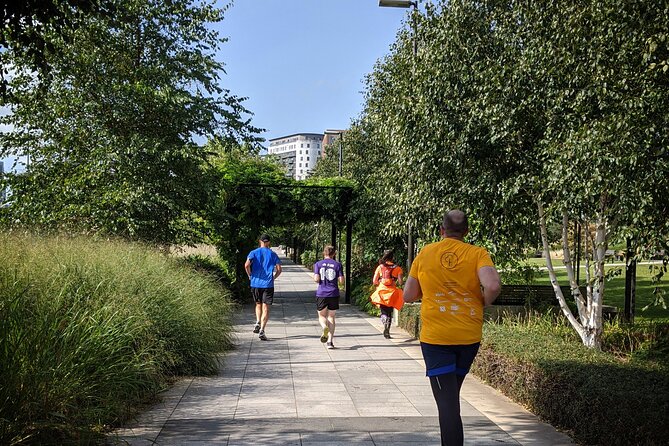
This is not a race, and it is not simply a guided jog past a few monuments. The route uses Birmingham’s canals and city streets to create a moving tour, with regular stops for short talks and photographs. You run, pause, listen, and then set off again.
That format matters. Birmingham is spread across several distinct areas, and some of its best stories sit beyond the central shopping streets. A normal walking tour might cover the civic centre and Bullring, but this route also reaches the Jewellery Quarter and Digbeth, two areas that reward a little extra effort.
The tour lasts about two hours and thirty minutes. The exact pace will depend on your group, but you should expect a proper run rather than a gentle stroll with occasional movement. The advertised distance is 12 kilometres, so you need to be comfortable spending a substantial part of the morning or afternoon on your feet.
The private setup is a real advantage. You are not trying to keep up with a large group or waiting for a slow line of people to cross every street. At the same time, private does not mean you can skip the physical demands. The operator recommends moderate fitness, and the route includes uphill running.
Other Birmingham trips people book alongside this one:
- Entry ticket to Hoo Zoo and Dinosaur World in Telford
★ 5.0 · 591 reviews - Cadbury World Entry Ticket
★ 3.0 · 524 reviews - Birmingham Walking Tour: Canals, Victorians & Today (1:30pm)
★ 5.0 · 346 reviews
Starting beside Roundhouse Birmingham
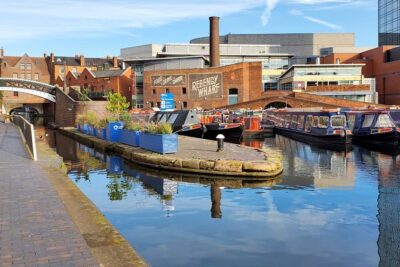
Your guide meets you at Roundhouse Birmingham, at 1 Sheepcote Street. This heritage building sits beside the canals and makes a useful starting point because it places Birmingham’s industrial past right under your feet before the run begins.
The opening ten minutes are used for introductions, a warmup, and a group ice-breaker. Your Run Leader also shares a few stories about the building. That warmup is more than a formality. It gives you a chance to settle into the group, check the pace, and make sure your shoes and clothing feel right before the distance builds.
From here, you run about half a mile along the canal toward Centenary Square. The canals are one of the tour’s best early touches. They offer a calmer route away from busy roads and help explain how Birmingham grew into an industrial centre. The operator points out that Birmingham has more canals than Venice, a popular comparison that gives you a quick sense of the scale of the network.
Centenary Square and Birmingham’s modern civic centre
After the first canal section, you stop at Centenary Square for about ten minutes. This is one of the city centre’s main public spaces, with several important buildings close together.
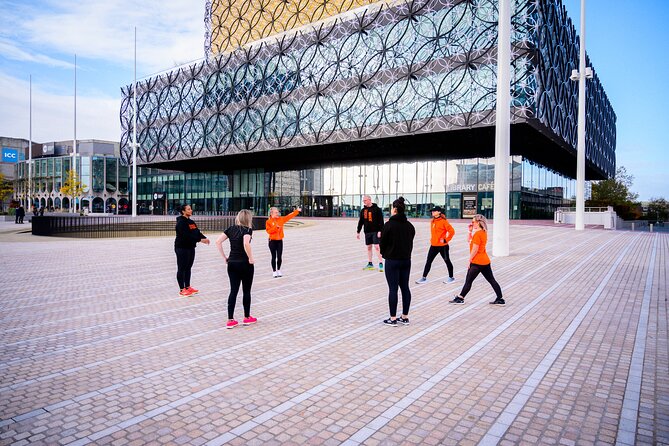
You see the Library of Birmingham, the Hall of Memory, Baskerville House, and the large water feature given the local nickname the overly designed puddle. The mix is typical of Birmingham: grand civic buildings, modern public architecture, memorials, and a healthy willingness to make fun of itself.
Your guide also explains how Birmingham began as a city more than 1,600 years ago. That broad timeline helps place the later stops in context. You are not just moving between attractive buildings. You are following the city from early settlement through industrial growth and into its modern urban identity.
The stop lasts about ten minutes, so expect a compact explanation rather than a long architectural lecture. That suits a running tour. You get the main ideas, a breather, and time to look around without losing the energy of the outing.
Jewellery Quarter: makers, cemeteries, and the FA Cup
The route then heads toward the Jewellery Quarter, after about a mile of straight running. This is one of the most rewarding parts of the experience because it feels different from the formal centre.
The Jewellery Quarter remains closely tied to manufacturing. The tour highlights the claim that 40 percent of the United Kingdom’s jewellery is made here, along with the area’s recognition by English Heritage. You see Victorian cemeteries, residential streets, independent food and drink spots, boutique hotels, museums, and creative workshops.
I like this stop because it gives you a useful reason to return later. The running route can introduce the quarter, but it cannot give you time to visit its museums or browse every workshop. Make a note of anything that catches your eye, then come back when you are not wearing running shoes.
The guide also shares stories about the FA Cup trophy made here and the Banksy mural associated with the district. These details add personality to the stop. You get craft, sport, street art, and local pride in one fifteen-minute break.
The practical catch is that the Jewellery Quarter stop may leave you wanting more time than the tour allows. That is not a flaw in the route, but it is worth planning around. If this area interests you, keep a free afternoon for a return visit.
Something different for another day:
- Discovering Birmingham 2 hour Walking Tour to the Jewellery Quarter
★ 5.0 · 333 reviews - Birmingham Slogging Gangs Walking Tour with Edward Shelby
★ 4.5 · 306 reviews - Birmingham City Centre Daily Walking Tour (10:30am & 2pm)
★ 5.0 · 265 reviews - SEA LIFE Birmingham Admission Ticket
★ 3.0 · 218 reviews
Digbeth and Birmingham’s industrial canal routes
From the Jewellery Quarter, the tour uses a less obvious canal path before reaching Digbeth. Along the way, your guide explains how Birmingham’s waterways helped fuel the Industrial Revolution and discusses the inventors who shaped that period, including figures presented with both their useful and less admirable sides.
That balance is welcome. Industrial stories can become a parade of clever machines and heroic businessmen, but Birmingham’s growth also had hard edges. The guide’s treatment of great and evil inventors suggests a more playful, human approach rather than a polished civic speech.
Digbeth is described as one of Britain’s coolest neighbourhoods, and the route focuses on its independent character, street art, and unusual sights. The language used by the operator is deliberately colorful, calling the area an adults’ playground and an art gallery on acid. Expect a stop with attitude rather than a neat collection of traditional monuments.
This is another place where a running tour works well. Digbeth rewards quick observation. You see changing walls, old industrial spaces, independent businesses, and creative projects as you move through it. The ten-minute stop gives you a sketch of the district, though not enough time to investigate every corner.
If you prefer polished architecture and quiet streets, Digbeth may feel rough around the edges. If you like creative districts with a strong local voice, it will probably be one of your favorite sections.
The Gay Village, China Town, and Theatreland
The next section brings you through Birmingham’s Gay Village, China Town, and Theatreland, concentrated along a colorful central street. Your guide explains how Birmingham’s LGBTQ+ scene developed and how this part of the city became an important social and cultural area.
The stop lasts about ten minutes. It is a useful reminder that sightseeing is not only about old buildings. The city’s identity also comes from communities, nightlife, food, performance, and social change.
The route then turns back toward the centre. The description warns you to resist the smells and sights along the way, which is practical advice if you are running near restaurants and food businesses. You may want to keep your pace steady rather than stop for an unplanned snack, since the tour already provides snacks at some point.
Birmingham Bull, Selfridges, and the old market
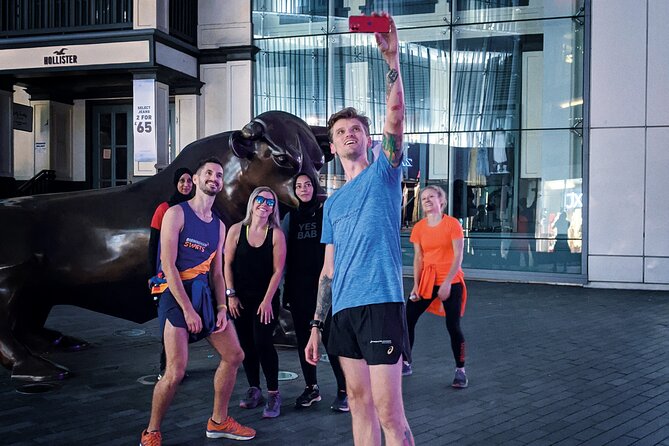
After some uphill running, you reach one of Birmingham’s best-known symbols, the bronze Bull. Your guide explains why bulls became important to the city and takes a photo of you beside it. Rubbing the Bull’s nose is optional, but it is a classic Birmingham ritual if you want a little luck.
This is one of the tour’s strongest photo stops. The guide handles the picture, so you do not need to ask a stranger or try to fit the whole group into a rushed selfie. For many people, that photograph will be the clearest record of the run.
You also pass the curved Selfridges building at Bullring, covered with 15,000 aluminium discs. It is an instantly recognizable part of Birmingham’s skyline and a sharp contrast to the older buildings elsewhere on the route.
The stop also covers the nearby market, which dates back to the twelfth century and continues to operate. That detail gives the shopping district a longer story than its modern malls might suggest. Birmingham’s commercial centre has changed form many times, but buying and selling have remained central to city life.
The hill before the Bull is worth noting. The tour is not flat from beginning to end, and this is one of the points where you may feel the distance. A moderate fitness level is sensible, especially if you are more accustomed to walking than running.
Victoria Square’s civic buildings and local nicknames
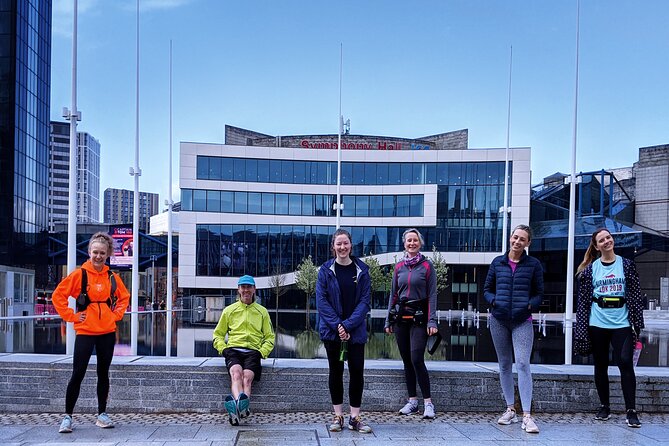
Victoria Square is the next major pause, with about ten minutes to take in several central landmarks. The group sees the Town Hall, Council House, Birmingham Museum and Art Gallery, Chamberlain Fountain, the Victoria statue, and the water feature locals call the Floozie in the Jacuzzi.
This is a good place for your guide’s local stories to do the work. The square has the grand civic feel of a European capital, and the comparison to Rome becomes part of the fun. You also hear why Queen Victoria supposedly disliked Birmingham so much, adding a bit of human drama to the official monuments.
Because so many buildings surround the square, this is a particularly efficient sightseeing stop. You cover major architecture without spending time walking between scattered sites. The tradeoff is that the information arrives quickly. If you want to tour Birmingham Museum and Art Gallery or study the civic buildings inside, plan another visit.
The Mailbox and the final canal return
After Victoria Square, you run a short 0.2 miles downhill to The Mailbox. This former postal building is now one of Birmingham’s high-end shopping and dining centres, recognized by its large red exterior.
The five-minute stop focuses on the building’s past and some underground secrets. It is a brief final look at how Birmingham has reused older commercial structures for modern city life.
From The Mailbox, the route heads uphill toward the canals and returns to Roundhouse Birmingham. You pass another notable canal-side building, public art, and a bridge that provides one more photo opportunity. The return section brings the experience full circle, linking the modern Mailbox and canal redevelopment with the industrial waterways seen at the beginning.
The finish at the original meeting point keeps logistics simple. You do not need to arrange transport from another part of Birmingham, and you can collect anything left at the start.
Is the $548.51 price good value?
At $548.51 per person, this is an expensive way to see Birmingham. The price needs careful thought, particularly because the activity lasts around two and a half hours and does not include bottled water.
The private format explains part of the cost. Only your group participates, and a dedicated Run Leader can give you more attention than a large public tour. You are also paying for a carefully planned route, running leadership, local interpretation, photo help at the Bull, snacks, and recommendations for the rest of your stay.
I would consider the price more reasonable for a small group that values privacy and wants an active introduction to the city. If several people share the experience, the personal format may feel worthwhile. For a solo visitor or couple comparing it with ordinary walking tours, the cost is harder to justify.
You should also factor in what the tour saves you. It covers distant districts in one outing, so you do not need separate transport or multiple short sightseeing trips. That convenience has real value if your Birmingham schedule is tight.
Pace, equipment, and practical planning
Bring your own bottled water. Snacks are provided, but the operator clearly says water is not, and running 12 kilometres without reliable hydration is poor planning.
Wear proper running shoes and clothing suited to the weather. The route includes canals, city streets, an uphill section, and several stops where you may cool down before starting again. Since the experience requires good weather, conditions can affect the schedule.
The activity is offered in English and uses a mobile ticket. It operates near public transportation, so reaching Roundhouse Birmingham should be manageable. Service animals are allowed.
The cancellation terms are strict. The experience is non-refundable and cannot normally be changed for any reason. If poor weather causes the operator to cancel, you can choose another date or receive a full refund. The same applies if the minimum number of participants is not reached, with the option of another date or experience.
Who should book this running tour?
I would recommend it to an active visitor who wants a fast overview of Birmingham and enjoys hearing local stories while moving. It is especially useful if you have only a short stay and want to connect the canals, historic districts, shopping areas, civic centre, and nightlife quarter in one outing.
It also suits runners who prefer sightseeing with a purpose. The stops prevent the tour from becoming a nonstop endurance run, while the distance gives you a proper workout.
I would hesitate if you are looking for a relaxed walking tour, have limited running fitness, dislike uphill sections, or want plenty of time inside museums and buildings. The route shows you many places, but most are viewed from outside.
The five-star feedback is encouraging, and Lucy is singled out for being friendly, enjoyable, and full of useful insight. Still, one review cannot guarantee that every guide will suit every personality. The private format gives you a better chance to communicate your pace and interests at the start.
Should you book the Best of Birmingham 12km Running Tour?
Book it if you want an active, private city introduction and the price fits your budget. The route is smart, varied, and much more revealing than a run confined to the central streets. The Jewellery Quarter, Digbeth, and canal sections give the experience its strongest local flavor.
Skip it if you mainly want value, indoor sightseeing, or a gentle introduction to Birmingham. At $548.51 per person, this is a specialist experience, not a bargain tour. For the right runner, though, it offers a memorable way to see a wide slice of the city before returning to explore your favorite districts at a slower pace.
FAQ
Where does the Birmingham running tour begin?
It begins at Roundhouse Birmingham, 1 Sheepcote Street, Birmingham B16 8AE, UK.
Where does the tour finish?
The activity ends back at Roundhouse Birmingham, the same location where it begins.
How long does the experience last?
It lasts approximately two hours and thirty minutes.
How far do you run?
The tour is advertised as a 12-kilometre running tour.
What language is the tour offered in?
The experience is offered in English.
Is this a private tour?
Yes. Only your group participates in the activity.
Is bottled water included?
No. Bottled water is not included, so you should bring your own water to stay hydrated.
Are snacks provided?
Yes. Snacks are provided during the experience.
What happens if bad weather cancels the tour?
If poor weather causes a cancellation, you will be offered a different date or a full refund. If the minimum number of participants is not reached, you can also be offered another date or experience, or receive a full refund.
Just added around Birmingham
- Birmingham to Heathrow Airport private taxi transfers★ 5.0 · 7 reviews
- Birmingham Private Self-Guided Walking Tour★ 4.0 · 13 reviews
- On the Origins of Charles Darwin: A Self-Guided Audio Tour of Shrewsbury★ 4.5 · 16 reviews
- Taste of Shrewsbury Food and Drink Tour with Guide★ 5.0 · 22 reviews
- Cotswolds Full-Day Tour From Birmingham★ 4.5 · 30 reviews
- From Birmingham Stonehenge and Bath Day Tour★ 4.5 · 33 reviews
- Birmingham Ghost Hunt: Haunted Self-Guide Tour & Quest★ 4.5 · 37 reviews
- 2.5-Hours Walking Tour of Birmingham into Black Heritage Madiba★ 5.0 · 49 reviews
Birmingham Tours, compared.

Entry ticket to Hoo Zoo and Dinosaur World in Telford
Read our review →
Birmingham Walking Tour: Canals, Victorians & Today (1:30pm)
Read our review →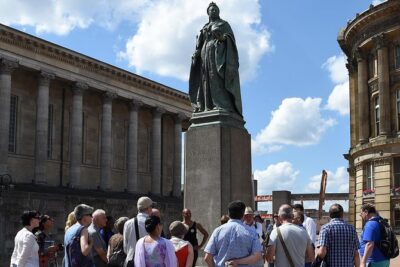
Discovering Birmingham 2 hour Walking Tour to the Jewellery Quarter
Read our review →
Birmingham Slogging Gangs Walking Tour with Edward Shelby
Read our review →
Birmingham City Centre Daily Walking Tour (10:30am & 2pm)
Read our review →
Fun, Flexible Treasure Hunt Around Birmingham with Cryptic Clues & Hidden Gems
Read our review →Browse the lists this tour appears in