
Reviewed · WALKING TOURS
Birmingham Private Self-Guided Walking Tour
Birmingham’s canals tell a surprising story. I like the low $12.26 price and the way Helen’s recorded narration links industrial waterways with modern squares, shopping streets, and community districts. I also like the freedom of a private tour, with no fixed group and three weeks of app access.
The catch is the technology. You need the Exploro app and clear access instructions before setting out. If the app link fails, or you miss that directions appear at the end of some written descriptions, the tour can become frustrating fast.
In This Review
- Key points at a glance
- Starting beside Birmingham’s old waterways
- Brindley Place, Sea Life, and the Roundhouse
- Centenary Square and Birmingham’s public face
- Victoria Square and St Philip’s Cathedral
- The Bullring, Grand Central, and St Martin’s Church
- Chinatown and Birmingham’s Gay Village
- How the audio app works in real life
- Timing, walking effort, and tour value
- Who should book this Birmingham walk?
- Final verdict: a useful route at a small price
- FAQ
- Where does the Birmingham walking tour start?
- Where does the tour finish?
- How long does the tour take?
- Is this a private tour?
- Is there an in-person guide?
- What does the tour include?
- What language is available?
- Are attraction admission tickets included?
- How much does the tour cost?
- Can I cancel or change the booking?
Key points at a glance
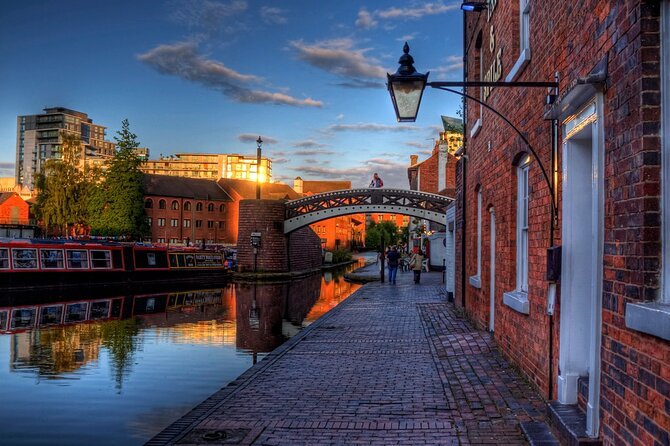
- 35 miles of canals: Gas Street Basin gives you a quick lesson in Birmingham’s industrial transport network.
- A city-centre route with variety: You move from Brindley Place and the Roundhouse to civic squares, the Bullring, Chinatown, and the Gay Village.
- Helen provides the audio: The narration is recorded by a real person, not a computer-generated voice.
- Plan on about three hours: The listed stops add up to roughly two hours, but one user needed just over three hours after allowing for walking and navigation.
- No attraction tickets are included: The route visits places such as the National Sea Life Centre, Library of Birmingham, and St Martin’s Church from the outside unless you choose to enter on your own.
- App preparation matters: Read the Before You Go section of your confirmation email and test access before your sightseeing time.
Starting beside Birmingham’s old waterways
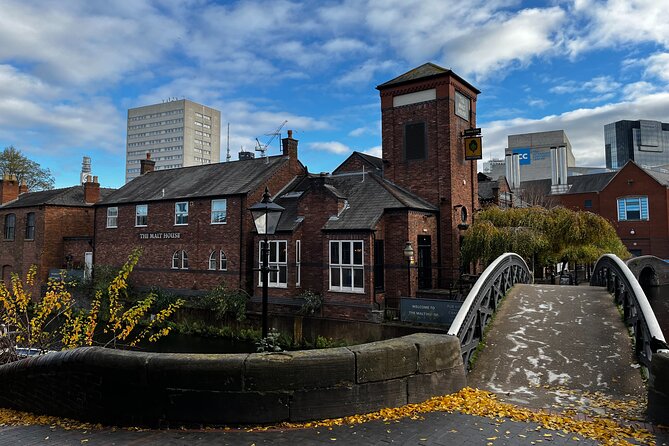
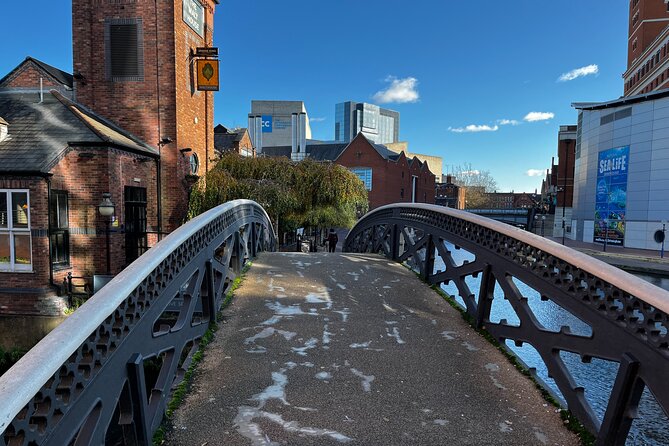
The tour begins at 197 Wharfside Street, Birmingham B1 1QH, near Gas Street Basin. This is a sensible starting point because the canal area gives you an immediate feel for the city’s industrial past before the route turns toward Birmingham’s newer public spaces.
Gas Street Basin is a compact stop, listed at about 15 minutes. Birmingham is often said to have more canals than Venice. That claim is not quite right, but the city does have about 35 miles of waterways, which is still an impressive figure. These canals were built to move coal, iron, and other goods, so the waterway is not just pleasant scenery. It explains why Birmingham grew into a major industrial centre.
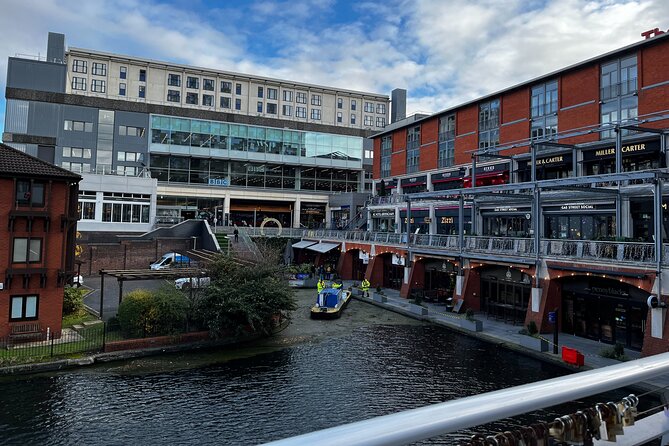
I would give yourself a few extra minutes here if you want to get your bearings. The official stop time is short, and the route has several turns ahead. You are also likely to pause for photographs, since the basin offers one of the clearest contrasts on the tour: old transport routes beside restaurants, offices, and modern apartments.
Brindley Place comes next, with about five minutes assigned to it. The area takes its name from James Brindley, the 18th-century engineer whose work helped improve Britain’s canal system. The stop is brief, but it adds useful context. You are not simply walking through a redeveloped district. You are seeing a modern part of Birmingham named for a man connected with the waterways that shaped the city.
More Walking Tours in Birmingham
- Birmingham Walking Tour: Canals, Victorians & Today (1:30pm)
★ 5.0 · 346 reviews - Discovering Birmingham 2 hour Walking Tour to the Jewellery Quarter
★ 5.0 · 333 reviews - Birmingham Slogging Gangs Walking Tour with Edward Shelby
★ 4.5 · 306 reviews
Brindley Place, Sea Life, and the Roundhouse
The National Sea Life Centre is one of the architectural highlights around Brindley Place. Admission is not part of the walking tour, but the audio guide provides information about it. That arrangement keeps the tour cheap, although it also means you should not assume every sight on the route is an included attraction.
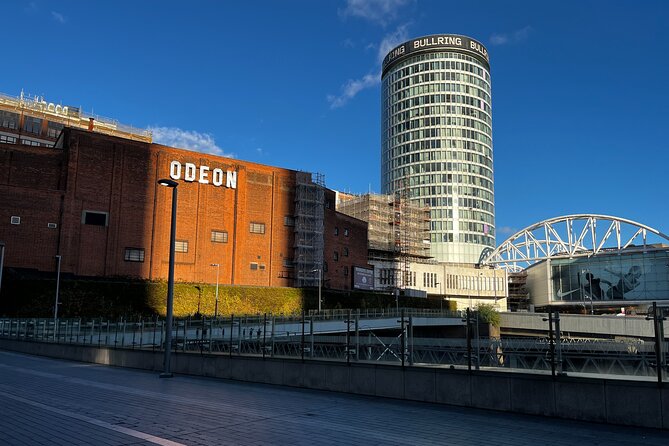
The Roundhouse Birmingham is one of the more unusual stops. Built in 1874 and designed by W. H. Ward, this circular building sits slightly away from the main tourist path. The listed stop takes only five minutes, but it may be one of the most rewarding moments for anyone who likes overlooked architecture.
The word hidden is often used too freely in travel writing, but the Roundhouse genuinely fits the idea of a less obvious city sight. It is not presented as Birmingham’s grandest building. Instead, it gives the walk a change of pace after the polished canalside development.
From there, the route passes Arena Birmingham and the International Convention Centre. These are modern event venues rather than long sightseeing stops. Arena Birmingham is a major entertainment venue, while the ICC has helped Birmingham attract large conferences and international events. Their value here is mainly visual and civic: they show how the city has repurposed its central canal district for present-day business and culture.
Centenary Square and Birmingham’s public face
Centenary Square receives about ten minutes. Its story reaches back to the late 19th century, when it was part of Birmingham’s urban planning. It was first called Congreve Square, after Sir William Congreve, a British Army officer, politician, and inventor.
The square is a useful transition point. The early route focuses on canals and industrial development. Here, the subject becomes public life, civic buildings, and the way Birmingham presents itself to residents and visitors. The audio format works well in a place like this because a short explanation can give meaning to an otherwise open city space.
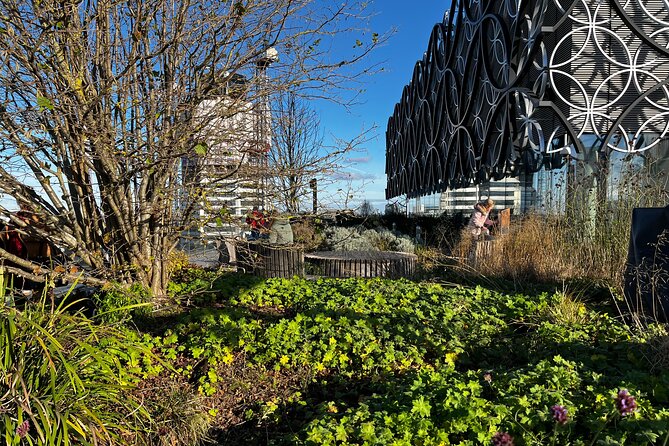
The Library of Birmingham is the next major stop, also allocated ten minutes. Its predecessor, the Birmingham Library, was established in 1861. The route gives you the background and helps place the library within the city’s longer interest in public learning.
You should note the difference between an audio stop and a museum visit. The tour tells you why the building matters, but it does not include a guided interior visit or an admission ticket. If you want to spend time inside, you will need to make that decision separately and allow more than the suggested tour duration.
Chamberlain Square follows, with another ten minutes. It was named for Joseph Chamberlain, an important Birmingham political figure, and was originally known as Corporation Street Square. The stop pairs naturally with the Library of Birmingham because both help explain the city’s civic identity.
Victoria Square and St Philip’s Cathedral
Victoria Square is listed at about ten minutes. It was once called Council House Square and received its current name in 1901, in honour of Queen Victoria’s Diamond Jubilee.
This is the kind of stop that benefits from audio commentary. On its own, a square can seem like a place you cross on the way to somewhere else. A short account of its former name and renaming gives you a reason to look around and notice how the city’s public spaces reflect changing politics and royal ceremonies.
St Philip’s Cathedral Garden comes next. St Philip’s Cathedral, commonly called Birmingham Cathedral, dates from the early 18th century and is described as the third-smallest cathedral in the United Kingdom. The stop is again about ten minutes.
The garden offers a calmer break from the traffic and retail streets. You can expect the tour to focus on the cathedral’s background rather than provide a formal religious tour. Since the route is self-guided, you control how long you pause, but the listed schedule assumes a quick visit.
At this stage, the route has already covered industrial Birmingham, modern redevelopment, public squares, education, politics, and religion. That range is one of the tour’s strongest features. It does not limit itself to one postcard view of the city.
More Walking Tours:
- Birmingham City Centre Daily Walking Tour (10:30am & 2pm)
★ 5.0 · 265 reviews - Birmingham Gangs Nighttime Historical Walking Tour with Pub Stops
★ 5.0 · 53 reviews - 2.5-Hours Walking Tour of Birmingham into Black Heritage Madiba
★ 5.0 · 49 reviews - Oxford University Walking Tour With University Alumni Guide
★ 5.0 · 6,905 reviews
The Bullring, Grand Central, and St Martin’s Church
The route then heads toward Bullring and Grand Central Birmingham. This stop is assigned 15 minutes, making it one of the longer pauses.
Grand Central sits next to Birmingham New Street Station. The station has Victorian roots, while the present shopping complex offers more than 60 shops and restaurants in its atrium. You get a useful look at the city’s transport and retail centres in one place.
The contrast is clear. New Street Station brings people into Birmingham, Grand Central gives them places to shop and eat, and the nearby Bullring continues the city’s long commercial tradition. This is not an old-world square, but it is important to understanding how Birmingham works today.
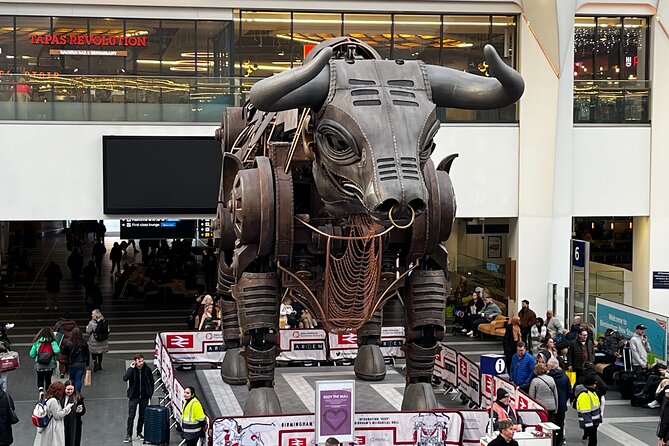
The Bull Statue is an extra point of interest along the way. It represents strength, resilience, and the city’s industrial character. It is also one of the route’s easiest visual markers, useful if you need to confirm that you are still in the right area.
St Martin’s Church Centre receives ten minutes. Officially St Martin in the Bull Ring, it is Birmingham’s oldest parish church, with roots going back more than 800 years. Its location beside the modern Bullring makes it especially effective as a sightseeing stop.
You get one of Birmingham’s best old-and-new contrasts here: a historic church beside a large modern shopping centre. The tour does not turn this into a long church visit, so check the time if you want to explore inside. The short stop is enough to understand why the building matters, but not necessarily enough for a detailed look.
Chinatown and Birmingham’s Gay Village
Birmingham Chinatown is next, with about ten minutes. The Chinese Quarter brings food, cultural traditions, and community history into the centre of the route. The description promises a look at the district’s character rather than a food tasting or restaurant booking, so treat this as a walking and listening stop.
This is also a point where the tour becomes more about living communities than monumental buildings. The city centre is not presented only through civic architecture. Chinatown shows how different cultural traditions have shaped everyday Birmingham.
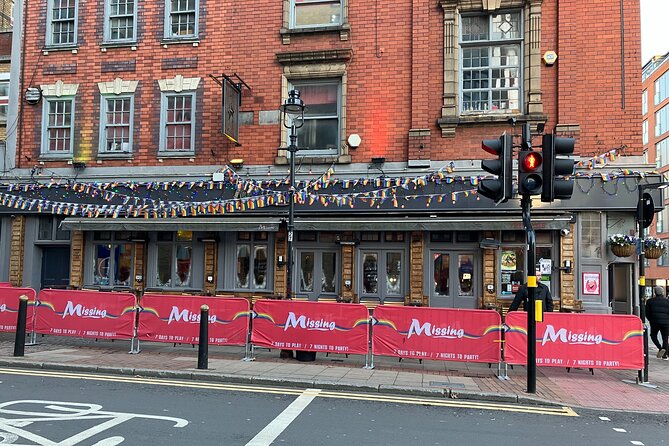
The final stop is Birmingham’s Gay Village, allocated 15 minutes. The district is described as inclusive and colourful, with a strong connection to LGBTQ+ community history, resilience, and progress.
Ending here is a smart choice. You finish in an active city-centre district rather than at a transport station or isolated monument. The tour ends in the Gay Village, and you are free to continue wandering around central Birmingham afterward.
The final location also gives the walking tour a broader social scope. You begin with canals built for coal and iron, then pass through venues, squares, shops, religious buildings, Chinatown, and a district tied to LGBTQ+ life. That variety is more useful than a route that simply strings together famous façades.
How the audio app works in real life
This is not a walking tour with a person waiting at the start. It is a private, self-guided activity delivered through the Exploro app. You receive three weeks of unlimited access, along with a map, GPS route, directions, stop information, audio, videos, photos, and recommendations.
Helen provides the recorded narration, and the audio is not computer-generated. That matters because a human voice can make a short explanation feel more natural and easier to follow.
The main weakness is the setup process. You must create or access an Exploro account, and the confirmation email tells you to check the Before You Go section. Do this before you arrive at the starting point, not while standing beside the canal.
Some directions appear at the end of the written descriptions. If you read only the opening text for each stop, you might miss the next turn. One user skipped several early points for this reason but managed to get back on route. That is a useful warning: read the full entry, then check the map before moving on.
There have also been cases where the access link caused confusion and required an external browser. The provider says the tour should be available directly inside the app once you are logged in, but you should still allow time to solve access problems before your planned walk.
Timing, walking effort, and tour value
The experience is advertised as roughly two to three hours. The stop times add up to around two hours, but the actual outing can run longer once you include walking between locations, photo stops, pauses to read directions, and any time spent getting the app working.
A little over three hours is a realistic planning figure if you prefer not to hurry. The tour requires moderate physical fitness, so expect a city walk rather than a seated attraction. No exact distance is provided, and you should not treat the listed minutes as a promise that the entire route can be completed in that time.
At $12.26 per person, the price is attractive for a private activity. If two or more people share the tour, you are paying for a flexible route, recorded narration, and access to supporting media rather than a live guide. That makes the value strongest for independent visitors who enjoy walking and want a framework for seeing central Birmingham.
The value is weaker if you expect personal explanations, spontaneous questions, or someone to rescue you when navigation goes wrong. There is no in-person guide. You are responsible for your phone, app access, route decisions, and pace.
All listed stops are free to visit from the route, but entrance to the National Sea Life Centre is not included. The same practical rule applies to any interior visit you choose to make at other sights. The tour price covers the self-guided content, not extra attraction tickets.
Who should book this Birmingham walk?
I would recommend it to a first-time Birmingham visitor who wants a broad introduction in one outing. It is especially useful if you like moving between different parts of a city and prefer to stop, pause, or replay audio whenever you choose.
It also suits couples, families with older children, and small private groups who do not want to join a fixed walking party. The three-week access period gives you room to split the route across more than one day, although the experience is designed as one walk.
You may want a different option if you dislike phone-based tours or want a human guide. The app problems are not a minor detail, since two poor experiences came from confusion before the walk even began. I would download the app, sign in, open the tour, and confirm the route before your sightseeing day.
The route is also less suitable if you want extended time inside museums, churches, or attractions. Its strength is the connected story of Birmingham’s streets and districts, not long visits at individual buildings.
The cancellation policy is strict: the experience is non-refundable and cannot be changed for any reason. That makes early technical checks even more important.
Final verdict: a useful route at a small price
Book this tour if you want a low-cost, flexible introduction to Birmingham and are comfortable guiding yourself with an app. The canals, Roundhouse, civic squares, Bullring, St Martin’s Church, Chinatown, and Gay Village give you a varied three-hour outline of the city.
Skip it if you need a live guide or do not want to troubleshoot technology. For everyone else, the price is fair, the route covers more than the obvious shopping core, and Helen’s human narration adds welcome direction. Prepare the app first, read every stop description fully, and allow closer to three hours than two.
FAQ
Where does the Birmingham walking tour start?
It starts at 197 Wharfside Street, Birmingham B1 1QH, near Gas Street Basin.
Where does the tour finish?
It finishes in Birmingham’s Gay Village. Afterward, you are free to continue walking around Birmingham city centre.
How long does the tour take?
The estimated duration is two to three hours. Allow extra time for walking, photographs, navigation, and pauses.
Is this a private tour?
Yes. Only your group participates, and there is no shared group with other participants.
Is there an in-person guide?
No. This is a self-guided tour delivered through the Exploro app. Helen provides the recorded audio narration.
What does the tour include?
It includes three weeks of unlimited access to the self-guided tour, a map, GPS route, directions, stop information, audio, videos, photos, and recommendations.
What language is available?
The tour is offered in English.
Are attraction admission tickets included?
No. Admission tickets are not included. In particular, entry to the National Sea Life Centre is not part of the tour price.
How much does the tour cost?
The listed price is $12.26 per person.
Can I cancel or change the booking?
No. The experience is non-refundable and cannot be changed for any reason.
Just added around Birmingham
- Birmingham to Heathrow Airport private taxi transfers★ 5.0 · 7 reviews
- Best of Birmingham 12km Running Tour★ 5.0 · 12 reviews
- On the Origins of Charles Darwin: A Self-Guided Audio Tour of Shrewsbury★ 4.5 · 16 reviews
- Taste of Shrewsbury Food and Drink Tour with Guide★ 5.0 · 22 reviews
- Cotswolds Full-Day Tour From Birmingham★ 4.5 · 30 reviews
- From Birmingham Stonehenge and Bath Day Tour★ 4.5 · 33 reviews
- Birmingham Ghost Hunt: Haunted Self-Guide Tour & Quest★ 4.5 · 37 reviews
- 2.5-Hours Walking Tour of Birmingham into Black Heritage Madiba★ 5.0 · 49 reviews
Walking Tours, compared.

Oxford University Walking Tour With University Alumni Guide
Read our review →
Tour for Muggles The Ultimate Harry Potter Walking Tour in London
Read our review →

Cambridge University Walking Tour by Alumni™ Kings College Option
Read our review →
Blackbeard to Banksy – The Ultimate Walking Tour of Bristol
Read our review →
Air Raid Shelter + St. Nicholas Market Walking Tour
Read our review →
Walking Tour of Bath with Blue Badge Tourist Guide
Read our review →
Changing of the Guard Guided Walking Tour in London
Read our review →Browse the lists this tour appears in