
Reviewed · WALKING TOURS
Bristol Harbourside Self-Guided Walking Tour
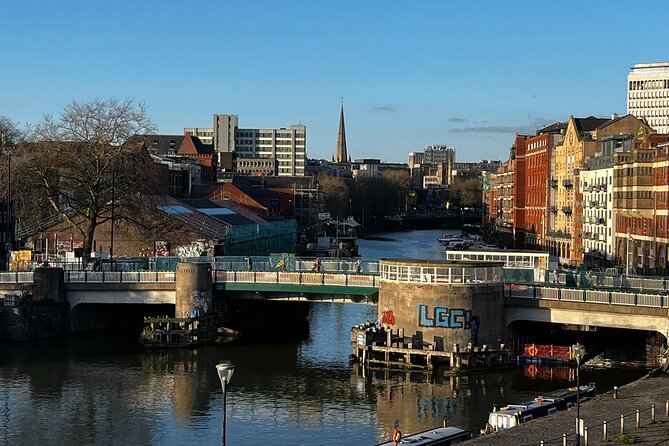
Bristol’s waterfront tells several centuries of stories. This self-guided walk links marshland, medieval streets, Georgian squares, old docks, caves, museums, and Brunel’s famous ship for about two to three hours. I like the freedom to pause whenever you wish, and I like that Helen’s narration uses a real human voice rather than a computer-generated one. The main concern is navigation: unclear street names, blocked access, or detours can make the route longer than advertised.
You get three weeks of access, GPS directions, photographs, videos, recommendations, and an audio guide for $12.33 per person. That is a fair price if you want historical context without joining a group, but this is not the choice for anyone who wants an in-person guide to steer the way.
In This Review
- Key things to know before walking
- Start at Millennium Square and Canon’s Marsh
- Pero’s Bridge and Bristol’s complicated past
- College Green brings churches, art, and civic life
- King Street and Queen Square reveal old Bristol
- Welsh Back and Castle Park connect trade with medieval Bristol
- Bridge Quay offers the best pause for orientation
- Redcliffe covers churches, sandstone, and caves
- Bathurst Basin and Princes Wharf show the working docks
- The Matthew and M Shed add human stories
- Wapping Wharf leads toward Brunel’s great ship
- Audio, app access, and walking conditions
- Is $12.33 good value?
- Who should choose this Bristol walk?
- Should you book it?
- FAQ
- How long does the Bristol Harbourside Self-Guided Walking Tour take?
- What language is the tour offered in?
- How much does the tour cost?
- Is there an in-person guide?
- How long can I access the tour?
- What does the app include?
- Where does the tour start?
- Where does the tour end?
- Are admission tickets included?
Key things to know before walking
- A harbour walk with a full city story: The route covers Bristol’s docks, medieval centre, Georgian squares, churches, caves, and maritime past.
- Helen provides the narration: The audio uses a named human guide, with photographs, videos, and extra recommendations in the app.
- Three weeks of access: You can return to parts of the route instead of trying to absorb everything in one outing.
- Free sights shape the value: The walk itself includes no admission charges, with optional time for places such as M Shed and the SS Great Britain.
- The route is private but not guided in person: Only your group uses the tour, yet you must manage directions, timing, and detours yourself.
- Navigation deserves attention: At least one route experience included unclear directions, unnamed streets, blocked paths, and a much longer walk than expected.
Start at Millennium Square and Canon’s Marsh
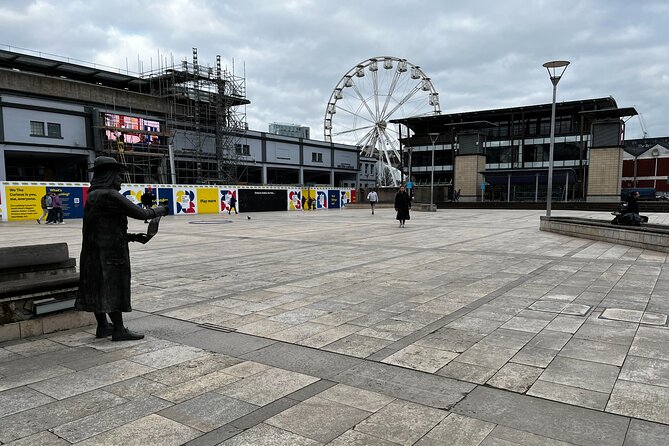
The walk begins at Millennium Square, on land once known as Canon’s Marsh. This was originally wet ground where the River Frome met the Avon. The marsh was drained and developed in the early 18th century, giving you a useful first lesson in Bristol’s geography: the modern waterfront grew from a meeting point of rivers, mud, trade, and engineering.
Allow about 10 minutes here. The square itself is modern, but the story reaches back to the physical foundations of the city. I like this kind of opening because it gives you a reason to look beyond the present buildings. You are not just walking beside water. You are following the places where Bristol changed its shape.
Next comes the Bristol Amphitheatre and Waterfront Square, a brief five-minute stop. Skateboarders often use the amphitheatre, and the site offers an interesting contrast with other parts of the city where design has been used to prevent skating. That small detail brings the waterfront into the present instead of treating it like a museum piece.
More Walking Tours in Bristol
- Blackbeard to Banksy – The Ultimate Walking Tour of Bristol
★ 5.0 · 1,961 reviews - Air Raid Shelter + St. Nicholas Market Walking Tour
★ 5.0 · 1,950 reviews - Ghosts, Ghouls & Gallows :The Original Bristol Ghost Walk
★ 5.0 · 262 reviews
Pero’s Bridge and Bristol’s complicated past
Pero’s Bridge opened in 1999 and honours an important local figure in Bristol’s past. The bridge’s pair of horn-shaped sculptures gives the stop an immediate visual clue, and Helen explains both the person commemorated and the meaning of the design.
This is one of the places where a short stop can carry serious weight. Bristol’s prosperity was tied to Atlantic trade, and the story of Pero’s Bridge points you toward the people and systems behind that wealth. Five minutes may be enough for the audio, but you may want to pause longer and look carefully at the bridge itself.
The next harbour stop recalls the medieval development of the city beside the Avon and Frome. The approximate site is marked by present-day fountains. It is a useful moment to connect the rivers with Bristol’s early settlement and to note recommendations for nearby places worth visiting later.
College Green brings churches, art, and civic life
College Green is a 15-minute stop and one of the more varied sections of the walk. It is a popular gathering place, and the audio introduces an important abbey, works by a major artist, another chapel, and a museum.
The strength here is variety. You are not hearing only about ships and warehouses. Religious buildings, public art, and museums show how Bristol’s identity was shaped by worship, culture, and civic life as well as commerce.
The stop is also a good place to make your own decision about pacing. The standard tour time is short, but the area offers enough material to justify a longer pause if you want photographs or plan to visit one of the museums mentioned in the narration.
King Street and Queen Square reveal old Bristol
King Street takes about five minutes, yet the audio helps you picture a much busier working waterfront. Ship captains, traders, and dock workers once moved goods between boats and stores here. That image is valuable because today’s pleasant streets can hide the noise and labour that once defined them.
Queen Square follows with another five-minute stop. This Georgian park is surrounded by trees, cobbled streets, and historic houses. Before its construction, the area was marshland used for dumping rubbish and practising with weapons. Houses began to appear in 1699, starting on the south side.
I like the pairing of these two stops. King Street shows commerce at close quarters, while Queen Square shows the planned, respectable city that developed as Bristol grew wealthier. You can hear how land once considered marginal became an address for substantial homes.
More Walking Tours:
- Guided Walking Tour of Bristol Old City and Harbour
★ 5.0 · 166 reviews - Guided Walking Tour Suspension Bridge Clifton Splendour & City.
★ 5.0 · 100 reviews - Oxford University Walking Tour With University Alumni Guide
★ 5.0 · 6,905 reviews - Tour for Muggles The Ultimate Harry Potter Walking Tour in London
★ 5.0 · 4,684 reviews
Welsh Back and Castle Park connect trade with medieval Bristol
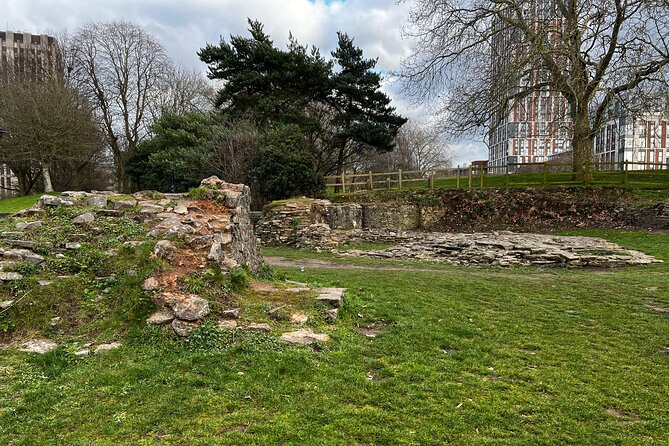
Welsh Back is a 10-minute stop with an unusual name and a long working past. The area remains active in the evening, with bars, restaurants, and some dining boats. Helen explains how the name relates to Bristol’s history, giving you a small piece of local vocabulary with a practical connection to trade.
Castle Park shifts the story back to Bristol’s medieval settlement. The park occupies the site of the old castle, so the open space carries the memory of a fortified urban centre. Allow five minutes for the audio, though the historical setting rewards a slower look.
This section is especially useful if you want to understand how Bristol moved from a medieval settlement to a trading city. The route does not isolate each period. It places them beside one another, which is exactly how the city feels when you walk it.
Bridge Quay offers the best pause for orientation
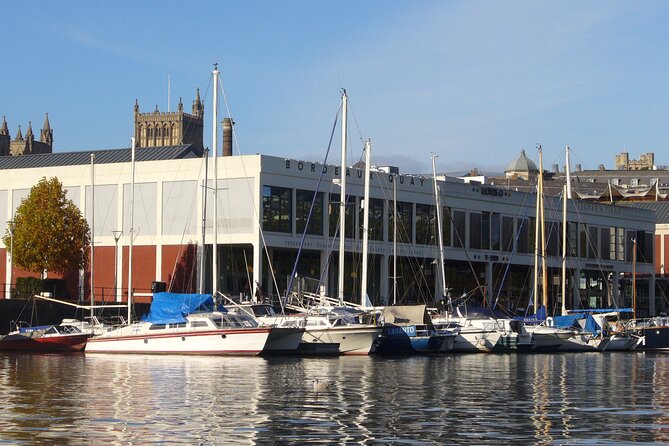
At Bridge Quay, you get a view toward Bristol Bridge, with St Peter’s, St Nicholas’, and St Mary Le Port churches in the background. The stop takes about five minutes, but it may be one of the most helpful for understanding the city’s beginnings.
Bristol Bridge is believed to be where the settlement began. Take a moment to watch the water and match the churches to the audio. This is a good spot to regain your bearings if you have been concentrating on the narration and directions.
The route’s navigation issue matters here and throughout the walk. One person found that some streets were not named clearly and that blocked access caused detours. If the GPS route does not match what you see, stop rather than following it blindly. Check the map, confirm the next landmark, and allow extra time.
Redcliffe covers churches, sandstone, and caves
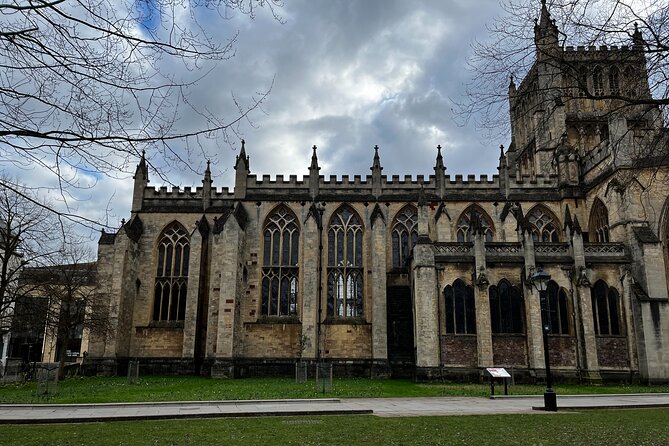
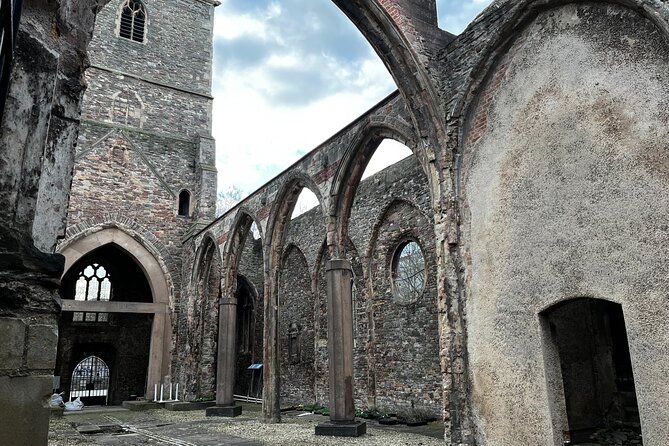
St Mary Redcliffe Church is a five-minute stop in the Redcliffe district. The church visible today is not the original building from the time of Henry I. That earlier church fell into disrepair and was rebuilt in the 14th century.
The stop is brief, but the building gives the surrounding area a strong historical anchor. The story also reminds you that old Bristol is not a single untouched town. Churches were repaired, rebuilt, and reshaped as the city changed.
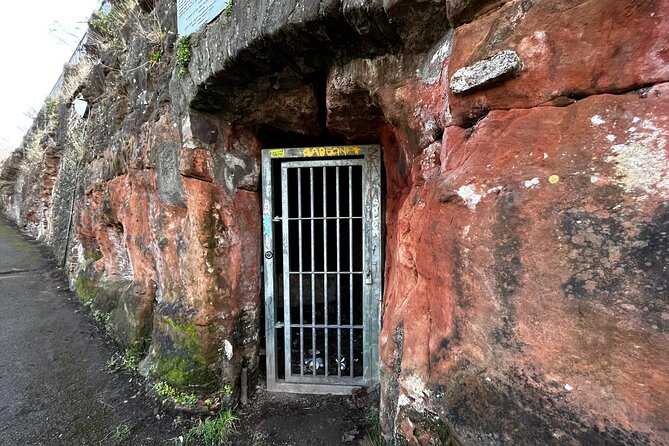
Redcliffe Caves takes about 10 minutes. The district gets its name from the bright red Triassic sandstone visible here, and houses along Redcliffe Wharf sit above a cave system that extends toward St Mary Redcliffe Church.
You should treat this as an exterior stop unless the app specifically tells you otherwise. The supplied details describe the cave system and the setting, but they do not promise entry. That distinction matters when you are planning your time.
Bathurst Basin and Princes Wharf show the working docks
Bathurst Basin lost its water supply when the New Cut was dug in 1809. At the basin entrance, the Ostrich pub dates from around 1745 and once served sailors, dock workers, and merchants.
This is a short historical aside, but it helps you read the waterfront as a working place. Old pubs were not just decorative survivors. They served the people who loaded cargo, travelled by sea, and worked long hours around the docks.
At Princes Wharf, you see how much Bristol has changed. Almost all the city docks are now closed to cargo ships, yet clues to their trading past remain if you look closely. The stop lasts about 10 minutes and is best approached with curiosity. Watch for old dock features and think about the scale of the goods movement that once filled this area.
The Matthew and M Shed add human stories
The Matthew of Bristol is a replica of the ship John Cabot sailed to the Americas in 1497. The replica may look surprisingly small, but it crossed the Atlantic to Canada in 1997 to mark the 500th anniversary of Cabot’s journey.
That detail makes the ship more than a waterfront prop. Its size helps you consider what an Atlantic voyage meant in the late 15th century, while its later crossing shows how Bristol has used maritime history to connect past and present.
M Shed is a free museum about Bristol and deserves more than a quick glance if you have time. The building is one of the few parts of the harbourside to retain all its original features. The tour allows about 15 minutes here, but the museum is an optional extension, not something you need to rush through to complete the audio route.
I would plan this section carefully. If you want to enter M Shed, save time rather than treating the 15-minute estimate as a fixed museum visit. The free admission improves the value of the walk, especially if you want more local context without adding another ticket.
Wapping Wharf leads toward Brunel’s great ship
Wapping Wharf was once used for shipbuilding and repair. In the 1800s, Bristol Docks were packed with boats loading and unloading goods, a sharp contrast with the area’s present-day appeal.
This stop is only about five minutes, but it gives you another useful before-and-after comparison. Modern waterfront development can make a dock look calm and polished. The audio helps you picture the heavy work that happened here.
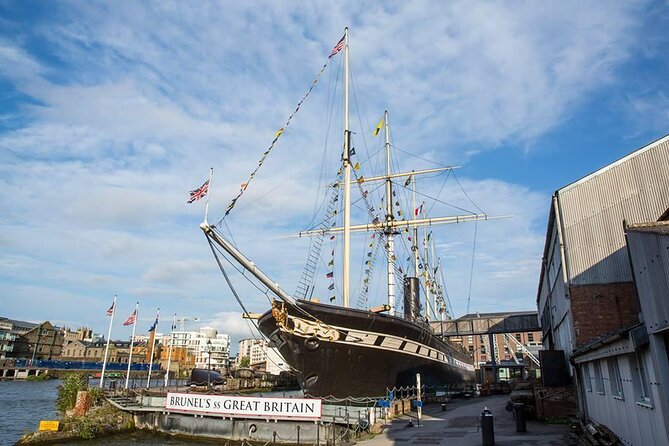
The route then brings you to Brunel’s SS Great Britain. Isambard Kingdom Brunel built the ship on this dock. Launched in 1843, it was the largest ship of its time and the first constructed using iron. It was described at launch as the greatest experiment since creation.
The supplied tour details identify SS Great Britain as the endpoint, at Great Western Dockyard on Gas Ferry Road. Other tour information describes the ending as central, so check the app’s current map and final instructions before setting out. Either way, this is a sensible place to finish because the ship gathers together the themes of engineering, shipping, trade, and Bristol’s connection to the wider world.
Audio, app access, and walking conditions
The tour provides three weeks of unlimited access through the app. That is one of its strongest practical features. You can split the route across more than one outing, repeat a section, or return to a stop after visiting a museum.
The app includes a map, directions, GPS route, stop information, photographs, videos, recommendations, and audio narration from Helen. The human voice is a meaningful advantage. It should feel more like listening to a local storyteller than following a machine-generated announcement.
You receive an email with activation instructions. The booking reference is not the activation code, so read the instructions carefully before you arrive. Also check the Before You Go section of your ticket, since that is where the current operating information is provided.
There is no in-person guide. Your group participates privately, but that means you are responsible for starting the audio, watching the route, and dealing with any access problem. The experience is near public transportation, service animals are allowed, and most people can participate according to the supplied details.
The advertised time is two to three hours, but I would not build a tight schedule around it. The route contains many short stops, and the navigation problem described above could add substantial time. Add room for pauses, photos, museum visits, and wrong turns.
Is $12.33 good value?
At $12.33 per person, the price is reasonable for a self-guided city walk with three weeks of access and multimedia content. The free admission at every listed stop keeps the basic outing inexpensive.
The value is best if you want structure but not a fixed group. You can walk at your own pace, pause for food, return to a favourite area, or stop the audio when you need a break. A private format also means you do not have to match another group’s speed.
The price is less attractive if you need firm route supervision. The experience does not include a person walking beside you, and one reported attempt ended halfway after directions became difficult to follow. Bristol’s changing access points make the map and GPS tools important, not optional extras.
The non-refundable policy is another practical factor. Once booked, you cannot change or cancel for a refund, so purchase only when your plans are reasonably secure.
Who should choose this Bristol walk?
I would recommend it to independent visitors who enjoy history in small portions and like having control over the day. It suits people interested in maritime trade, medieval Bristol, Georgian architecture, churches, industrial change, and Brunel’s engineering.
It is also a good fit if you want a private activity for your own group and prefer a real recorded narrator to a synthetic voice. The three-week access period helps if you are staying in Bristol long enough to divide the route.
I would be cautious if you dislike GPS walking, have a very tight timetable, or expect a guide to solve route problems in person. The walk covers a lot of ground, and the official two to three hours may not allow for every detour or optional museum visit.
Should you book it?
Book this tour if you want an affordable framework for seeing Bristol’s harbourside and historic centre, and if you are comfortable checking a map when needed. Helen’s narration, the wide range of subjects, and the three weeks of access give the experience genuine value.
Skip it if you need flawless directions or a live guide. For everyone else, keep extra time in hand, read the activation instructions before arrival, and treat the route as a flexible city walk rather than a timed march.
FAQ
How long does the Bristol Harbourside Self-Guided Walking Tour take?
The estimated duration is approximately two to three hours.
What language is the tour offered in?
The tour is offered in English.
How much does the tour cost?
The listed price is $12.33 per person.
Is there an in-person guide?
No. This is a self-guided experience with audio narration from Helen rather than an in-person guide.
How long can I access the tour?
You receive three weeks of unlimited access to the self-guided tour in the app.
What does the app include?
It includes a map, directions, GPS route, stops, audio narration, videos, pictures, recommendations, and related information.
Where does the tour start?
The listed starting point is 9C3VC9XX+WRRC9XX+WRR in Bristol, United Kingdom.
Where does the tour end?
The listed endpoint is Brunel’s SS Great Britain at Great Western Dockyard, Gas Ferry Road, Bristol BS1 6TY.
Are admission tickets included?
The listed stops have free admission. M Shed is also free to enter, while the supplied information does not state that entry to SS Great Britain or any other paid attraction is included.
Just added around Bristol
- Bristol private pub hopping and sightseeing with local guide★ 5.0 · 6 reviews
- Afternoon Bath City Tour – Private tour from Bristol with a local guide★ 5.0 · 7 reviews
- Brunel’s Bristol: A Self-Guided Tour from SS Great Britain to Clifton Bridge★ 4.5 · 11 reviews
- Wine & Cheese in the Somerset Valleys – with Michelin-star lunch!★ 5.0 · 12 reviews
- 4 Day Tour in Cornwall, Devon and Stonehenge from Bristol★ 4.5 · 14 reviews
- Bristol Old City Food & drink Tour★ 5.0 · 15 reviews
- Cocktail Classes in Bristol, England★ 4.5 · 15 reviews
- Self-Guided Craft Beer Tour (Explore Old Market)★ 4.5 · 19 reviews
Walking Tours, compared.

Oxford University Walking Tour With University Alumni Guide
Read our review →
Tour for Muggles The Ultimate Harry Potter Walking Tour in London
Read our review →

Cambridge University Walking Tour by Alumni™ Kings College Option
Read our review →
Blackbeard to Banksy – The Ultimate Walking Tour of Bristol
Read our review →
Air Raid Shelter + St. Nicholas Market Walking Tour
Read our review →
Walking Tour of Bath with Blue Badge Tourist Guide
Read our review →
Changing of the Guard Guided Walking Tour in London
Read our review →Browse the lists this tour appears in