
Reviewed · WALKING TOURS
Best Of Liverpool Heritage, History & Culture Guided Walking Tour
Liverpool reveals itself on foot.
This 2-hour-15-minute walking tour links the city’s maritime past, grand civic buildings, Ropewalks district, and Beatles landmarks in one well-planned route. I like the way it gives first-time visitors a clear sense of Liverpool’s layout, and I especially like that local guides such as Mike, Carl, Pam, Allan, and Roy bring personal warmth and humor to the facts. The main drawback is that the pace can feel brisk, and the route may change, with a few listed stops not always reached.
At $31.90 per person, the tour offers solid value if you have limited time or want context before exploring alone. You will not go inside major museums or attractions, and food and drinks are not included, but you will cover a surprising amount of central Liverpool without dealing with traffic or transport.
In This Review
- Six useful things to know before you book
- Starting at the Bluecoat on School Lane
- Ropewalks and the old Sailors Home
- Campbell Square and the converted Victorian gaol
- Thomas Steers Way and Liverpool’s buried dock story
- Royal Albert Dock and Liverpool’s maritime identity
- Meeting the Beatles at the waterfront statue
- The Three Graces and the waterfront skyline
- Castle Street and Liverpool Town Hall
- Exchange Flags and the Nelson Monument
- Derby Square and the route toward Mathew Street
- What the guides add to the experience
- Price, timing, and practical value
- Who should book this Liverpool walk?
- Should you book the Best Of Liverpool walking tour?
- FAQ
- Where does the tour begin?
- Where does the tour finish?
- How long does the walking tour last?
- Is the Beatles Statue included?
- Is the Cavern Club included?
- Is the route difficult?
- Can children and dogs join the tour?
Six useful things to know before you book
- Start at the Bluecoat: Meet outside Liverpool’s oldest surviving arts centre on School Lane, close to the city centre.
- See two sides of Liverpool: The route moves from Ropewalks and medieval streets to the waterfront and the Three Graces.
- The Beatles appear, but do not dominate: You pass the Beatles Statue and finish near Mathew Street and the Cavern quarter.
- Expect local storytelling: Guides including Mike, Carl, Pam, Allan, Roy, Colleen, and Paul are praised for humor, energy, and strong knowledge of Liverpool.
- Plan for cobbles and weather: There are no hills or stairs, but comfortable, non-slip shoes and a bottle of water are sensible.
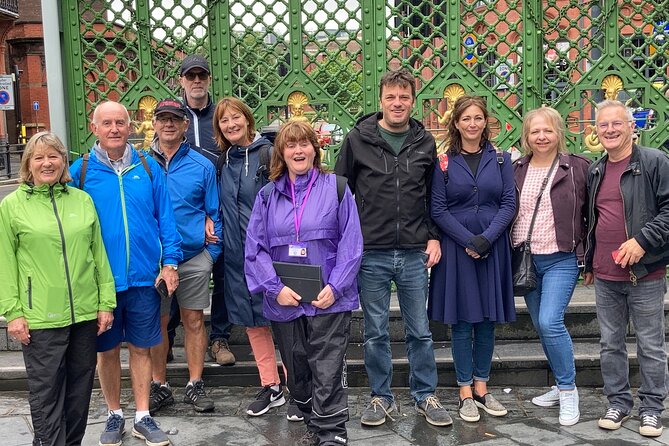
- Small groups help: The maximum is 20 people, though some departures may be much smaller and feel almost private.
Starting at the Bluecoat on School Lane
The tour begins at the front gates of the Bluecoat building, School Lane, Liverpool L1 3BX. This is a useful city-centre meeting point, and the opening stop immediately gives you a taste of Liverpool’s cultural life.
Your guide sets the tone here before leading you toward the old maritime quarter. The Bluecoat is not a long stop, so do not expect an interior visit as part of the tour. Its value is mainly as a meeting place and a first clue that Liverpool is much more than a Beatles destination.
You should arrive ready to walk. The tour is conducted in English, uses a mobile ticket, and lasts a little over two hours. Since the group may include people with different walking speeds, a comfortable pace matters. One useful detail from the tour’s feedback is that guides tend to answer questions readily, especially when the group is small.
More Historical Tours in Liverpool
- A Walk Through Time: History of Liverpool Walking Tour
★ 5.0 · 911 reviews - History Guided Tour of Liverpool and the Beatles
★ 5.0 · 408 reviews - Liverpool Hidden History and Dead House Evening Walking Tour
★ 5.0 · 200 reviews
Ropewalks and the old Sailors Home
The first stretch takes you to the Liverpool Sailors Home Gateway, a striking monument connected with the maritime community. It also provides a good photo stop, particularly because of the golden Liver bird.
This is a smart early introduction to Liverpool’s working past. The city’s waterfront fame can make it easy to focus only on grand buildings and famous bands, but the Sailors Home points toward the people who passed through Liverpool for work, trade, and sea travel.
From there, the walk continues to Henry Street in the Ropewalks district. The name comes from the rope-making trade that once served sailing ships. You spend about 15 minutes in this area, where the street pattern and older buildings help explain how industries shaped the city beyond the docks.
I like this part because it gives you a physical sense of Liverpool’s former trades. You are not simply being shown a postcard view. You are walking through a district whose name still preserves what happened there.
Campbell Square and the converted Victorian gaol
Campbell Square is tucked close to Ropewalks and offers one of the tour’s more unexpected sights: The Bridewell, a former Victorian gaol now converted for another use.
Depending on access, you may get a look inside one of the original cells. That small possibility adds character to the stop, though you should not treat it as a guaranteed interior visit. The tour is mainly outdoors, and operational changes can affect access.
This is the sort of stop that helps the walk feel less predictable. It connects Liverpool’s polished centre with a grittier piece of its past. If you enjoy old buildings, unusual urban details, and stories that do not appear on every standard sightseeing route, Campbell Square should appeal.
Thomas Steers Way and Liverpool’s buried dock story
At Thomas Steers Way, the guide turns to the city’s first dry dock and the maritime development that followed. A large fountain marks the site, and you can take a quick look down through a port hole.
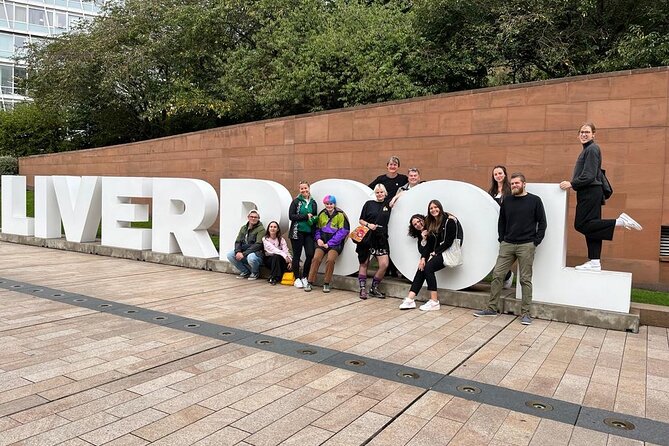
The oversized LIVERPOOL sign is here too. Its colours change for seasons and events, making it an easy photo stop. The sign is modern and playful, while the dry dock story reaches back to the foundations of Liverpool’s port.
I find the contrast useful. You see how the city presents itself today while standing on a place tied to its early dock system. It is also a good reminder that much of Liverpool’s waterfront story is layered, with old dock activity now represented through public art, design, and open spaces.
More Walking Tours in Liverpool
- Liverpool Ghost Walking Tour
★ 5.0 · 862 reviews - Beatles Famous Walking Tour Of Liverpool- Fully Guided
★ 5.0 · 751 reviews - Downtown Liverpool Walking Tour – In Spanish
★ 5.0 · 591 reviews - Tales from the Necropolis – A Ghost Walk Through St. James Cemetery
★ 5.0 · 263 reviews
Royal Albert Dock and Liverpool’s maritime identity
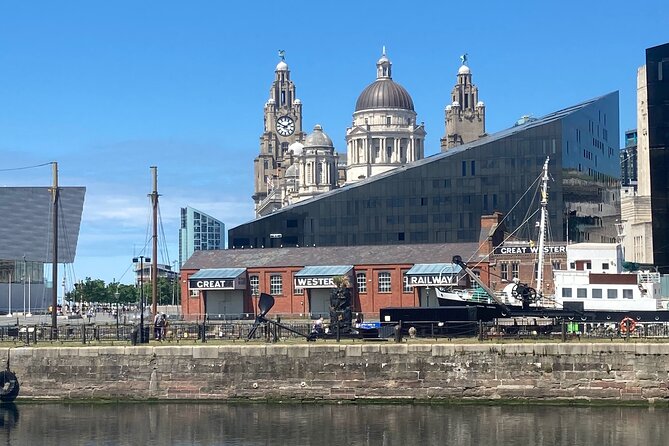
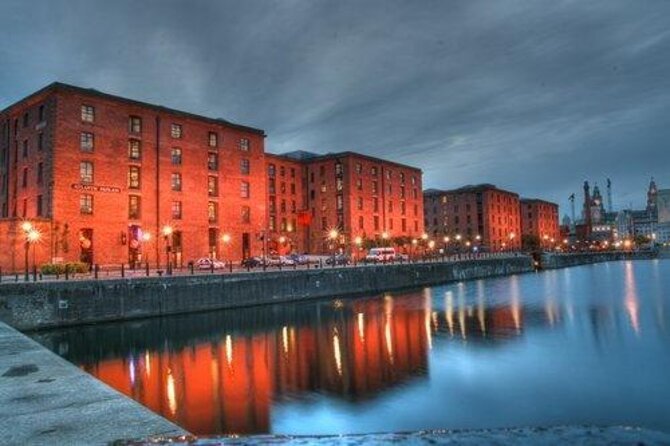
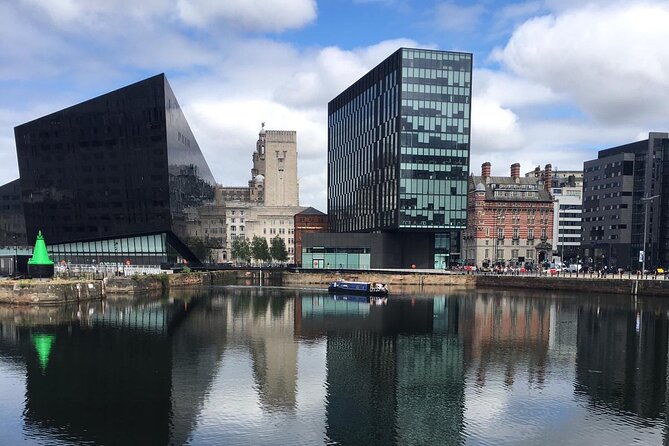
The walk then reaches Royal Albert Dock, one of the tour’s longer stops at about 20 minutes. Here you hear how the docks shaped Liverpool’s growth and how the Titanic became part of the city’s maritime story.
The guide also points out a mix of older and newer architecture along the waterfront. This is a good place to keep your eyes moving upward and outward. You get the scale of the dock, the contrast between historic warehouses and later buildings, and a clearer sense of how Liverpool’s identity was tied to the sea.
The bronze statue of Bill Fury is another stop along the way. It has become a shrine for his fans, adding a music connection that is not limited to the Beatles. That broader musical thread is useful because Liverpool’s popular culture reaches well beyond one famous band.
Royal Albert Dock can be busy, and the open waterfront is exposed to wind and rain. On a wet or blustery day, a waterproof layer will make the experience much more pleasant. Poor weather can lead to cancellation, in which case you are offered another date or a full refund.
Meeting the Beatles at the waterfront statue
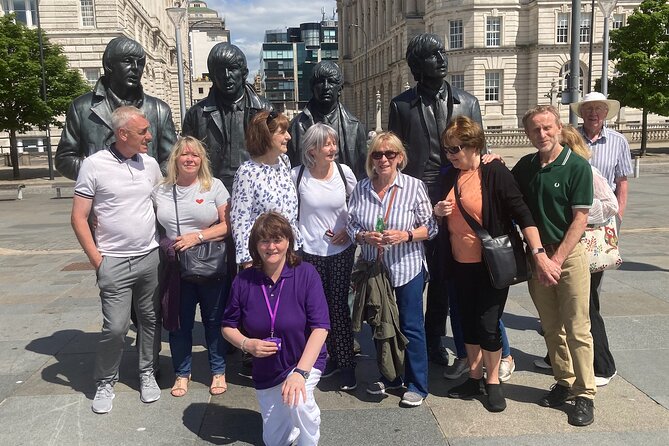
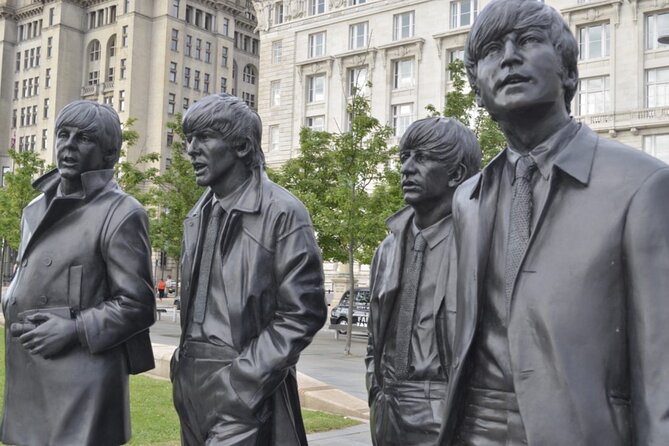
The Beatles Statue is a natural highlight for many people. Sculpted by Andrew Edwards, it gives you a chance to take photographs with the Fab Four as the route passes by.
The tour does not present itself as a full Beatles history walk. Instead, the band forms one part of a wider story about Liverpool’s port, streets, buildings, and culture. I think that balance works well for first-time visitors who want Beatles landmarks but also want to understand the city around them.
Access to the statue can occasionally be restricted. If that happens, the route may use alternative statues instead. That is worth knowing if this is the one stop you care about most. For a detailed account of the band’s rise and Liverpool connections, the company also offers a separate Beatles walking tour after this experience.
The Three Graces and the waterfront skyline
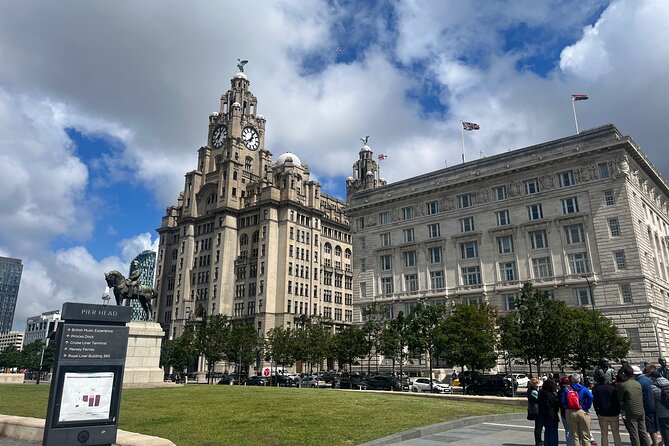
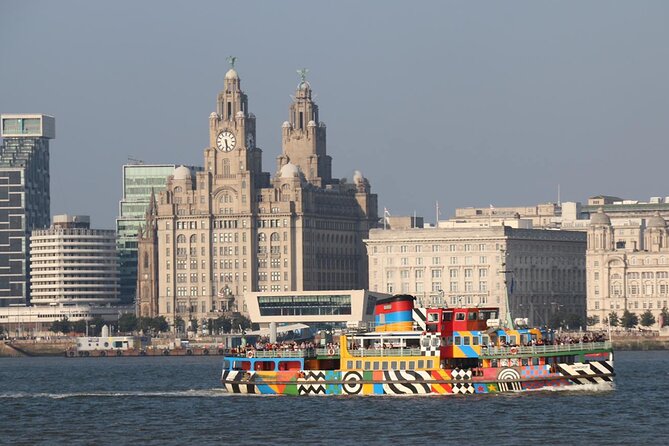
The route continues to the Three Graces: the Cunard Building, the Port of Liverpool Building, and the Liver Building. These Grade II listed buildings form one of Liverpool’s most recognisable architectural groups.
The Liver Building is home to the city’s famous Liver birds, often described as guardians of Liverpool. The Cunard Building connects to the city’s ocean-going past, while the Port of Liverpool Building completes the grand waterfront composition.
This is one of the best parts of the tour for architecture. Your guide explains the heritage of the buildings rather than simply pointing them out for photographs. You also get a better understanding of why Liverpool’s waterfront carries such weight in the city’s story.
The stop lasts about 15 minutes, enough for an explanation and photographs without turning the walk into a long architectural lecture. Guides are encouraged to help with pictures, and that can be useful when you are travelling alone or in a small group.
Castle Street and Liverpool Town Hall
From the waterfront, you head along Castle Street, where Liverpool’s modern centre still connects with medieval origins. The street is framed by handsome buildings and offers a change of mood after the open dockside.
The route then approaches Liverpool Town Hall, a Grade I listed building recognised as one of England’s finest surviving 18th-century town halls. Along the way, you hear about earlier town halls dating back to the 1500s.
This section gives the tour a strong sense of time. Liverpool is not only a port city built during the industrial age. Its civic centre also preserves older traces, and Castle Street helps link those periods together.
The buildings are best appreciated with a guide because a quick walk down the street can otherwise feel like nothing more than a pretty urban stroll. Here, details about earlier city government and changing civic life give the architecture meaning.
Exchange Flags and the Nelson Monument
Exchange Flags forms a courtyard facing the Town Hall. It is a Grade II listed area with connections to the Second World War, adding another layer to the city’s political and military story.
The courtyard also contains a large bronze monument to Nelson dating from the early 1800s. This is a useful pause in the route, especially if you enjoy monuments that show how Liverpool connected to wider British events.
The tour does a good job of shifting subjects. You move from sailors and docks to public buildings, wartime history, monuments, and music. That variety keeps the walk moving, though it also means no single topic receives the depth of a specialist tour.
Derby Square and the route toward Mathew Street
At Derby Square, the guide discusses Liverpool Castle, which once stood here, as well as the imposing monument to Queen Victoria. The stop helps explain how the centre changed as older structures disappeared and later civic monuments took their place.
The planned route continues toward Mathew Street, where the tour ends at a convenient city-centre location near the Cavern quarter. You can then explore Mathew Street independently and visit the Cavern Club area on your own.
There is one practical caution here. The published route includes several stops, but the exact walk can vary for operational reasons, and some departures may not reach every listed location. A few people have found that places such as Derby Square, the Eleanor Rigby statue, or parts of Mathew Street were missed when the guide became absorbed in other stories. If a specific stop matters to you, ask your guide early in the walk.
What the guides add to the experience
The guide is the heart of this tour. Names attached to particularly strong departures include Mike Dowling, Carl, Pam, Allan, Roy, Colleen, Paul, Rob, Chris, and Michael.
The praise is consistent in the useful ways. Guides are described as friendly, clear, funny, and deeply familiar with Liverpool. Mike is noted for his passion and lively delivery, Carl for answering questions and offering a broad introduction, Pam for her command of local history, and Allan for his humor, photographs, and careful pacing.
Roy brings strong local character and Scouse humor. Colleen has researched the city extensively, while Paul is praised for tailoring the walk to personal interests and suggesting other things to do during a stay.
A small group can make a real difference. Some departures have had only two or three people, allowing the guide to answer questions quickly and adjust the emphasis. Larger groups are capped at 20, but one limitation is that there are no supplied audio headsets. If you have trouble hearing in a crowd, stay close to the guide and speak up when needed.
Price, timing, and practical value
At $31.90, this is reasonably priced for a guided city introduction lasting around 135 minutes. You are paying for a local guide, a route that covers several distinct parts of central Liverpool, and the time saved by not working out the connections yourself.
The value is strongest if you have only a day or two in the city. The walk shows you where the waterfront, civic centre, Ropewalks, and Mathew Street fit together. Afterward, you can choose which places deserve a longer visit.
The tour includes the guided walk and an experienced local guide. It does not include food, drinks, museum admission, or entry to the Cavern Club. Bring water, wear shoes with good grip, and allow for uneven cobbles even though the route has no hills or stairs.
Children under 16 must be with a responsible adult. Service animals are allowed, and well-behaved dogs are welcome, though busy areas and group walking may not suit every dog. You should have a moderate level of fitness.
Free cancellation is available up to 24 hours before the start time for a full refund. Changes or cancellations made inside that window are not refunded. Since the experience depends on good weather, a weather cancellation gives you the choice of another date or a full refund.
Who should book this Liverpool walk?
I would choose this tour for a first visit, a short stay, or a morning when you want to get your bearings fast. It suits people who like a mixture of architecture, maritime stories, local culture, monuments, and Beatles connections rather than a tour devoted to one subject.
It also works well for repeat visitors. One local participant had visited Liverpool many times since the 1970s and still learned new details. That says something about the guide-led format: familiar streets can look different when someone explains the trades, vanished docks, old maps, and civic stories behind them.
You may prefer another option if you dislike walking in changeable weather, need guaranteed access to a particular statue or interior, or want a slow specialist tour. The route covers plenty of ground, and its strength is range rather than long visits at each stop.
Should you book the Best Of Liverpool walking tour?
Book it if you want a friendly, efficient introduction to Liverpool that gives equal room to the docks, old streets, civic buildings, and music. The strongest reason to go is the quality of the local storytelling, with guides such as Mike, Carl, Pam, and Allan repeatedly praised for making facts lively and easy to follow.
I would book it early, especially since it is commonly reserved about 18 days ahead. Wear sensible shoes, bring water, and treat the itinerary as a flexible route rather than a promise that every stop will receive equal time. For most first-time visitors, $31.90 buys a useful city framework and several ideas for what to explore next.
FAQ
Where does the tour begin?
The tour begins in front of the Bluecoat building at School Lane, Liverpool L1 3BX.
Where does the tour finish?
It ends at the entrance to Mathew Street in Liverpool city centre, near the Cavern quarter.
How long does the walking tour last?
The tour lasts approximately 2 hours and 15 minutes.
Is the Beatles Statue included?
The route normally passes the Beatles Statue, sculpted by Andrew Edwards, for photographs. Access can occasionally be restricted, in which case alternative statues may be visited.
Is the Cavern Club included?
The tour ends near Mathew Street and the Cavern quarter, but exploring Mathew Street and visiting the Cavern Club are not included as part of the guided walk.
Is the route difficult?
The route has no hills or stairs, but you will walk for more than two hours on some uneven surfaces, including cobbles. Comfortable, non-slip shoes are recommended.
Can children and dogs join the tour?
Children under 16 must be accompanied by a responsible adult. Service animals and well-behaved dogs are allowed, although the walk includes busy areas and group walking.
More Historical Tours
- Liverpool Heritage, History, Culture Walking Tour-Shore Excursion
★ 4.5 · 21 reviews - Private Tour in Liverpool – History, Football, Views & Local Beer
★ 5.0 · 18 reviews - Inspirational Women Liverpool Past-Present History Tour – monthly
★ 5.0 · 17 reviews - London Small Group Tour of Historical Pubs
★ 5.0 · 10,422 reviews
Just added around Liverpool
- Welcome to Liverpool Tour – 2 Hour Private Walking Tour★ 5.0 · 7 reviews
- Private Half-Day Liverpool Tour with a Local, Personalized★ 5.0 · 7 reviews
- 3 Hours Private City Highlights Liverpool Walking Tour★ 5.0 · 7 reviews
- Football Experience With A Local Host In Liverpool★ 4.5 · 8 reviews
- Liverpool Football Club Museum Entry★ 5.0 · 10 reviews
- The Liverpool Pass®: All top attractions inc. Hop-On Hop-Off Bus Tour | 2-Days★ 4.5 · 11 reviews
- Liverpool Ultimate Beatles Ticket To Ride Half-Day PRIVATE Tour★ 5.0 · 12 reviews
- Liverpool Film and Music – 2 hour Private Walking Tour★ 5.0 · 12 reviews
Walking Tours, compared.

Oxford University Walking Tour With University Alumni Guide
Read our review →
Tour for Muggles The Ultimate Harry Potter Walking Tour in London
Read our review →

Cambridge University Walking Tour by Alumni™ Kings College Option
Read our review →
Blackbeard to Banksy – The Ultimate Walking Tour of Bristol
Read our review →
Air Raid Shelter + St. Nicholas Market Walking Tour
Read our review →
Walking Tour of Bath with Blue Badge Tourist Guide
Read our review →
Changing of the Guard Guided Walking Tour in London
Read our review →Browse the lists this tour appears in