
Reviewed · HISTORICAL TOURS
Jane Austen’s Bath And History Trail
Bath rewards curious walkers. This 2.5-hour tour connects Jane Austen’s former homes with the city’s grand Georgian streets, medieval abbey, Roman remains, and famous social rooms. I like the way it treats Austen as part of Bath’s larger story, not as an isolated literary attraction. I also like the small group limit of 10, which gives you a better chance to ask questions and hear the guide clearly.
The route is especially useful if you want to get your bearings early in a Bath visit. You’ll see many major sights while learning how architecture, social life, and Bath’s fashionable reputation shaped Austen’s writing. The main drawback is the amount of walking, including some uphill sections and steep steps, while several museums and interiors cost extra.
In This Review
- Key points to know before you book
- Why this Bath walking tour works
- Starting at Pulteney Bridge and Sydney Place
- The Jane Austen Centre and Regency Bath
- No. 1 Royal Crescent and Georgian ambition
- Bath Abbey and the city’s medieval center
- Thermal springs, the Pump Room, and Austen’s social world
- Queen Square and Austen’s short residence
- The Circus and John Wood’s bold design
- The Assembly Rooms and Bath’s social calendar
- Walking pace, group size, and practical comfort
- What you pay for, and what costs extra
- Who should book Jane Austen’s Bath and History Trail?
- Should you book it?
- FAQ
- Where does the tour begin?
- Where does the tour end?
- How long does the tour last?
- What language is the tour offered in?
- What is included in the price?
- Is the internal Jane Austen Centre tour included?
- Are museum entrance fees included?
- Is entry to the Roman Baths included?
- How many people can join the tour?
- What happens if bad weather cancels the tour?
Key points to know before you book
- Jane Austen’s Bath homes: See the sites linked with her residences at No. 4 Sydney Place and No. 13 in Queen Square.
- A strong city overview: The route includes Pulteney Bridge, the Circus, Bath Abbey, the Roman Baths area, the Pump Room, and the Assembly Rooms.
- Small-group format: A maximum of 10 people makes this more personal than a large city walk.
- Free Jane Austen Centre entry: You can enter the centre and browse its book shop, but the internal museum tour is not included.
- Bring sensible shoes: The walk is generally slow, but it covers plenty of ground and includes uphill stretches.
- Plan extra time for interiors: Admission to No. 1 Royal Crescent, the Roman Baths, the Assembly Rooms, and other museums is not covered by the tour price.
Why this Bath walking tour works
At $40.24 per person, this is priced as a guided city walk rather than an all-inclusive attraction pass. That distinction matters. You are paying for the guide’s interpretation, route planning, and local stories, not for entry into every museum along the way.
I see good value here if you are visiting Bath for the first time. In two and a half hours, you’ll pass the city’s best-known landmarks and several Austen connections. You can then decide which paid sites deserve your remaining time and money.
The tour has earned a 4.8 out of 5 rating from 77 reviews, with 95 percent of customers recommending it. The most consistent praise concerns Ulrich Wenske’s command of Bath’s architecture, Austen’s family life, and the city’s past. He also has a relaxed style, answering questions and adjusting the pace when possible.
The walk is offered in English or German. Some feedback notes that Ulrich’s German accent and quick movement between stops can make parts difficult to hear, especially outdoors. Stay close to the group and ask him to repeat anything you miss.
More Historical Tours:
- Bath: Local Pubs & Historic Sights Walking Tour (3h)
★ 5.0 · 31 reviews - London Small Group Tour of Historical Pubs
★ 5.0 · 10,422 reviews - Soho Music & Historic Pubs Tour
★ 5.0 · 1,993 reviews
Starting at Pulteney Bridge and Sydney Place
Meet outside the Pulteney Bridge Coffee Shop at 17 Pulteney Bridge. This detail deserves attention because the Jane Austen Centre is not the meeting point. The two places are roughly a 20-minute walk apart, and arriving at the wrong one can mean missing the start.
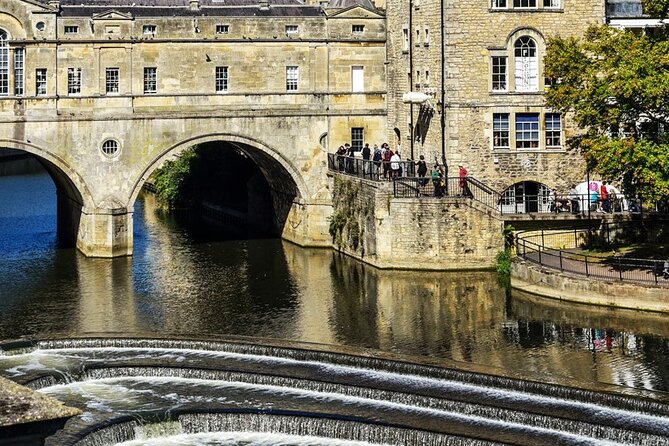
Pulteney Bridge makes a fine opening scene. Designed in 1769, it was modeled after Florence’s Ponte Vecchio and has shops lining both sides. The bridge crosses the River Avon and leads into a part of Bath where the city’s Georgian planning begins to make sense.
From here, the group continues along Argyle Street toward Laura Place and Great Pulteney Street. Great Pulteney Street is one of Bath’s grandest avenues, lined with large town houses and tied to prominent residents from the 18th and 19th centuries.
The Holburne Museum of Art is visible from this area. You won’t enter it as part of the walk, but the view helps place Bath’s eastern end on the map.
A particularly useful Austen detail comes at No. 4 Sydney Place. A name plaque marks Jane Austen’s first Bath dwelling. You won’t enter the residence, yet seeing the actual building gives her Bath years a stronger physical connection than simply reading about them.
Allow around 20 minutes for this opening section. It combines architecture, orientation, and literary history without asking you to pay an additional admission fee.
The Jane Austen Centre and Regency Bath
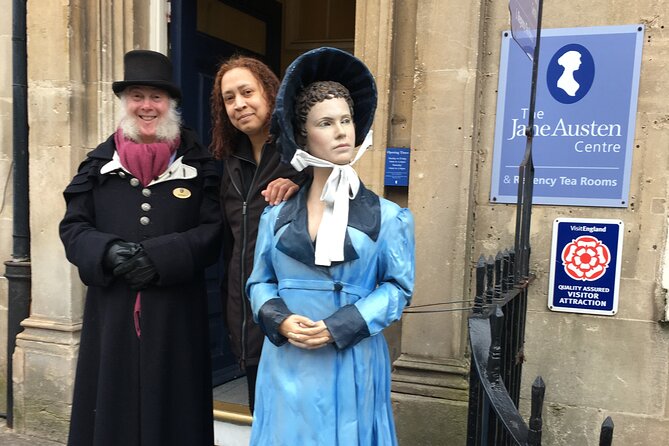
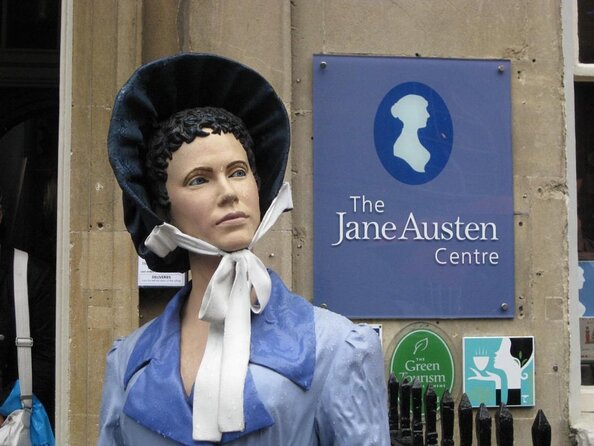
The Jane Austen Centre offers a look at Austen’s life in Bath and the social world of the Regency period. The tour includes free entry into the centre and a visit to its book shop.
That free entry is useful, but be clear about what it means. The internal tour led by the centre is separate and is not included. If you want to spend more time with the exhibits, costumes, displays, and shop, plan that as an additional stop before or after the walk.
The centre matters because Bath was not simply a backdrop in Austen’s life. She lived in the city for a short period, observed its social customs, and used Bath settings in novels such as Northanger Abbey and Persuasion. The walk helps connect those written scenes with the streets and buildings around you.
I would not treat the centre as the main reason to book this experience. The larger value comes from seeing the centre as one piece of a wider route. You learn where Austen lived, where fashionable people gathered, and how the city’s design encouraged social display.
No. 1 Royal Crescent and Georgian ambition
The Royal Crescent is among Bath’s most photographed sights. Its sweeping curve contains 30 terraced houses joined by giant Ionic columns, creating one of the clearest examples of Georgian architectural theater in Britain.
The stop lasts about 15 minutes. You’ll hear how the crescent was built in the second half of the 18th century and why its scale mattered. The façade was designed to impress, but the houses behind it also reveal how wealthy residents lived.
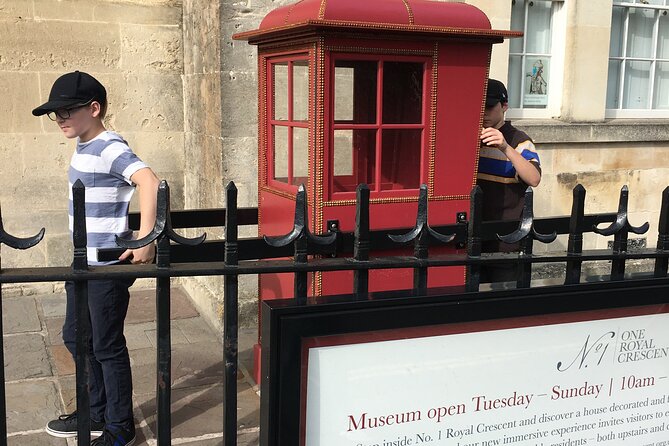
No. 1 Royal Crescent operates as a museum showing the interior of a grand Georgian home. Admission is not included, so you’ll need a separate ticket if you want to go inside.
This is one of the tour’s useful choices. You see the exterior with an explanation of its purpose, then decide if the interior museum suits your interests. If you love decorative arts and period rooms, return later. If you mainly want Austen connections and city orientation, the exterior visit may be enough.
Something different for another day:
- Walking Tour of Bath with Blue Badge Tourist Guide
★ 5.0 · 1,877 reviews - Stonehenge, Avebury & the Cotswolds from Bath (Small group)
★ 5.0 · 798 reviews - Roman Baths and Bath City Walking Tour
★ 4.5 · 762 reviews - Fully Guided Bath Ghost Tours
★ 5.0 · 539 reviews
Bath Abbey and the city’s medieval center
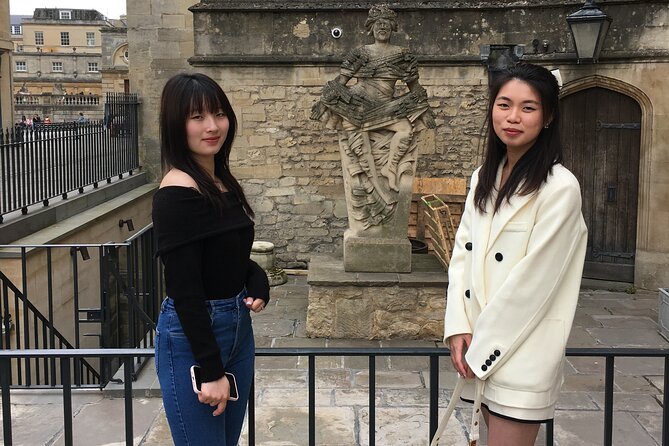
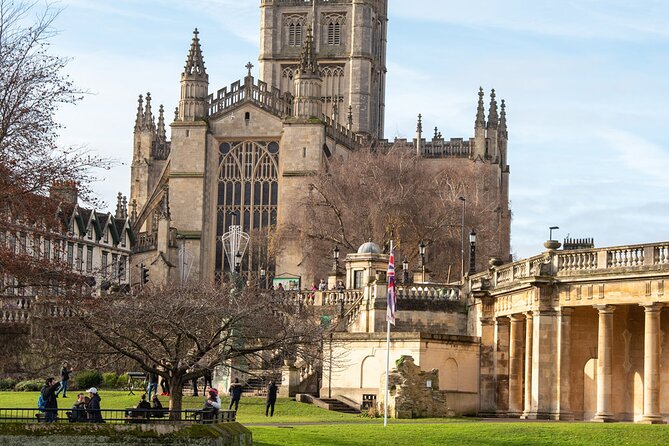
Bath Abbey provides a sharp change of mood from the elegant Georgian crescents. The building’s story reaches back to the early 12th century, with major restoration begun by Bishop Oliver King in 1499 and completed under Elizabeth I in 1611.
The abbey is known for its memorials and wall plaques, and the tour explains notable details inside. It is also linked with the coronation of Edgar I as the first King of England in 977, a point that gives the building a place in the nation’s early royal story.
The visit is planned for around 20 minutes. Admission is not included, so check the current arrangements when you visit. The tour provides context, but it does not replace a longer visit if you want time to study the windows, memorials, and interior details at your own pace.
I like this part of the route because it prevents the Austen theme from becoming too narrow. Bath is a city of Roman, medieval, Georgian, and modern layers. The abbey helps you see that timeline in one compact stop.
Thermal springs, the Pump Room, and Austen’s social world
The route also explains Bath’s famous thermal water. The city’s springs originate from around 10,000 years ago, and the guide discusses the Hetling Spring, Cross Spring, and King’s Spring.
Bath’s modern thermal bathing is represented by a rooftop pool kept at about 35 degrees Celsius and open in summer and winter. The experience described here does not include bathing, so treat this as an explanation of Bath’s spa culture rather than a swimming session.
The Roman Baths area is nearby. It contains the Roman temple of Sulis Minerva and the pools that made Bath famous long before Austen arrived. An audio tour is recommended separately, either before or after the walking tour.
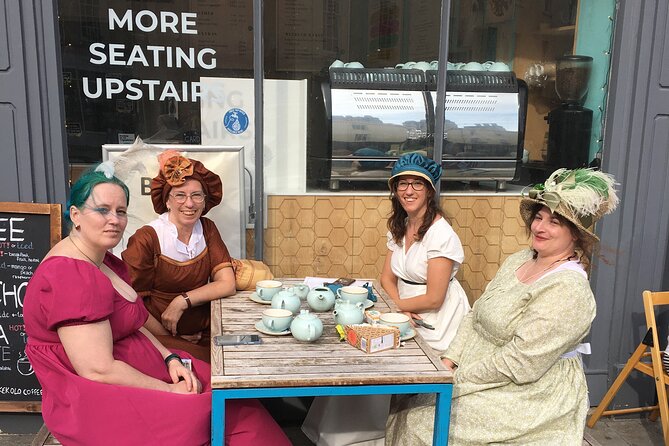
Next to the Roman Baths is the Pump Room, a symbol of Bath’s Georgian golden age. Fashionable society came here for balls, tea, and the custom of taking the waters. In Northanger Abbey, Catherine and Isabelle meet in this setting.
This is where the literary connection becomes especially clear. Austen’s Bath was a place for watching people, managing reputations, forming alliances, and worrying about money. The buildings were social stages, and the tour explains how they functioned.
Queen Square and Austen’s short residence
The route includes Queen Square and the site of No. 13, where Jane Austen lived briefly in 1799. The stop focuses on the details of that residence and its place in her time in Bath.
Short stays can be easy to overlook in a biography. Here, they become part of the walking experience. You see that Austen’s connection with Bath was not limited to one address or one famous building. It developed across several homes and social settings.
Queen Square also helps explain Bath’s planned Georgian character. The square, the crescents, and the wide streets were designed to create order and grandeur. That built environment shaped how people moved through the city and how they encountered one another.
The Circus and John Wood’s bold design
The Circus is one of the tour’s strongest architectural stops. Work began in 1754, and the design came from the John Wood architects. The circular form drew inspiration from prehistoric stone circles and was also intended to recall the Colosseum in Rome.
The guide explains the planning behind the site and the details that make it unusual. The buildings form a complete circle of curved town houses, with classical decoration tying the whole composition together.
The stop takes about 20 minutes and is free to view. You may also hear about the acoustic effect created by the trees in the center. One small interactive detail is trying the echoing trees, which gives the stop a bit of fun after the architectural explanation.
I especially value this section because it moves beyond dates and famous names. You learn how Bath’s planners used geometry, classical references, and older British monuments to create a city that felt both modern and timeless.
The Assembly Rooms and Bath’s social calendar
The Assembly Rooms were the major public rooms of Regency Bath. The complex included ballrooms, an octagon, a card room, and a tea room, all designed for fashionable social life.
The tour allows about 15 minutes here. You’ll learn how people gathered, danced, played cards, drank tea, and watched one another. These were not merely pretty rooms. They were places where introductions mattered and where social standing could be displayed or challenged.
Admission is not included. The rooms may also host events, so access can vary. The tour gives you the historical setting, while a separate visit lets you study the interiors if they are open.
For Austen fans, this is one of the most relevant stops. Her Bath novels depend on social encounters, awkward conversations, and the pressure of public behavior. Seeing the rooms where that kind of social life took place makes those scenes easier to picture.
Walking pace, group size, and practical comfort
The tour lasts about two hours and 30 minutes, though some feedback describes it as closer to two hours depending on the day. Expect a real walking route, not a short series of stops around one square.
You may encounter uphill sections and steep steps. Wear comfortable shoes and carry water. An umbrella is sensible in Bath, where poor weather can change the feel of an outdoor tour quickly.
The route can still work in rain if you are prepared. Ulrich has offered shelter points and a virtual-style explanation when weather was especially poor, though continuing outdoors may be possible at the group’s discretion. The experience requires good weather, and if the provider cancels for that reason, you receive the option of another date or a full refund.
A maximum of 10 people is a real advantage. It should be easier to hear explanations, ask about a building, or keep the walk conversational. Several people have also had the tour to themselves, which can make the experience feel highly personal, though you should not book expecting a private tour.
The walk is near public transportation, and most people can take part. No special accessibility details are provided, so anyone concerned about steps or hills should contact the provider before booking.
What you pay for, and what costs extra
The $40.24 price is fair if you want a guide to connect the city’s main sights in one well-planned route. You get an English or German-speaking guide, a small group, entry to the Jane Austen Centre itself, and a broad introduction to Bath.
Extra costs include:
- The internal Jane Austen Centre tour
- No. 1 Royal Crescent
- Bath Abbey admission, if charged at the time of your visit
- The Roman Baths
- Any audio tour at the Roman Baths
- Other museums along the route
That can be a benefit rather than a flaw. You are not forced to pay for attractions that do not interest you. I would schedule the walk early in your Bath stay, then return to the Roman Baths or No. 1 Royal Crescent afterward if the guide’s explanation has whetted your appetite.
Free cancellation is available up to 24 hours before the start time for a full refund. Changes or cancellations inside that window are not accepted and are not refunded. Most importantly, confirm the meeting point at Pulteney Bridge before setting out.
Who should book Jane Austen’s Bath and History Trail?
I would recommend it to first-time Bath visitors who want both orientation and interpretation. It is also a good choice for Austen readers who want to see her former homes and the social settings connected with Northanger Abbey.
You’ll get the most from it if you enjoy architecture, local stories, and asking questions. The guide covers much more than Austen, including Roman Bath, medieval Bath Abbey, Georgian planning, the Beatles, and local history. Some people have enjoyed the extra stories, while others may prefer a strictly Austen-focused presentation.
I would think twice if you dislike walking, need a fully step-free route, or want extended time inside museums. The experience is mainly outdoors, and several major interiors require separate admission.
Should you book it?
Book this tour if you want a friendly, detailed introduction to Bath with Jane Austen as the thread tying it together. The route covers an impressive amount in 2.5 hours, and Ulrich Wenske’s strongest qualities are his personal approach, broad local knowledge, and willingness to answer questions.
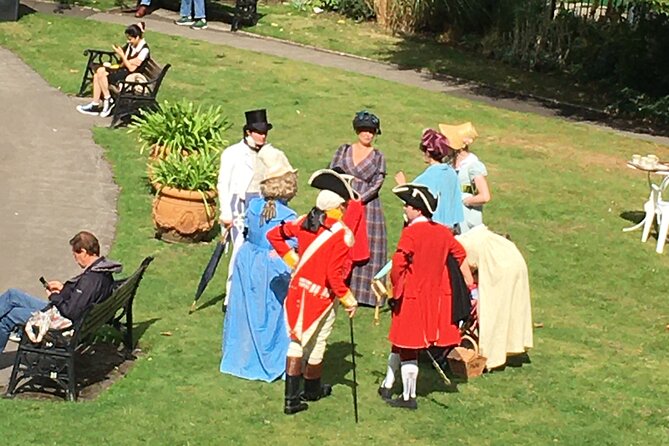
Skip it if you want a costumed performance, a deep museum visit, or a route with very little walking. Also check the meeting point carefully: start at the Pulteney Bridge Coffee Shop, not the Jane Austen Centre.
For most visitors with comfortable shoes and a free morning or afternoon, this is a sensible way to see Bath’s main sights before choosing where to spend more time.
FAQ
Where does the tour begin?
It begins at the Pulteney Bridge Coffee Shop, 17 Pulteney Bridge, Bath BA2 4AY, UK.
Where does the tour end?
The experience ends back at the meeting point.
How long does the tour last?
The advertised duration is approximately two hours and 30 minutes.
What language is the tour offered in?
The tour is offered in English or German.
What is included in the price?
The price includes the guided walking tour and entry to the Jane Austen Centre, including access to its book shop.
Is the internal Jane Austen Centre tour included?
No. The centre’s internal tour guides are not included and must be booked separately.
Are museum entrance fees included?
No. Entrance fees for museums, including No. 1 Royal Crescent, are not included.
Is entry to the Roman Baths included?
The provided tour details do not include Roman Baths admission. A separate audio tour is recommended before or after the walk.
How many people can join the tour?
The tour has a maximum group size of 10 people.
What happens if bad weather cancels the tour?
If the provider cancels because of poor weather, you’ll be offered another date or a full refund. You can also cancel up to 24 hours before the start time for a full refund.
Just added around Bath
- Full-Day Private Tour of Stonehenge and Bath with Pickup★ 5.0 · 6 reviews
- Bridgerton’s Filming Locations in Bath Audio Guide★ 5.0 · 7 reviews
- Private Guided Tour of Jane Austen’s Bath★ 5.0 · 7 reviews
- Private Day Tour from Bath to Stonehenge and Salisbury with Pickup★ 5.0 · 9 reviews
- Wells, Cheddar Cheese and Cheddar Gorge – Private Day Trip from Bath★ 5.0 · 10 reviews
- The Beatles in Bath June 10th 1963★ 4.5 · 10 reviews
- Bath Private Guided Walking Tour★ 5.0 · 10 reviews
- Private Cotswolds tour from Bath★ 5.0 · 12 reviews
Historical Tours, compared.


Shadows of York: Ghost Walk and Horrible History.
Read our review →
A Walk Through Time: History of Liverpool Walking Tour
Read our review →
Royal Historic Pubs Walking Guided Tour in London
Read our review →
Private Group: Historical Pub Walking Tour of London
Read our review →
Best Of Liverpool Heritage, History & Culture Guided Walking Tour
Read our review →Browse the lists this tour appears in