
Reviewed · HISTORICAL TOURS
Oxford: 90 minute Architectural & Historical Highlights Tour
Oxford’s old stones tell lively stories. This 90-minute walk packs colleges, medieval towers, libraries, famous scholars, and a few delightful oddities into a compact introduction to the city. I like the way guide Sophie connects architecture with people such as Tolkien, Philip Pullman, John Wesley, Christopher Wren, and Edmund Halley. I also like the practical extras: a map, a guidebook, and personal tips on places to eat and drink.
The main consideration is pace. With 17 stops and only an hour and a half, you will spend more time listening and looking from the street than touring interiors. The advertised college entry also needs checking, since Balliol College is marked as having an admission charge not included.
In This Review
- Key points to know before you book
- Why this quick Oxford walk works
- Starting beside the Weston Library
- Martyrs’ Memorial and Oxford’s northern gateway
- Exeter and Lincoln: college life from the street
- St Mary’s tower and the Oriel neighborhood
- Corpus Christi and Merton’s medieval details
- Examination Schools and Queen’s College
- New College and the Bridge of Sighs
- Wren, Rowling, and the great libraries
- Radcliffe Camera and the final Balliol stop
- What the price really means
- Who will get the most from this tour?
- Should you book this Oxford walk?
- FAQ
- Where does the Oxford tour start?
- Where does the tour end?
- How long does the experience last?
- Is the tour offered in English?
- Is college admission included?
- What happens if bad weather cancels the tour?
Key points to know before you book
- Sophie’s storytelling: Expect history, science, literature, religion, and humor rather than a dry roll call of college names.
- A fast route through central Oxford: The walk covers Martyrs’ Memorial, medieval city gates, famous colleges, the Bodleian Library, Radcliffe Camera, and Balliol College.
- Small-group feel: The maximum group size is 15, a useful limit on narrow streets and crowded college lanes.
- Useful follow-up help: You receive a complimentary map and guidebook, plus suggestions for food and drink.
- Strong overall feedback: The experience has a 4.9 rating from 23 reviews, with 100 percent recommending it.
- Outdoor timing matters: The tour requires good weather and may be moved or refunded if poor weather causes cancellation.
Why this quick Oxford walk works
Oxford can feel confusing at first. Its university buildings are spread through the city rather than enclosed behind one grand gate, and college entrances often look modest from the street. This route gives you a useful framework, so you can return later to the places that catch your eye.
I especially like the way this experience treats Oxford as both a university and a city. You hear about medieval religion, royal support, Protestant martyrs, coffee houses, marmalade, science, literature, and student life. That mix helps you understand why Oxford feels more layered than a collection of pretty courtyards.
Sophie is the guide whose name appears throughout the feedback, and her strengths are clear. She brings an academic subject down to human scale, using stories and humor to keep the pace lively. One family found that she held the attention of children, parents, and grandparents, while another group appreciated her ability to guide in both English and French.
The walk is also suited to a short day trip from London. One person who had spent many years visiting Europe found Oxford strikingly different from central London, especially during the busy season. That is useful context: you can see a lot in a morning or afternoon, but you will not get the same experience as spending several days here.
More Historical Tours in Oxford:
- Natural History Museum Tour – by Uncomfortable Oxford™
★ 4.5 · 17 reviews - Reformation Oxford Christian History Tour private groups
★ 5.0 · 14 reviews - History of Medicine Tour – by Uncomfortable Oxford™
★ 4.5 · 8 reviews
Starting beside the Weston Library
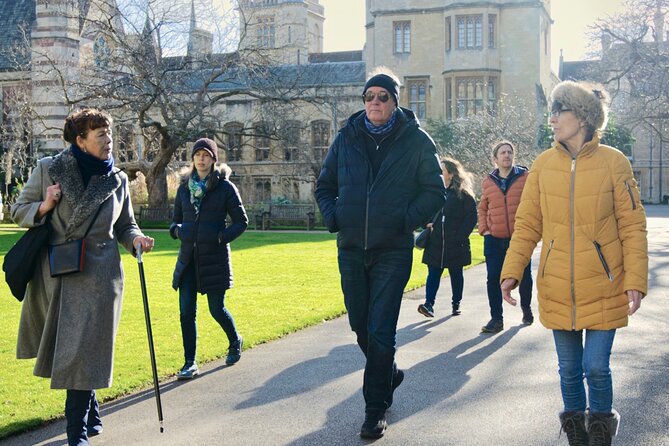
The meeting point is outside the Weston Library on Broad Street, Oxford OX1 3BG. This is a sensible place to begin because you are already near several major university buildings, and the route quickly puts you in the historic center.
The tour is offered in English, with mobile tickets and pickup listed as available. Since a specific meeting point is provided, I would confirm the pickup details before setting out. The route is near public transportation, and most people can take part.
The small-group limit of 15 matters here. Oxford’s lanes and college approaches can be tight, and a compact group makes it easier to hear the guide and pause without blocking everyone else. Still, expect a walking tour on city streets, not a seated lecture. Wear comfortable shoes and plan for changing weather.
Martyrs’ Memorial and Oxford’s northern gateway
The Martyrs’ Memorial introduces the religious conflicts of 16th-century England. This Victorian monument remembers Protestant figures who were executed during the reign of Mary I. It is a solemn opening, but it also gives you an early reminder that Oxford’s story is shaped by faith and politics as much as by scholarship.
A short walk brings you to St Michael at the North Gate. Its Anglo-Saxon tower formed part of the medieval city gate and is described as probably Oxford’s oldest surviving building. The stop is brief, so you should listen for the main story rather than expect time to inspect every stone.
This part of the route is valuable because it places the university inside the old city. Oxford was not built as a sealed academic campus. Its colleges developed alongside shops, churches, roads, and city government, and that relationship sometimes produced friction.
Exeter and Lincoln: college life from the street
Exeter College offers an early look at Oxford’s architectural variety. Its chapel drew inspiration from the Oxford Movement and was modeled on Paris’s Sainte-Chapelle. The college has also educated figures including Philip Pullman, J. R. R. Tolkien, and Alan Bennett.
The stop lasts only a few minutes, so you are mainly seeing and discussing the exterior. That is enough to spot the connection between religious design and university identity, but not enough for a detailed chapel visit.
At Lincoln College, the original frontage on Turn Street helps explain the university’s origins and its changing relationship with Oxford itself. The college is also associated with Prime Minister Rishi Sunak and the Wesley brothers, John and Charles, who became major Methodist figures.
I like these two stops together because they move beyond the familiar Harry Potter image of Oxford. You get architecture, writers, political figures, and religious reformers, all tied to buildings you can see in a short stretch of road.
Something different for another day:
- Oxford University Walking Tour With University Alumni Guide
★ 5.0 · 6,905 reviews - 1.5-hour Oxford City and University Walking Tour
★ 4.5 · 1,383 reviews - Oxford Official University & City Tour
★ 5.0 · 1,134 reviews - City Sightseeing Oxford Hop-On Hop-Off Bus Tour
★ 4.5 · 1,042 reviews
St Mary’s tower and the Oriel neighborhood
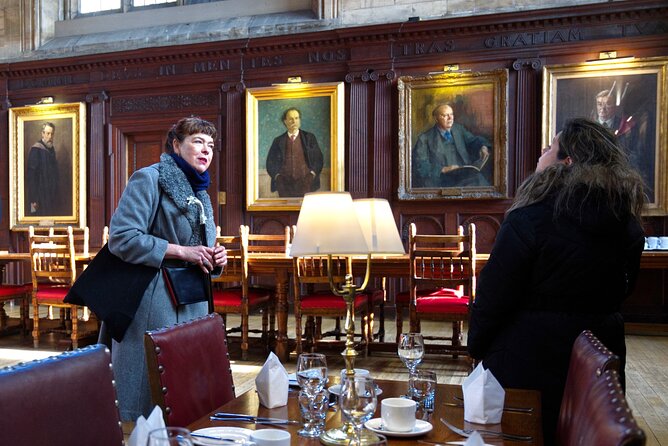
The University Church of St Mary the Virgin was Oxford University’s first building and is listed in the Domesday Book. The tour focuses on its stained glass and the way the church inspired C. S. Lewis. You can also learn about the magnificent spire, although the route does not say that the climb is included.
This is one of the more important stops for understanding old Oxford. The university grew out of a medieval religious setting, so the church is not just a scenic building. It helps explain why theology, worship, and academic work remained closely linked for centuries.
Next comes Oriel College, one of the university’s oldest colleges. Its front quadrangle is noted for its Oriel windows, and the college is now strongly associated with rowing. Nearby Corpus Christi College holds an annual tortoise race, a wonderfully odd detail that gives the formal university world a human touch.
The route passes east of Christ Church rather than making it a full stop. If you have extra time, the Christ Church Picture Gallery is tucked behind the college’s imposing eastern entrance. That suggestion is useful, but you should treat it as a separate visit, not part of the 90-minute walk.
Corpus Christi and Merton’s medieval details
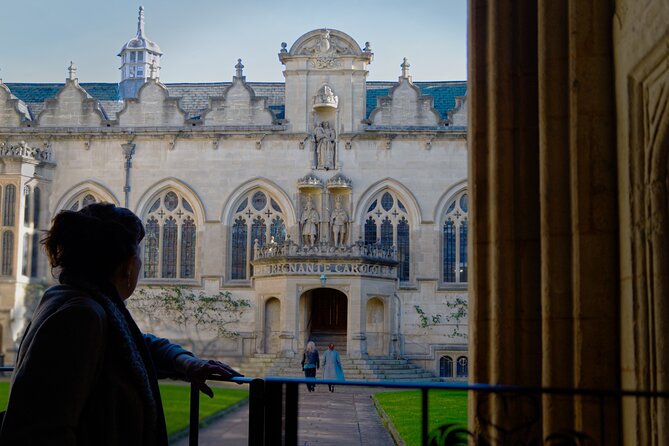
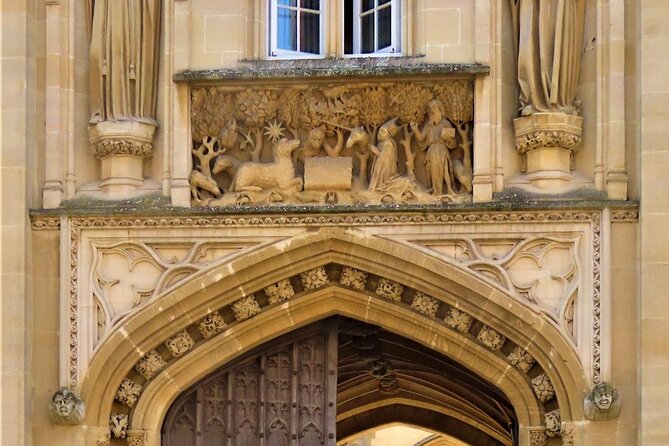
Corpus Christi College sits along a cobbled street listed as a national treasure. Its early 16th-century architecture includes carved animal figures, including a pious pelican. These small details are exactly the sort of thing you might miss while hurrying between larger sights.
Merton College is Oxford’s third college and has some of the route’s most appealing architectural details. Look for the 15th-century frieze above the gatehouse, which tells the story of how colleges developed in the university’s earlier days. The chapel’s decorated flying buttresses add another layer of visual interest.
Merton also connects to the Bodleian Library through Thomas Bodley, a graduate who founded the library. Its library is described as the oldest continuously surviving library in Oxford. That fact makes the later library stops feel less like isolated attractions and more like part of one long academic tradition.
Examination Schools and Queen’s College
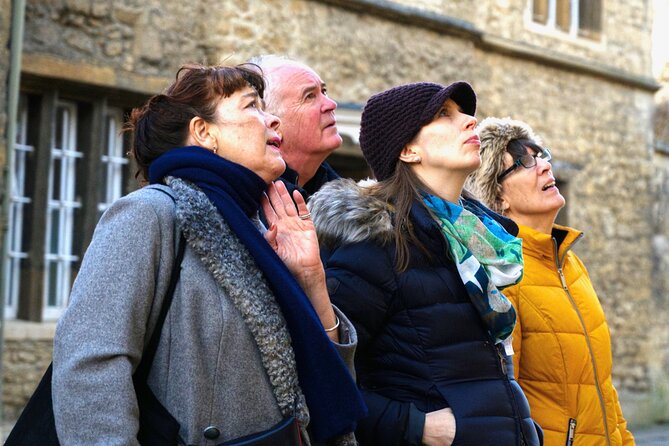
The Examination Schools mark a later stage in university life. Oxford held its first written examination in the early 19th century, while this grand Victorian building dates from the 1870s. Its Jacobean and Tudor styles were highly modern in their own time.
The building also reflects a push to make education available to more people. That does not mean Oxford became broadly accessible overnight, but it does show how the university’s systems were changing. I appreciate this stop because it adds social and institutional context to the prettier college façades.
Queen’s College brings together architecture, comedy, philanthropy, and local business. Rowan Atkinson studied there, while the college was founded for poor scholars from northern England. One of those scholars later became wealthy enough to help fund the 18th-century rebuilding, with designs contributed by Christopher Wren and Nicholas Hawksmoor.
The High Street then opens up a wider view of Oxford’s city life. It was once the road to London, and it is linked with Frank Cooper’s marmalade and England’s first coffee house. The coffee house connection also reflects the return of Jewish people to England after their earlier ban, adding a social and political note to what might otherwise seem like an ordinary street.
New College and the Bridge of Sighs
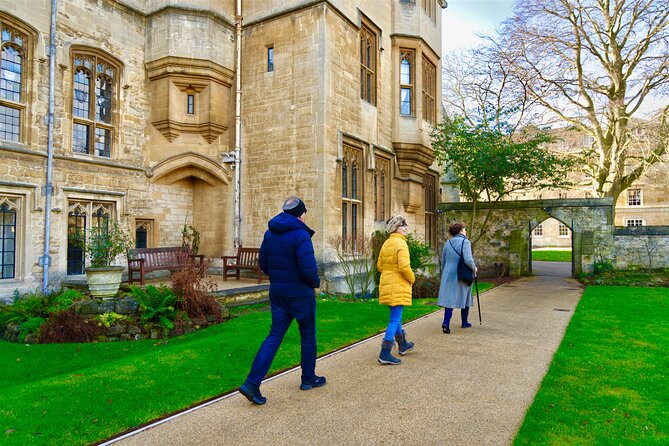
New College’s gatehouse explains how the college was founded after the 14th-century plagues. Its setting has appeared in many films, so this may be a familiar sight even if you have never visited Oxford.
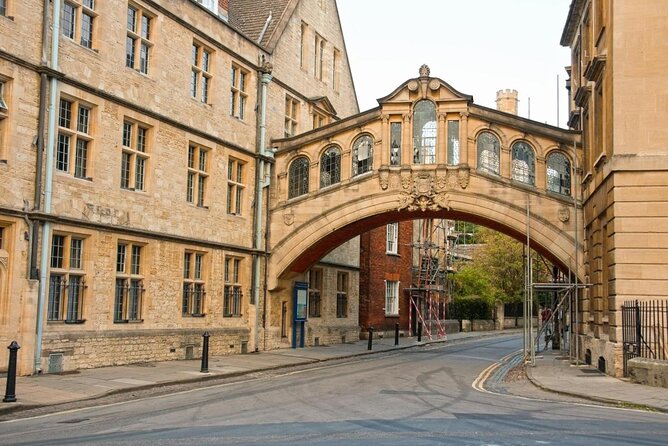
The Bridge of Sighs is one of Oxford’s most photographed structures. It looks Venetian, but it was built in the 20th century and belongs to Hertford College. The nearby house of Edmund Halley adds a scientific link, since Halley gave his name to the comet.
This is a good example of the tour’s tone. Oxford offers plenty of grand medieval-looking buildings, but not all of them are medieval. You get a gentle correction to the postcard image, along with a quick reminder that the city has produced important work in astronomy as well as literature.
Wren, Rowling, and the great libraries
The Sheldonian Theatre is a 17th-century building used for university ceremonies and is believed to be Christopher Wren’s first building. Wren later designed St Paul’s Cathedral in London, and he also served as Oxford’s astronomer.
The route then reaches the Divinity School and the Duke Humphrey’s Library. The Duke Humphrey room was built in the 15th century to house a gift of more than 200 books from the king’s brother. Both spaces were used for Harry Potter scenes, an appealing detail for film fans, but their original purpose is just as interesting.
The Oxford Central Library is described as being built on top of the medieval perpendicular Divinity School. That layering of old and new is very Oxford: working city services share space with buildings created for medieval scholarship.
At the Bodleian Library, you learn how the library began and how it continues to operate. It now holds more than 13 million books. The tour only allows a few minutes here, so you will not see the whole complex, but the stop gives you a clear reason to return for a dedicated library visit.
Radcliffe Camera and the final Balliol stop
Radcliffe Camera was Oxford’s first science library. It also introduces Sir John Radcliffe, a royal physician and one of the university’s more eccentric and generous benefactors.
The building is one of Oxford’s defining views, but the story behind it gives the dome more meaning. You are not simply photographing an elegant circular library. You are seeing how private wealth helped shape the university’s public intellectual life.
The final stop is Balliol College, where undergraduates began gaining access to the university and its colleges. The itinerary allows 15 minutes here, longer than most earlier stops, and marks admission as not included.
That last point needs attention. The tour summary says entry to a medieval college is included, yet Balliol’s admission is listed separately as not included. Ask the operator which college interior, if any, is part of your booking. The difference affects the value, especially if seeing a working college courtyard is your main reason for booking.
What the price really means
The displayed price is $0 per person, which makes this look like an exceptional bargain. If that no-charge price applies at the time you book, you receive a guided introduction, a map, a guidebook, and food and drink suggestions without a listed tour fee.
I would still check the final booking screen carefully. Confirm the college entry, pickup details, and any conditions attached to the zero price. The route includes many exterior views, while admission tickets are listed as free at most stops, so the value comes mainly from Sophie’s interpretation and the time saved planning your own first circuit.
The 4.9 rating from 23 reviews and the 100 percent recommendation figure support the idea that the guide is the central asset. Praise focuses on Sophie’s attentiveness, humor, energy, and command of Oxford’s architecture and history. One person even noted that she kept going after injuring her wrist, although you should not expect any guide to work through an injury.
Who will get the most from this tour?
I would choose this walk if you have one day in Oxford, are visiting from London, or want an orientation before choosing which colleges and museums to enter on your own.
It suits families particularly well. Sophie has handled groups ranging from children to grandparents, and she has guided in English and French. It also works for adults who want more than literary landmarks, since the route includes religion, science, education, politics, commerce, and student traditions.
You may want something else if your main goal is long interior visits. Ninety minutes is enough for a lively overview, not a slow architectural study. The pace may also feel quick in poor weather, although the experience requires good weather and offers another date or a full refund if it is canceled for that reason.
The group maximum of 15 keeps the walk personal, but it is not a private tour. If you want to stop often for photographs or linger inside each college, plan separate visits afterward.
Should you book this Oxford walk?
I would book it for a first look at Oxford, especially if Sophie is available and the zero-price offer remains valid. The route gives you a useful map of the center, introduces a remarkable range of people and buildings, and leaves you with practical ideas for the rest of your day.
Before paying or confirming, ask one clear question: which medieval college entry is included? If that point is settled, this is a strong-value way to get your bearings quickly. If college interiors are your priority, use the walk as an introduction and budget extra time for Balliol, Christ Church, the Bodleian Library, or the college that most interests you.
FAQ
Where does the Oxford tour start?
The tour starts at the Weston Library on Broad Street, Oxford OX1 3BG, UK.
Where does the tour end?
The walk ends at the Golden Cross, Oxford OX1 3EU, UK.
How long does the experience last?
The tour lasts approximately 1 hour and 30 minutes.
Is the tour offered in English?
Yes. The experience is offered in English. Sophie has also guided families in both English and French, but French is not listed as a standard tour language.
Is college admission included?
The tour summary says that entry to a medieval college is included. However, Balliol College is marked as admission not included, so you should confirm which college entry is covered before booking.
What happens if bad weather cancels the tour?
The experience requires good weather. If it is canceled because of poor weather, you are offered a different date or a full refund. The standard cancellation terms say the booking is otherwise non-refundable and cannot be changed.
Just added around Oxford
- Cotswolds One Day Guided Cycle Tour – Private Groups★ 5.0 · 7 reviews
- Follow the Money Tour – by Uncomfortable Oxford™★ 5.0 · 7 reviews
- CS Lewis & Tolkien Tour with Magdalen Entry Public tour 13.45★ 5.0 · 8 reviews
- Oxford Scenic Cycle Tour- 2 persons minimum summer season★ 5.0 · 8 reviews
- Oxford Private Guided Walking Tour★ 4.5 · 8 reviews
- History of Medicine Tour – by Uncomfortable Oxford™★ 4.5 · 8 reviews
- Oxford: to Cotswolds (Half Day)★ 5.0 · 8 reviews
- Oxford Walking Tour – Discover its University and Traditions★ 4.0 · 9 reviews
Historical Tours, compared.


Shadows of York: Ghost Walk and Horrible History.
Read our review →
A Walk Through Time: History of Liverpool Walking Tour
Read our review →
Royal Historic Pubs Walking Guided Tour in London
Read our review →
Private Group: Historical Pub Walking Tour of London
Read our review →
Best Of Liverpool Heritage, History & Culture Guided Walking Tour
Read our review →Browse the lists this tour appears in